By Professor El Hassane HZAINE
The Strait of Gibraltar is, as Paul Pascon (Franco-Moroccan ethnologist) would say, a composite place that carries in its waters the superimposed memories of centuries-old historical periods. Indeed, as early as the 9th century B.C. The Phoenicians forged the first links between Africa and Europe, followed by the Carthaginians and then the Romans, who transformed this passage into a vital artery of human and commercial exchanges.
The first geopolitical shock came in 711 AC. When the Umayyad military leader Tariq ibnoZiyad and his Muslim army crossed the strait, ushering in seven centuries of Muslim presence marked by a vibrant Andalusian culture on both shores.
The second shock was the Christian Reconquista and the annexation by Spain of the two presidencies Melilila (1496) and Sebta (1580), Moroccan enclaves that became enduring symbols of the disputed border. The third shock came in 1704 with the British seizure of the Rock, endorsed by the Treaty of Utrecht (1713): Gibraltar then became the « gateway to the Mediterranean », the logistical and intelligence pivot of the British Empire, especially after the opening of the Suez Canal in 1869.
The twentieth century brought its share of geopolitical shocks: the French and Spanish protectorates in Morocco (1912–1956) fragmented the southern shore, while Tangier, which was established as an International Zone (1923–1956). Moroccan independence in 1956 restored national sovereignty, but left the Sahara provinces, Ceuta, Melilla and the ZaffarineIslands in abeyance.
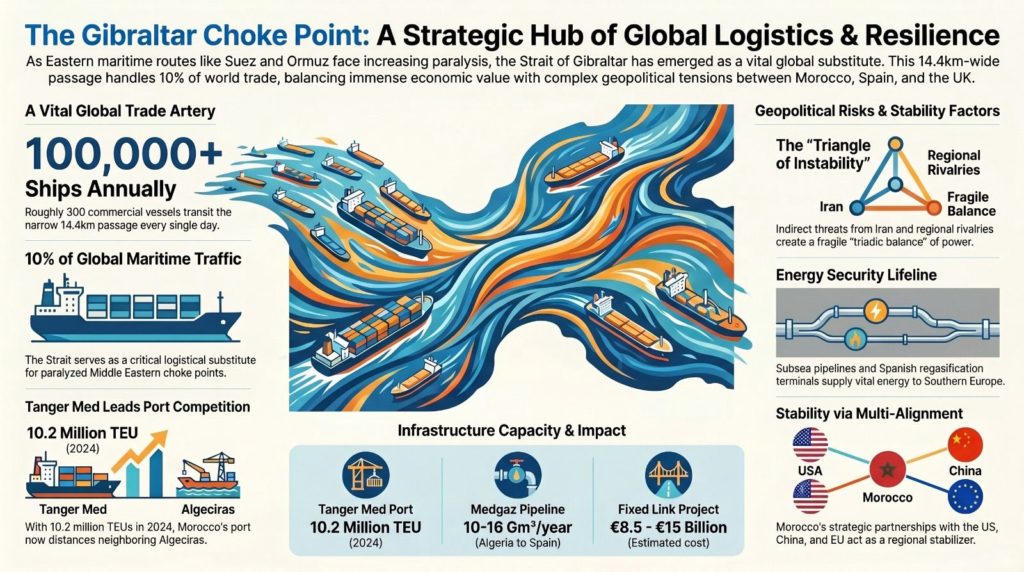
Today, the strait lives under a fragile « triadic balance » between Morocco, the United Kingdom and Spain, framed by the 1982 Montego Convention but undermined by persistent disputes.
The strategic importance and vulnerability of maritime straits vary according to their geopolitical environment, the nature of political regimes in adjacent coastal states, the volume and sensitivity of the flows they carry, and the availability-or absence-of viable alternative routes. In this regard, a useful distinction can be made between “bypassable” chokepoints, such as the Suez Canal, where rerouting via the Cape of Good Hope remains possible albeit at the cost of substantial delays, higher freight rates, and significant logistical disruption, and “non-substitutable” chokepoints, such as the Strait of Hormuz and to some extent Gibraltar strait, whose closure would trigger immediate systemic shocks, reverberating across global energy markets, supply chains, and the broader world economy.
Geopolitical tensions and the upsurge of the Strait of Gibraltar
58 km long and narrowing to 14.4 km, the Strait of Gibraltar is the only natural link between the Atlantic and the Mediterranean, and a natural border between Europe and Africa. The depth of its sills (up to 900 m) allows the transit of ballistic missile submarines (Brown, 2009). The liberal regime of innocent transit passage, codified by the 1982 Montego Bay Convention (UNCLOS), prohibits coastal states from obstructing navigation, thus guaranteeing freedom of movement essential to global trade.
The Strait is one of the busiest shipping lanes in the world. On average, more than 100,000 commercial ships pass through it each year, or about 300 per day. This flow includes oil tankers, container ships, ro-ro ships and car ferries. For example, on the Algeciras-Tangier Med route alone, truck traffic reached 44,426 units in February 2026, while the total number of crossings on all the lines of the Strait amounts to several thousand per month.
In the face of the paralysis of the eastern straits in March 2026 (95% drop in traffic atHormuz, 60% reduction at Suez), the Strait of Gibraltar has established itself as a global safety valve, since container shipping companies, including Maersk, Hapag-Lloyd and CMA CGM, announced during March 2026 that they are redirecting their vessels around the Cape of Good Hope.
Beyond maritime logistics, the strait has also become a vital route for European energy security, linking African fields to southern Europe via undersea pipelines. However, this artery is a theatre of multiple geopolitical rivalries where the interests of local and extra-regional powers intersect.
Indeed, the Hormuz crisis and the Middle East frequent wars have consolidated the position of the Strait of Gibraltar as an essential maritime passage route; judging by the great rerouting through the Cape of Good Hope that has enhanced the strategic value of Gibraltar and the ports on both sides of it -in particular Tangier Med and Algeciras, and to some extent, Valencia to the north, Cadiz to the west and Nador West-Med to the east, which will be operational soon. The Strait has recorded an upward trend in the capture of maritime traffic equivalent to 10% of the world’s maritime traffic, thus confirming its role as a logistical substitute for the paralyzed Middle Eastern choke points.
Geoeconomics: Ports and Energy Corridors
The maritime Centre of gravity has shifted to the west. Morocco’s $7 billion investment in Tangier Med (10.2 million TEUs in 2024) has outpaced Algeciras. At the same time, the Strait of Gibraltar has become essential to European energy security. Spain operates six regasification terminals (40% of EU capacity). Two gas pipelines cross the seabed: the GME (Algeria-Morocco-Spain, suspended in 2021) and Medgaz (Algeria-Spain, 10-16 Gm³/year). Any disruption would have immediate consequences for European energy prices.
Besides, Morocco and Algeria are pursuing competing naval modernization programs, influencing the balance of surveillance capabilities; the two countries are engaged in port competition (Tangier Med against Djen Djen and El Hamdania), gas (Medgaz against the Nigeria-Morocco project) and diplomatic competition. The exclusion of Algeria from the Morocco-Spain fixed tunnel project reinforces its feeling of encirclement. This rivalry still hinders Maghreb integration.
In terms of energy, Morocco is positioning itself as a future green hydrogen hub (Sila Atlantikproject) and the fixed tunnel project (€8.5-15 billion) aims to create structural interdependence between the two shores.
Vulnerabilities and Stressors: The Instability Triangle
Several factors could destabilize the Strait of Gibraltar, starting with the galloping Iranian influence; although Iran has no direct access to the Mediterranean and even less to the Strait of Gibraltar, its threats to close the waterways are part of a logic of deterrence and diplomatic leverage.
Tehran is thus seeking to increase its negotiating power, particularly with the United States on its nuclear program, by extending its control over strategic straits, including by proxies.
Iran’s ability to project itself indirectly into the Mediterranean is not hypothetical; it is even at the origin of the diplomatic rupture between Morocco and Iran in May 2018 when Rabat got its hands on irrefutable evidence of Hezbollah’s delivery of drones and missiles to the Polisario Front, by means of the Iranian legation in Algiers (Al Jazeera, Associated Press, 2018).
In addition, a coordinating commander of the Islamic Revolutionary Guard Corps explicitly threatened in December 2023 that « the Mediterranean Sea, the Strait of Gibraltar and other waterways will soon be closed » (Reuters, 2023). Such a threat, although difficult to execute directly, could be implemented through allied non-state actors – polisario, Hezbollah, Houthis – or through indirect naval harassment.
Moreover, in 2025, Washington Post revealed that Polisario fighters had been trained in Syria by Hezbollah and would have fought with this formation against the uprising against the regime of Bashar Al Assad, confirming the existence of a real « triangle of instability » (Algeria-Iran-Polisario) at the gateway of the Strait of Gibraltar. This episode is a powerful illustration of how Iran, without a direct naval presence in the western Mediterranean, couldnevertheless project its influence and destabilize the approaches to the strait by relying on its regional alliances and proxies.
It goes without saying that the rivalry between Rabat and Algiers constitutes the oldest structural tension in the vicinity of the strait; the closure of the borders since 1994, the territorial dispute over the Moroccan Sahara and Algeria’s ambitions to isolate Morocco from sub-Saharan Africa and to access the Atlantic no longer need to be demonstrated.
Territorial crises and political instrumentalization: the sword of Damocles
Two additional factors, one cyclical and the other structural, both inherent to Spanish-Moroccan relations, could destabilize the Strait. The instrumentalization of the so-called « Moroccan threat » by the right and especially by the Spanish far right remains the sword of Damocles hanging over the strait. Groups such as Vox maintain a hostile discourse on Morocco and the recovery of Ceuta and Melilla, fueling exaggerated perceptions that could, if they come to power, generate diplomatic tensions. However, several structural constraints would probably limit its impact: Spain’s European commitments, its Atlantic obligations within NATO, and above all the strategic alliance between Rabat and Washington, consolidated on April 16, 2026 by the signing of a new 2026-2036 military cooperation roadmap, makes Morocco a privileged partner of the United States in the region, which would dissuade any unilateral venture by Madrid.
In this regard, it should be remembered that the Aznar government sent a whole armada to dislodge a handful of Moroccan gendarmes during the crisis on the island of Laila (known as Persil) in July 2002. This minor territorial dispute – an uninhabited islet of 13.5 hectares – showed that a seemingly insignificant dispute could, in a few hours, inflame relations between Rabat and Madrid and threaten transit through the strait to the point of requiring immediate American mediation in the person of US Secretary of State Colin Powell.
This episode, now largely forgotten, reminds us that the stability of the strait does not depend only on geopolitical balances (O’Reilly, J. G. 1988), but also on domestic political factors linked to local political moods, electoral calculations and the still vivid memory of past territorial crises.
Morocco’s multi-alignment strategy: a guarantee of the stability of the strait
In a « multiplex » world in the midst of strategic changes, Morocco has been able to impose a strategy of active multi-alignment, playing the connector role between rival powers without aligning itself durably with any pole. This approach, inherited from a centuries-old diplomatic tradition, makes Morocco the central pivot of a « romantic triangle » (Dittmer, 1981) between the United States, China, Europe and the GCC countries.
In terms of soft power, the status of Commander of the Faithful of the King of Morocco makes it possible to promote an Islam of moderation that is essential to Europe. On the geo-economic level, Morocco controls 70% of the world’s phosphate reserves (LFP batteries), develops an automotive ecosystem of one million vehicles per year, and positions itself as a nearshoring and friend shoring platform. The green hydrogen strategic plan will also generatereverse energy dependence with some European countries and ensures the supply of the Rock of Gibraltar in times of crisis.
New synergies for consolidated stability
Beyond the tensions, positive dynamics are emerging; the fixed link (submarine tunnel) project between Spain and Morocco, estimated at between €8.5 billion and €15 billion, would create unprecedented physical interdependence, making the rupture not only costly but materially impossible. The joint organization of the 2030 FIFA World Cup by Spain, Morocco and Portugal is an accelerator of cooperation and a multiplier of cross-investments, creating joint committees and mutual trust.
The final resolution of the Moroccan Sahara issue on the basis of the Moroccan autonomy plan following SC Resolution 2797 adopted on October 31, 2025, now widely recognized in particular by the 27 and the United Kingdom, paves the way for a stabilization of the Maghreb and the reactivation of the Arab Maghreb Union.
As concerns Ceuta and Melilla, they will find their solution in a peaceful dialogue thanks to the prestige and charisma of the two monarchies which know how to appease the fervor of the political parties that seek to instrumentalize the identity or security register. The era of asymmetrical interdependence is over, the solution will come from dialogue and mutual recognition of interests.
It is clear that the Strait of Gibraltar is the composite space where logistics, surveillance, energy infrastructure and geopolitical rivalries converge. Its resilience depends on the ability to manage multiple sources of tension: Iranian influence, the Moroccan-Algerian and Anglo-Spanish and Morocco-Spanish rivalries, territorial crises and political uncertainties in the Western Mediterranean. In this context, the Kingdom of Morocco, through the wisdom of its leadership, its strategy of multi-alignment and its seesaw game between rival powers, appears to be a factor of stability. A détente between Rabat and Algiers, combined with a containment of Iranian influence and the achievement of structuring synergies (fixed link, 2030 World Cup, Sahara resolution), would significantly reduce the risks weighing on this vital corridor for Europe.
References
1. O’Reilly, J. G. (1988). The regional geopolitics of the Strait of Gibraltar. Durham University.
2. Hzaine, E. H. (Moroccan World News March 2026). Straits under tension: crossroads of world trade and theatres of strategic rivalries.
3. Brown, J. A. O. C. (2009). Anglo-Moroccan Relations and Gibraltar. Cambridge University.
4. Hzaine, E. H. (Morocco World News 2026). « Morocco, a Strategic Pivot in a Multiplex World ».
5. Shatha Abdul Rahman Al-Saadi and all, the regional and international geopolitical dimensions of the Gibraltar region.





Un commentaire
Generally I do not learn post on blogs, but I wish to say that this write-up very compelled me to try and do it! Your writing taste has been amazed me. Thanks, quite nice article.