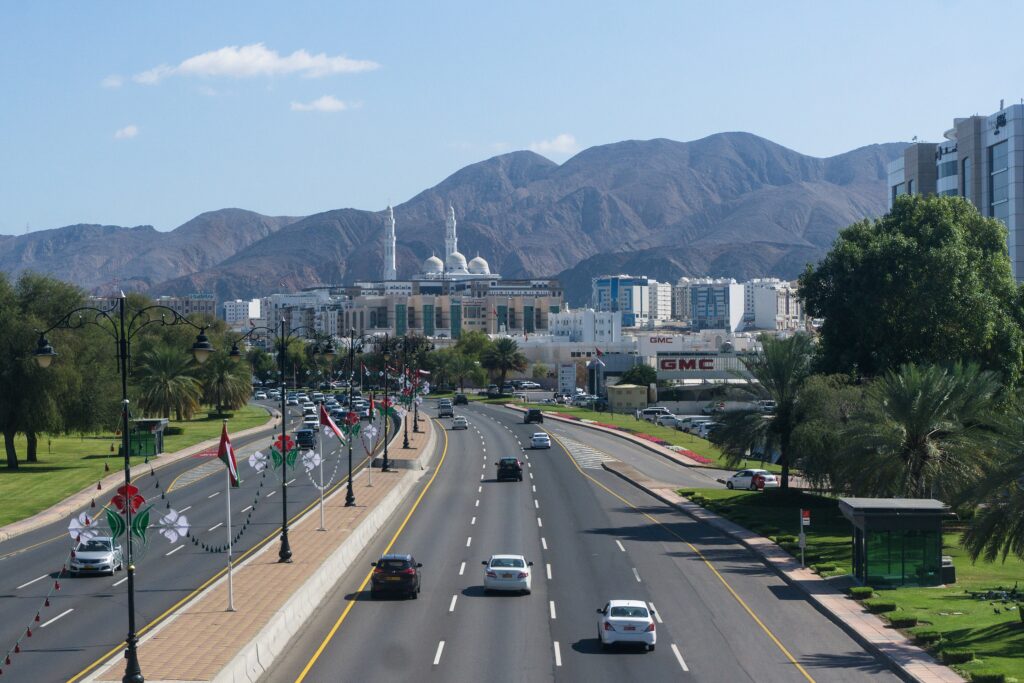
Falling public debt, together with growing investment and expanding social services, reflects the progress made at home, while mediation and scientific partnerships give the sultanate an international presence that reaches beyond the Gulf.
Oman celebrated its National Day on 20 November with a development record marked by improved public finances and the expansion of investment and social services. Between 2020 and 2025, public debt fell from 65.9% to 34.6% of gross domestic product, while annual economic growth averaged around 3.2% between 2021 and 2025. These results come as the country enters a new phase of Oman Vision 2040, focused on broadening its productive base and increasing the contribution of non-hydrocarbon sectors.
Alongside its domestic transformation, Muscat continues to invest in its international relations and its diplomatic role. In Geneva, this approach is reflected in a partnership with Switzerland on mediation and peacebuilding, scientific cooperation and international engagement around Oman’s social protection reforms. These ties place the sultanate’s progress in a broader context, linking national development to deeper engagement with international institutions and markets.
Improving public finances and falling debt
Oman’s public debt continued to fall in 2026, declining by around 600 million Omani rials in the first nine months of the year to stand at 14.1 billion rials. In September, Standard & Poor’s affirmed the sultanate’s BBB- investment-grade rating with a stable outlook, according to the review published to mark National Day.
Public revenue rose by 16% up to the end of the third quarter to reach around 9.828 billion rials, against expenditure of 9.738 billion rials, yielding a surplus of around 90 million rials. Payments of arrears owed to the private sector amounted to 1.434 billion rials, while foreign exchange reserves stood at around $19.5 billion at the end of June.
These indicators provide a firmer fiscal footing for the next phase. Sustaining them, however, will depend on the economy’s ability to diversify its sources of income and reduce the exposure of public revenue to fluctuations in the oil sector.
Oil-driven growth
GDP at constant prices grew by 5.1% in the second quarter of 2026 to around 9.9 billion rials. The sectoral breakdown, however, reveals the continuing weight of hydrocarbons: oil activities rose by 14.7%, compared with 0.7% for non-oil activities.
This gap does not call into question the progress made in other sectors of the economy, but it shows that diversification has not yet fundamentally changed the sources of growth. This underlines the importance of the 11th Five-Year Development Plan 2026-2030, which targets economic growth of around 4% at constant prices and aims to raise the share of non-oil revenue to 37.4% of total public revenue by 2030.
Trade and logistics are showing some signs of expansion beyond oil. Cargo volumes rose by 15% at the Port of Salalah and by 52% at the Port of Sohar in the first half of 2026. Over the same period, foreign investment in wholesale and retail trade grew by 9.7% to reach 305.3 million rials.
In a broader indicator of capital inflows, the Omani Ministry of Foreign Affairs said in April that the stock of foreign direct investment had exceeded 31 billion rials at the end of 2025, up 8.1%.
The sultanate is also seeking to develop financial services through the Oman International Financial Centre, established in January 2026 to attract banking, investment and insurance institutions and to support financial innovation. The year saw its institutional and regulatory arrangements put in place, including the appointment of its board of directors.
Duqm: linking the energy transition to manufacturing
In the electricity sector, the share of grid-connected renewables rose from 4.26% in 2024 to 9.46% in 2025, according to Ministry of Energy and Minerals data published on the Ministry of Foreign Affairs website. Plans aim to raise the share of renewables in electricity generation to 30% by 2030.
In Duqm, the ambition is not limited to building new power facilities: it also aims to manufacture the equipment for them locally. In January 2026, the Public Authority for Special Economic Zones and Free Zones and Mawarid Turbines signed three usufruct contracts (granting land-use rights) relating to the construction of a wind turbine factory, as well as two agreements covering the installation of six wind turbines to supply the factory with clean energy.
The first phase is valued at around 70 million rials, with a planned production capacity of 800 to 1,000 megawatts. It covers the manufacture of turbine components and blades, while the second phase will focus on towers and other parts of the production chain.
The project’s provisions include training and skills development for young Omanis, in cooperation with the technology supplier Shanghai Electric Wind Power, as well as the establishment of programmes with local universities and institutions. The project will mainly serve the Omani market, with plans to expand into Gulf and African markets via the port of Duqm.
The port’s role in supporting economic diversification is particularly significant in this context. Its strategic location links Duqm’s industrial projects to international shipping routes, facilitating exports and strengthening its potential as a regional logistics hub, tasked with receiving goods from international markets, transhipping them and distributing them to ports across the region.
The project’s significance lies in its combination of energy production with the development of local industrial and technical capabilities. The agreements and the announced production capacity nevertheless remain indicators of the intended scale of the investment; they do not, in themselves, confirm that commercial production has begun.
Population and employment: the social challenge of diversification
Oman’s population stood at around 5.36 million at the end of 2025, including 3.04 million citizens, or 56.7% of the total, according to data from the National Centre for Statistics and Information published by the Muscat Daily. Muscat Governorate was the most populous, with around 1.53 million inhabitants.
The structure of the labour market helps explain why it matters to link investment to vocational training. Figures for September 2024, reported by the Oman Observer citing the centre, show that the private sector employed around 1.42 million expatriates and 414,000 Omanis. The public sector, by contrast, employed around 378,000 citizens and 42,000 expatriates. Although these figures date from 2024, they illustrate the disparity in the distribution of employment between the two sectors.
Against this backdrop, industrial projects take on added value in so far as they create technical jobs and career paths for citizens in the private sector. The Ministry of Labour announced that 53,525 opportunities had been secured by the end of September 2026, or 89% of the annual target. This figure includes recruitment, the replacement of expatriate workers with Omanis and employment-linked training, not solely newly created jobs.
Expanding healthcare and social protection
The economic reforms have been accompanied by investment in public services across the governorates. Achievements in 2026 include the opening of the 260-bed Al Suwaiq Referral Hospital, at a cost of more than 75 million rials; Khasab Referral Hospital, in Musandam; and Mahout Hospital, in Al Wusta, at a cost of 17 million rials, as well as the expansion of Sur Hospital.
The foundation stone was also laid for Al Namaa Hospital, in North Al Sharqiyah, at an estimated cost of 56.05 million rials and with a planned construction period of 30 months, reflecting the continued expansion of healthcare infrastructure beyond the capital.
More than 1.5 million people were receiving social protection benefits at the end of 2025. The 2026 budget allocated some 614 million rials to benefits under the scheme, with the number of beneficiaries expected to reach around 1.63 million during the year.
Geneva: social policy, science and diplomacy
In June 2026, Geneva hosted the launch of a report on Oman’s social protection reform. It examined the restructuring of the system, including the merger of 11 pension funds into a single fund and the extension of coverage across the different stages of life. The Omani experience thus found its way into the international debate on the relationship between social protection, fiscal sustainability and development.
Oman’s engagement in Geneva also extends to scientific cooperation. In May, the Ministry of Education signed a scientific and technical cooperation agreement with CERN, the European Organization for Nuclear Research, at its Geneva headquarters, as part of efforts to deepen the country’s integration into international research networks.
On the diplomatic front, Omani-Swiss cooperation rests on a memorandum of understanding on mediation and peacebuilding signed in 2019, as well as on regular political consultations held since 2021.
The complementary roles of the two countries became apparent during two rounds of US-Iranian talks in Geneva in February 2026. Oman hosted the discussions, while Switzerland provided logistical and security support, according to an account published by the Swiss Federal Department of Foreign Affairs. This cooperation reflects a shared commitment to keeping channels of dialogue open, without playing down the complexity of the issues at stake or guaranteeing the outcome of the negotiations.
Common interests and prospects for cooperation
These ties make Oman’s transformation directly relevant to Switzerland. The Swiss Federal Department of Foreign Affairs identifies logistics, infrastructure, energy, sustainability and tourism as areas offering opportunities for Swiss companies, while also highlighting cooperation in vocational training, innovation and scientific research.
Economic relations are underpinned by an investment protection agreement in force since 2005 and by the free trade agreement between the European Free Trade Association (EFTA) and the states of the Gulf Cooperation Council, which entered into force in 2014.
The record of recent years shows that Oman has made progress in reducing its debt and expanding investment and social services. The next test will be to increase the contribution of non-hydrocarbon sectors to growth and to translate investment into output and stable employment. It is at this intersection between domestic reform and international cooperation that the Omani experience takes on its full significance, whether viewed from Muscat or from Geneva.
Translated from French. The French original prevails.