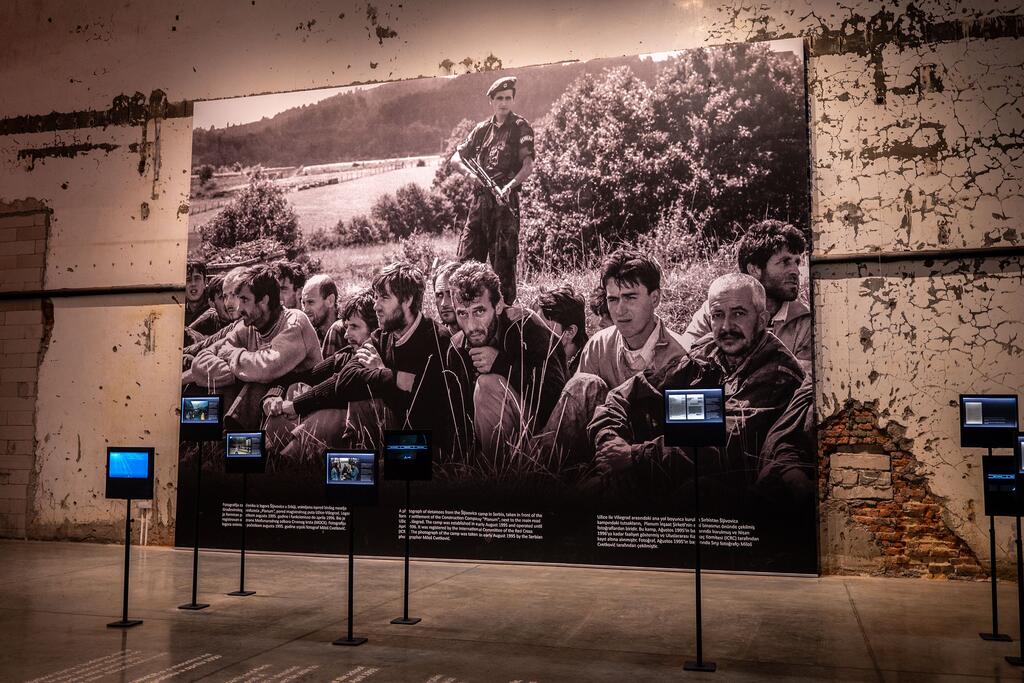
An exhibition at the Srebrenica Memorial shows terrified Bosnian Muslim men in July 1995. UN/Darko Zecevic
“I do not remember my father’s voice. I do not remember the warmth of his embrace. I do not remember the colour of his eyes.” In a few sentences, Emina Sinanović reminded the United Nations General Assembly that the Srebrenica genocide does not belong to history alone. It continues to shape the present for thousands of survivors and has now become, for the United Nations, a test of its ability to defend the truth in the face of new forms of revisionism.
Thirty-one years after the massacre of more than 8,000 Bosnian Muslim men and boys in July 1995, the ceremony held at UN Headquarters in New York was anything but a traditional commemoration. It formed part of a broader strategy aimed at turning remembrance into a tool for conflict prevention, at a time when hate speech, disinformation and the denial of historical facts are gaining ground.
The emotion stirred by Emina Sinanović’s testimony was not merely that of a daughter deprived of her father. Her address illustrated a conviction that now runs through the United Nations: genocide denial is not simply a historical debate, but a factor that undermines peace. “Every act of denial is another shot fired in the Kravica warehouse,” she said, referring to one of the main execution sites of July 1995. In a few words, she summed up an idea that is steadily gaining ground in international forums: denying a mass crime amounts to prolonging its political and psychological effects.
Memory becomes a diplomatic issue
This shift has gathered pace since the adoption in 2024 of the General Assembly resolution designating 11 July as the International Day of Reflection and Commemoration of the 1995 Genocide in Srebrenica. Opposed by Serbia and by the authorities of Republika Srpska, the resolution was not intended solely to honour the victims. It reflected the UN’s determination to embed Srebrenica permanently in international policies for the prevention of mass atrocities.
The unveiling a few months later of a flower-shaped memorial in the gardens of United Nations Headquarters in New York follows the same logic. The monument commemorates the victims, but also the failure of the international community to protect a “safe area” placed under a UN mandate. Rarely has an international organisation chosen to commemorate publicly a tragedy that also remains one of its greatest failures.
This institutional recognition comes at a time when the memory of Srebrenica remains bitterly contested in the Balkans. Despite rulings by the International Criminal Tribunal for the former Yugoslavia and the International Court of Justice classifying the massacres as genocide, attempts to downplay or deny them persist. Several political leaders continue to dispute that classification, while some convicted war criminals are still held up as heroes in parts of the region.
A duty to remember or a prevention strategy?
The message delivered by the UN Secretary-General, António Guterres, goes far beyond the Bosnian case alone. For him, commemorating Srebrenica is above all about defending the facts established by international courts and preventing the manipulation of history from paving the way for tomorrow’s violence. “After Srebrenica, the world declared: ‘Never again’. Yet hate speech is on the rise, fuelling discrimination, extremism and division,” he warned.
This analysis echoes that put forward for several years by genocide prevention specialists. Massacres never arise spontaneously. They are preceded by long phases of political polarisation, the dehumanisation of entire groups and the spread of narratives portraying certain populations as an existential threat. As the President of the General Assembly, Annalena Baerbock, pointed out, “genocides do not begin with mass graves; they begin with hatred”.
In this sense, the commemoration of Srebrenica marks a significant shift in UN doctrine. Remembrance is no longer seen solely as a moral obligation towards the victims, but as a tool for preventing mass atrocities. Defending historical facts is becoming a component of international security in the same way as diplomatic mechanisms or early-warning systems.
A battle against revisionism in the digital age
This dimension is all the more important because contemporary conflicts are also fought in the information sphere. Social media, disinformation campaigns and, now, artificial intelligence tools make it possible to spread alternative narratives rapidly, challenging facts that have nonetheless been established by international courts.
The battle over Srebrenica thus illustrates a deeper transformation: remembrance has become an arena of political confrontation. Survivors are no longer content simply to bear witness; they are defending the credibility of international institutions and the value of the law against attempts to rewrite history.
The documentary Les Gardiens de la mémoire de Srebrenica, screened during the ceremony, reflects this shift. Survivors who have chosen to return to live in Srebrenica explain that passing on their story is now a form of civic engagement. Their testimony is no longer intended merely to preserve the memory of the missing, but to prevent the mechanisms that led to the genocide from being repeated elsewhere.
The UN confronts its own responsibility
Finally, the commemoration carries particular weight because it forces the United Nations to confront its own history. Srebrenica remains the symbol of the organisation’s failure to protect a population placed under its responsibility. By turning this tragedy into an international day of reflection, the UN is not celebrating a triumph of multilateralism; it is publicly acknowledging a failure from which it intends to learn lessons.
This approach reflects a broader shift in UN culture. In the face of rising identity-based conflicts, disinformation campaigns and challenges to international law, the organisation now seeks to make the protection of historical truth an instrument of prevention. From this perspective, defending the memory of Srebrenica is not merely about honouring the dead. It is about preserving the very foundations of the rules-based international order.
Indeed, in closing her testimony, Emina Sinanović made no plea for compassion. “I am not asking the world to carry my pain. I am asking it to face up to its responsibility.” Through this responsibility, the entire philosophy of this new remembrance policy comes into view: peace rests not only on the end of wars, but also on the ability of societies to protect the facts, to acknowledge crimes and to prevent forgetting from becoming the prelude to fresh violence.
Translated from French. The French original prevails.