In Geneva, a meeting held on the sidelines of the United Nations Forum on Business and Human Rights examined how to turn international principles into concrete safeguards. The discussions brought together perspectives from Morocco, Africa and International Geneva.
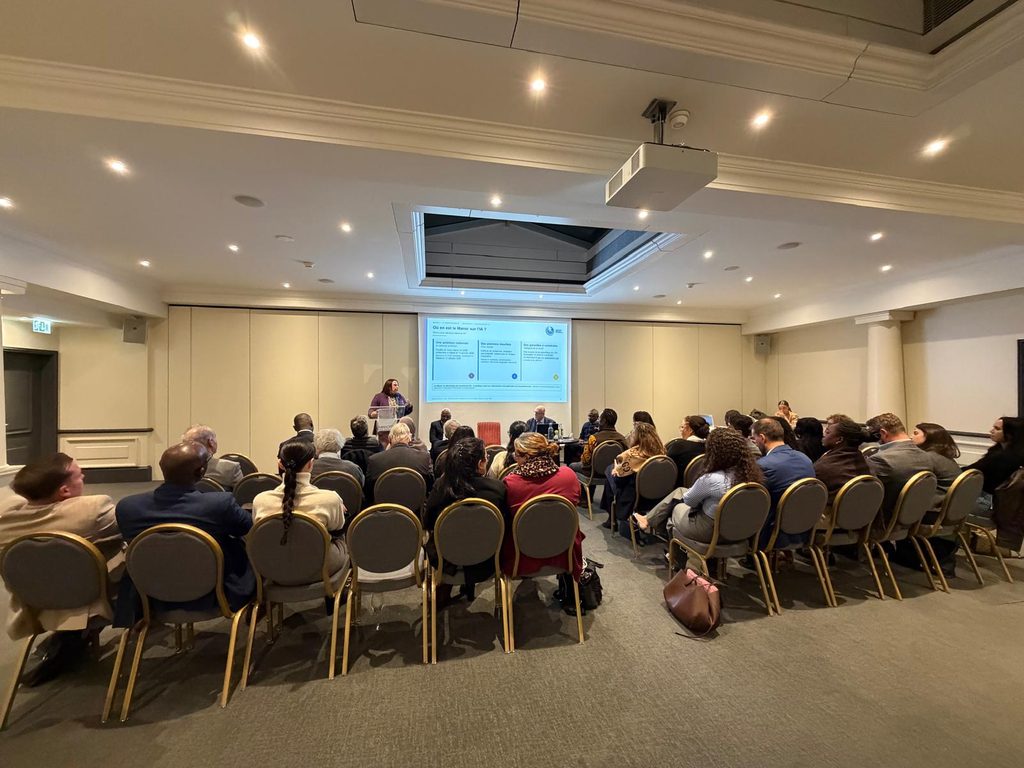
How can artificial intelligence be developed without sidelining fundamental rights? This question brought together specialists in AI, human rights and access to justice in Geneva on 23 November. Organised by the International Observatory for Peace, Democracy and Human Rights – Geneva (IOPDHR-GENEVA-NGO), in partnership with the Geneva AI Governance Institute (GAIGI), the meeting was held on the sidelines of the 15th United Nations Forum on Business and Human Rights.
The debate comes fifteen years after the adoption, in 2011, of the United Nations Guiding Principles on Business and Human Rights. Their framework rests on three interlinked responsibilities: states must protect human rights, businesses must respect them, and those affected must have access to effective remedies. Applied to artificial intelligence, these principles raise a practical question: how can we ensure that national strategies and the rules applicable to businesses genuinely protect people, both before and after a system is deployed?
Recognising frameworks without imposing a single rule
In his address, the founder of GAIGI, Axel Mazolo, presented regulatory interoperability as a possible response to the proliferation of national and regional frameworks. The aim would not be to impose a uniform global regulation, but to enable different systems to understand one another and, where safeguards allow, to recognise each other’s assessments.
The issue also concerns small and medium-sized enterprises. A company that develops an artificial intelligence tool and operates in several markets may find itself facing distinct requirements and procedures. Repeated assessments can drive up its costs and complicate its access to certain markets. Fragmentation can also make it harder for a person affected by an automated decision to know which rule applies and to whom a challenge should be addressed.
The challenge is therefore twofold: to facilitate cooperation between regulatory frameworks while ensuring that bringing them closer together does not weaken protections. In this regard, Axel Mazolo cited in his speech the experience of international trade, where the WTO Agreement on Technical Barriers to Trade encourages, under certain conditions, the acceptance of the results of conformity assessments carried out by other members.
He also presented the Geneva Bridge, an open-source tool developed by GAIGI to map different requirements against one another. The tool aims to provide regulators and companies with a common language for comparison, to which civil society can also refer. It replaces neither the decisions of the authorities nor the assessment of the risks specific to each system.
Strategies that must be turned into safeguards
The discussions drew in particular on the “Morocco AI 2030” roadmap, presented by Karima Rhanem, an expert in artificial intelligence and communication. Built around sovereignty and trust, innovation and competitiveness, and impact and influence, it sets ambitious targets for 2030: generating 100 billion dirhams in added value, creating 50,000 direct and indirect jobs, and training and certifying 200,000 professionals.
The roadmap also highlights the JAZARI Institutes and the development of solutions suited to the country’s linguistic realities, notably Darija. These ambitions give a sense of the choices ahead: investing in skills and innovation while strengthening cybersecurity and the protection of personal data. The discussions also touched on the draft “Digital X.0” legislative framework and on expectations regarding transparency, the explainability of algorithms and respect for fundamental rights.
A strategy is not in itself a guarantee. Its impact will depend on the rules, oversight and accountability that accompany its implementation.
Rights that must be enforceable
Aicha Duihi, President of IOPDHR-GENEVA-NGO, pointed out that automated systems can influence decisions on employment, justice, social benefits and migration procedures. She warned against algorithmic discrimination, the opacity of systems and violations of privacy.
For those affected, protection cannot be limited to a promise of transparency. It requires being able to understand that an automated system contributed to a decision, to request human review and to challenge that decision before an accessible mechanism. It also means identifying the responsibilities of the various actors — developers, suppliers, public administrations and the companies using the systems — throughout the system’s life cycle.
Access to justice was addressed by Sanjeewa Liyanage, Director of International Programmes at International Bridges to Justice, in Switzerland. Artificial intelligence can make legal information easier to access and help detainees get in touch with a lawyer, particularly where resources are limited. But it cannot replace human legal assistance or the guarantees of a fair trial. Independent human oversight, the confidentiality of lawyer-client communications and the availability of free and swift remedies remain essential.
Biro Diawara, Programme Officer for United Nations Affairs at the Rencontre africaine pour la défense des droits de l’homme (RADDHO), for his part highlighted the risks of disinformation, hate speech and manipulation of public opinion associated with certain uses of AI. He called for governance involving states, businesses and civil society, as well as international cooperation enabling African countries to take part in drawing up standards.
Making room for African perspectives
The discussion placed these issues in a broader context: African countries cannot be regarded merely as recipients of standards designed elsewhere. The African Union’s Continental Artificial Intelligence Strategy and the Malabo Convention on Cyber Security and Personal Data Protection bear witness to initiatives already under way on the continent.
The recognition of assessments must also be able to work both ways. Cooperation between regulatory frameworks will be credible only if African perspectives help to define common requirements, and if the safeguards adopted genuinely protect people’s rights.
The Geneva discussions thus linked three levels that are often treated separately: national strategies, corporate obligations and the remedies available to those affected. In the run-up to the Geneva AI Summit in June 2027, how these fit together will be one of the key issues for international cooperation. The development of artificial intelligence is measured not only by its capabilities or its economic value, but also by the ability to prevent harm, to make responsibilities clear and to provide redress for violations when they occur.
Translated from French. The French original prevails.