Off Hokkaidō, Russia administers four territories claimed by Japan. For former residents and their descendants, the deadlock between Tokyo and Moscow is measured by whether they can return to the graves of their loved ones. The last organised visits to the Japanese cemeteries took place in 2019.
One winter in the 1990s, when I was living in Tokyo, I went to Nemuro, at the eastern tip of Hokkaidō. I wanted to see the sea ice. From Sapporo, the journey took hours, through snow and ice. The landscape reminded me of Alaska or Lapland. In Nemuro, I finally saw the sea locked in ice.
I stayed at a minshuku, a small family-run guesthouse. Japanese travellers were staying there in the hope of catching a glimpse of the islands where, they told me, their forebears had lived. They told me their story. That was how I first heard about the dispute between Japan and Russia over the islands Japan calls the “Northern Territories” (北方領土).
On 31 October 2026, Kuni Tabata, 90, and her daughter Hitomi Hoshi put their hands together in prayer aboard a plane that had taken off from Hokkaidō. Along with other former island residents and their relatives, they are taking part in a memorial ceremony held from the air. During the flight, Kuni Tabata tells her daughter about the school she attended on the island of Kunashiri. Jiji Press gathered their account.
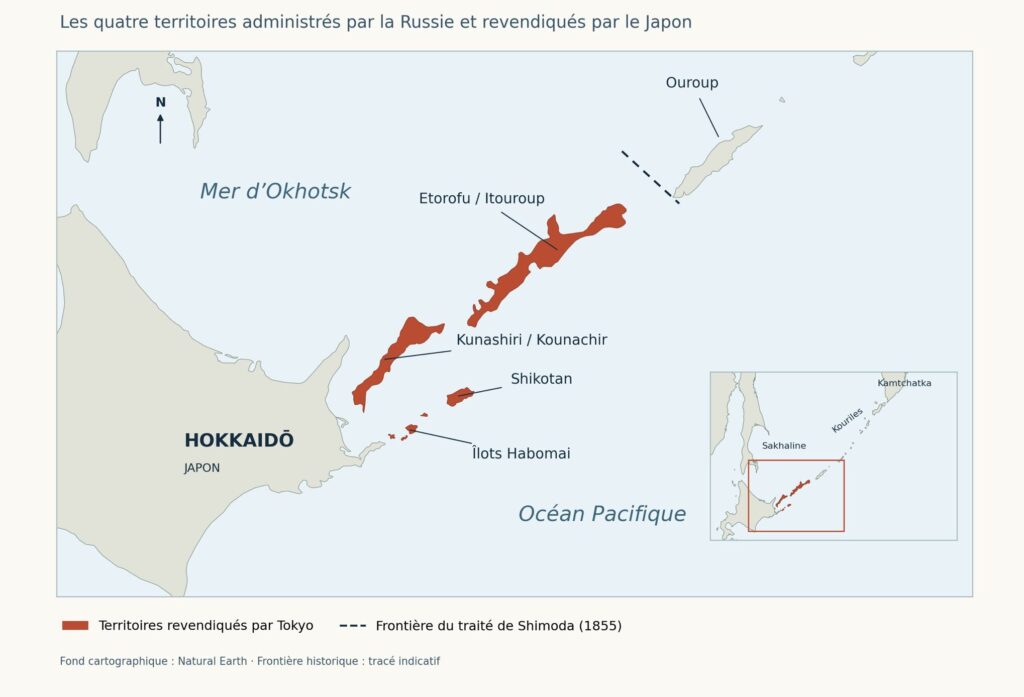
Four territories off Hokkaidō
The Kuril archipelago stretches from Hokkaido, in Japan, to Russia’s Kamchatka Peninsula. At its southern end, Tokyo claims Etorofu (Iturup), Kunashiri (Kunashir), Shikotan and the Habomai group of islets. Japan calls them the “Northern Territories”. The Habomai islets lie very close to the Nemuro Peninsula.
In 1855, the Treaty of Shimoda set the first border between Japan and Russia in the archipelago, between Etorofu, which was Japanese, and Urup, which was Russian. In 1875, the Treaty of Saint Petersburg gave Japan the eighteen islands still held by Russia, from Urup to Kamchatka. In exchange, Tokyo renounced its rights to Sakhalin. On the eve of the Second World War, the whole of the Kurils was under Japanese sovereignty. The distinction between the territories lying south of the 1855 border and the islands acquired in 1875 remains at the heart of Tokyo’s case.
The Soviet takeover in 1945
In February 1945, at Yalta, Washington and London agreed with Moscow that the Kurils would be handed over to the USSR in return for its entry into the war against Japan. The USSR entered the war in August 1945 and took control of the four territories between 28 August and 5 September. Japan signed the Instrument of Surrender on 2 September. The USSR incorporated the islands in 1946. Some of the inhabitants fled to Hokkaido. Others were later forcibly evacuated, as former islanders recount in the archives of the Japanese public body responsible for the Northern Territories issue.
In 1951, the Treaty of San Francisco formalised Japan’s renunciation of the Kuril Islands and southern Sakhalin. The text did not define the extent of the Kurils and named no beneficiary. The USSR did not sign the treaty. Tokyo maintains that the four territories it claims fall outside that renunciation. Moscow regards its sovereignty over them as having been secured at the end of the war.
A peace without a treaty
On 19 October 1956, a Soviet-Japanese joint declaration ended the state of war and restored diplomatic relations. Its Article 9 provides for the transfer of Shikotan and the Habomai islands to Japan after the conclusion of a peace treaty. Etorofu and Kunashiri remain outside that commitment. In 2018, Shinzo Abe, the Japanese Prime Minister, and Vladimir Putin agreed to take up the declaration again as a basis for negotiations. In March 2022, after the sanctions imposed by Tokyo in response to the invasion of Ukraine, Moscow broke off the negotiations.
Vladimir Putin’s visit to Etorofu on 13 August 2026 drew a protest from Tokyo. On 18 November, on the sidelines of the APEC summit in Shenzhen, the Japanese Prime Minister, Sanae Takaichi, and the Russian President nevertheless agreed to stay in contact. But the Japanese announcement made no mention of any resumption of negotiations on the treaty. The exchange comes as Tokyo undertakes a broader reassessment of its defence policy.
Paying respects from afar
The cemetery visits began in 1964 under a humanitarian arrangement. The last ones took place in 2019. The pandemic halted them from 2020, and the diplomatic rupture of 2022 then prevented them from resuming. Tokyo continues to call on Moscow to restore the visits. In the meantime, ceremonies are held from the sea or the air.
Why is paying respects at ancestors’ graves so important to the Japanese? I have personally witnessed this cult of the dead. In the Nagano region, a Japanese friend, a helicopter pilot, was killed in an accident during a rescue operation. With my friend the mountaineer Kazuyuki Takahashi, I went to offer my condolences to his widow. She received us in the kitchen, as the main room was entirely taken up by an altar erected in memory of her late husband. Kazuyuki explained to me that it is the deceased who will decide when his soul leaves the room. My attention was held by the fruit and a bowl of rice placed on the altar and replaced every day.
That bowl of rice with two hashi (chopsticks) planted upright in it has stayed with me. It spoke of the place the deceased still held in the home. In Japan, this bond is also expressed through rituals performed at the cemetery. During Obon, the time of year when ancestors are honoured, families visit the graves of their loved ones, clean them, leave offerings and join their hands in prayer. For the former inhabitants of the Southern Kurils and their descendants, returning to the island where their loved ones lie means being able to perform these rituals beside them.
In an archive testimony, Kenshirō Miyashita, a native of Etorofu, recalls taking part in five or six voyages to the islands. In rough weather, he was sometimes unable to go ashore. He said that simply seeing his island up close already meant a great deal to him. He hoped that one day some of his ashes would be buried there.
Follow the author on X: Seals Consulting
Sources and further reading
Testimonies of former residents, Hoppō Ryōdo
Cabinet Office of Japan, 2026 review of visits and commemorations, pp. 21 and 22
Yalta Agreement, National Diet Library · Treaty of San Francisco, United Nations
Diplomatic Bluebook of Japan 2026, Russia and Belarus
Reuters · Putin’s visit to Etorofu · The Shenzhen meeting
Further reading from LTDN
Japan turns the page on pacifism while remaining peaceful
Translated from French. The French original prevails.