
By Michael Jacobs, Professor of Political Economy at the University of Sheffield.
Something unexpected has happened at the UN climate conference, COP31, as it nears its conclusion in Antalya, Turkey: negotiators are now discussing ways of cooling the planet. That may seem surprising, but the question of how to respond to the latest climate science was not on the agenda when the conference began.
The summit’s latest draft decision now explicitly recognises a role for carbon dioxide removal (CDR), alongside massive cuts in emissions. This is a significant shift, secured under pressure from some of the countries most vulnerable to climate change: the small island states. It follows the publication, over the past month, of two particularly alarming scientific reports.
The World Meteorological Organization (WMO) has confirmed that the rate at which the Earth is warming is accelerating. One reason is that our planet is becoming less “reflective”: the loss of ice and snow, changes in cloud formation and, paradoxically, reduced air pollution mean that more solar radiation is being absorbed by the Earth instead of being reflected back into space. As a result, the Paris Agreement goal of limiting warming to 1.5°C will not be met.
A new term now describes this climate trajectory: “overshoot” (overshoot). As a report by the United Nations Environment Programme (UNEP) explains, the best scenario we can now hope for is to exceed the 1.5°C threshold while limiting the scale and duration of that overshoot as far as possible. The aim is to bring emissions to a peak as quickly as possible, then return to 1.5°C of warming later this century.
Unfortunately, UNEP also stresses that this goal may be harder to achieve than it appears. The longer temperatures remain above 1.5°C, the greater the risk of triggering irreversible changes in certain natural systems, such as the polar ice sheets and glaciers, ocean currents and the Amazon rainforest. Such changes could make any return to lower temperatures impossible.
Beyond cutting emissions
Until now, we have thought of there being essentially two responses to global warming: reducing greenhouse gas emissions (mitigation) and adapting to the warming that has already occurred (adaptation). But overshooting the 1.5°C threshold means that reaching net zero emissions will no longer be enough. By the time we achieve that goal, the planet’s temperature will already be too high. Overshoot will therefore require two further kinds of response.
As well as reducing the quantities of greenhouse gases released into the atmosphere, we can seek to physically remove them from it. This process is known as carbon dioxide removal (CDR), or Carbon Dioxide Removal (CDR). Various methods of increasing the planet’s capacity to reflect solar radiation will also have to be considered.
Among the avenues being explored are reducing aircraft contrails, which trap heat, increasing the area of white surfaces on the Earth’s surface — buildings and agricultural crops — and stabilising glaciers.
These solutions could also include various “solar radiation management” techniques, such as brightening clouds over the oceans or injecting reflective aerosols into the stratosphere. While some of these “climate cooling” technologies may help to bring temperatures down, they require far more in-depth research and rigorous oversight.
Removing carbon dioxide already in the atmosphere must not be confused with carbon capture and storage (CCS), which involves capturing emissions from industrial facilities before they are released into the atmosphere. In every scenario aiming for carbon neutrality, carbon capture and storage is needed to deal with residual emissions from fossil fuels.
But we now know that carbon dioxide removal will also be essential: first as a complement to emissions reductions, in order to slow warming, and then to bring global temperatures back down to a safer level.
There are various potential methods of carbon removal. Some are well known and do not provoke major controversy, even if they are not yet being implemented on a sufficient scale. These include natural processes: planting trees, restoring ecosystems and improving the capacity of soils to store carbon. Other, so-called “novel” methods are still being developed.
In the oceans, some techniques aim to increase carbon uptake, notably by enhancing the alkalinity of seawater or by fertilising phytoplankton with added iron. On land, some methods involve speeding up natural processes. Examples include incorporating plant-derived charcoal, known as biochar, into soils, or accelerating the formation of carbonates through rock weathering.
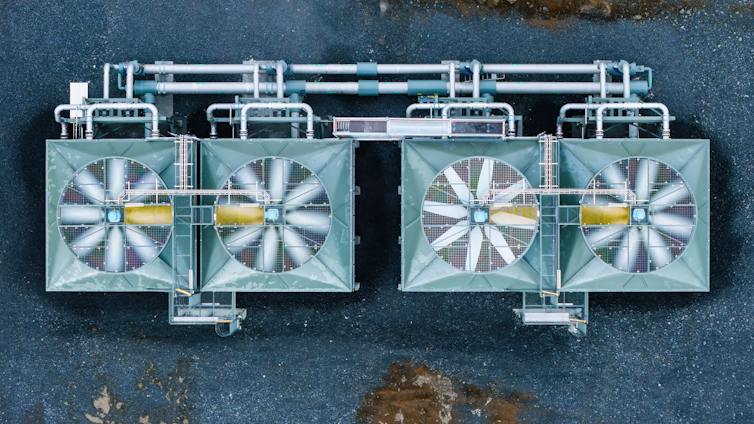
A direct air capture facility in Iceland, one of the first installations of its kind.
Other interventions rely on more advanced technologies. One example is bioenergy with carbon capture and storage (BECCS). This technique involves burning biomass to produce energy, then capturing the resulting emissions and storing them underground. Another method is “direct air capture” (Direct Air Capture), which involves extracting CO₂ from the atmosphere using sophisticated machinery.
All of these methods are now being tested, but they remain costly. Some also carry environmental risks. Before they can be deployed at scale, states will need to make sure that they do not cause harmful side effects. That, in turn, means the international community must think seriously about the rules that should govern their development and use.
The politics of cooling the planet
Yet there is currently no framework in which such discussions can take place. Neither the new methods of carbon dioxide removal nor the techniques designed to increase the Earth’s reflectivity are formally part of the COP negotiations, or indeed of any other United Nations political process.
This is because many countries have long held that discussing these solutions risked diverting attention from the overriding priority: cutting emissions. That position has also been championed by some major climate-focused non-governmental organisations (NGOs), which do not want other issues to distract from their campaign against fossil fuels.
But the world has changed. Climate science now shows that cutting emissions alone will no longer be enough to keep the planet on a safe climate trajectory. In these circumstances, blanket opposition to new carbon removal and planetary cooling techniques is becoming hard to sustain.
Governments must step up research into these methods and consider how they should be regulated. At the very least, they must agree to debate them. That is why the latest developments at COP31 matter so much. At this stage, it is not yet certain that states will manage to adopt a declaration on how to respond to overshooting the 1.5°C threshold. Some countries remain opposed to the idea.
But if the final text recognises the need to resort to methods of actively cooling the planet, it will mark the start of a new era in climate action.
This article is republished from The Conversation.
Translated from French. The French original prevails.