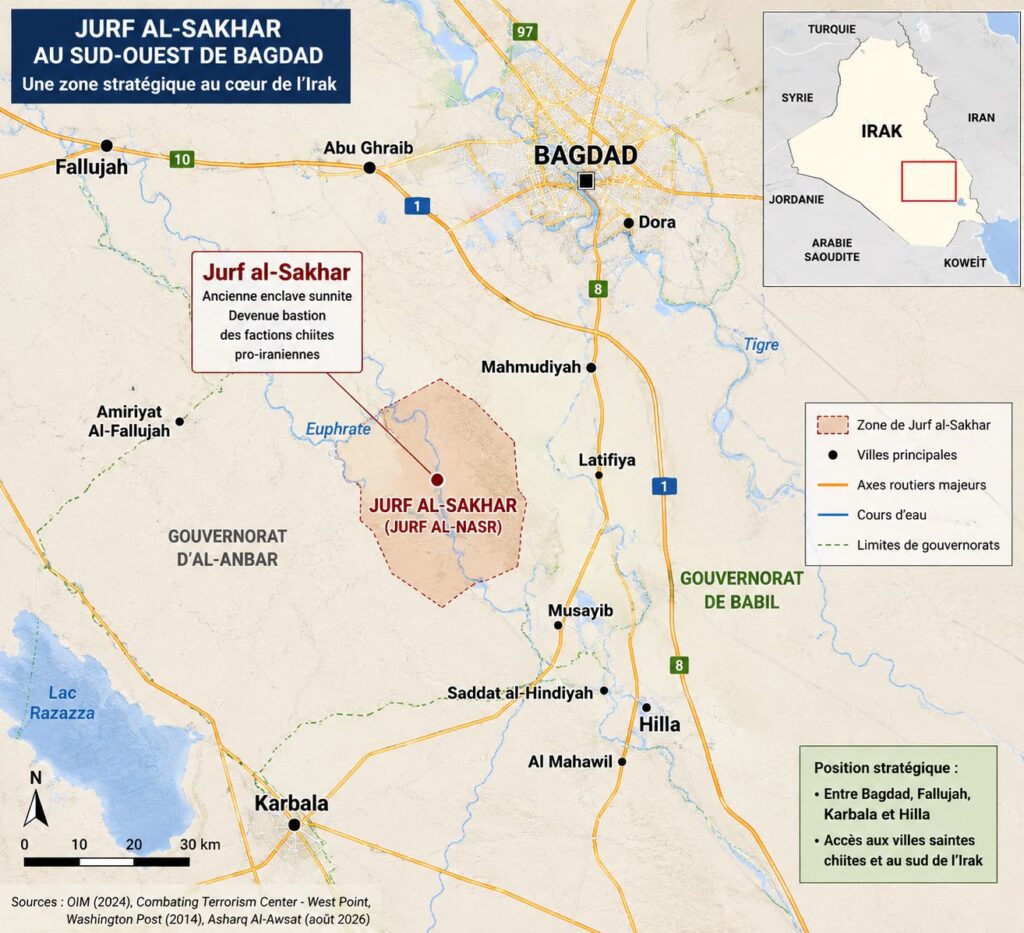
The army and the federal police began deploying on Friday 20 November in Jurf al-Sakhar, a Kataib Hezbollah stronghold south of Baghdad. The entry of state forces is the result of a compromise with the Iranian-backed faction. The extent of the transfer of authority remains to be established, while the road to Karbala is due to reopen on Saturday morning.
In Jurf al-Sakhar, a farming area of Babil province crossed by the Euphrates, Kataib Hezbollah imposed its control after the region was retaken from Islamic State in 2014. An investigation into alleged oil diversion triggered the stand-off with the Prime Minister, Ali al-Zaidi. The faction denies the accusations. One of its officials, Abu Talib al-Saidi, had warned that its men would resist being ousted. Read our article of 17 November
Kataib Hezbollah tones down its rhetoric
On 19 November, the leader of Kataib Hezbollah, Abu Hussein al-Hamidawi, described the outcome of the talks as positive and asked his fighters to resume their usual duties. He said disagreements would be dealt with through private channels, without announcing a complete withdrawal. The faction confirmed that he had met Esmail Qaani, commander of the Quds Force of Iran’s Revolutionary Guards; Hadi al-Amiri, who heads Badr, a powerful Shia political and military organisation close to Tehran; and Falih al-Fayyadh, chairman of the body that oversees the Hashd al-Shaabi. The Kataib Hezbollah statement, reported by 964media
Iraqi Shia politicians negotiated the handover to avoid a confrontation. On 20 November, Reuters saw Iraqi soldiers taking up positions in the centre of the town, where members of Kataib Hezbollah were still present. The full terms of the compromise remain unknown. The Reuters report
Badr’s political calculation
According to Al-Araby Al-Jadeed, the leader of Badr and other officials warned the Iraqi Prime Minister that a confrontation in Jurf could spread to other regions. Ali al-Zaidi relies on Shia parties, while Kataib Hezbollah belongs to the Popular Mobilisation Forces (Hashd al-Shaabi), which bring together several armed groups. The faction’s brigades therefore officially answer to the head of government, in the same way as the other Hashd units.
For officials from Badr and from Asaib Ahl al-Haq, another Iran-aligned Shia armed faction represented in the government, a confrontation would risk weakening the political order that emerged in 2003, in which Shia parties hold a dominant position. According to these sources who spoke to The National Context, a state capable of controlling its borders and protecting its economy can also better serve the interests of Tehran’s Iraqi allies. The arrangement adopted in Jurf allows Baghdad to resume responsibilities there, while the Kataib Hezbollah brigades remain part of the Hashd. The National Context’s analysis
In a message to the armed forces released by his office on 20 November, Ali al-Zaïdi called on deployed units to show “restraint and wisdom”. “We are not waging a battle. Everyone there is your brother,” he told them. He reaffirmed his goal: “No weapons outside the authority of the state.” The Prime Minister presents Jurf as the starting point for restoring that authority across Iraq. His speech specifies neither what will become of Kataeb Hezbollah’s weapons nor where its brigades will go. The text of the speech
Who controls access to Jurf?
The Federal Police lead the new joint command, which brings together the army and brigades of the Hashd al-Shaabi. The Energy Police say they have taken charge of the section of the oil pipeline that crosses the area. Under the plan outlined in the 18 November diagram, the Federal Police are to hold the populated centre while relief brigades from the Hashd are to secure the sector towards the Shia holy city of Karbala. The actual deployment of units has yet to be verified. 964media’s update on the handover
This division keeps within the Hashd the task of securing the approaches to Karbala, which Kataeb Hezbollah cited to justify its presence in Jurf. Handing the residential areas to the Federal Police could also reduce friction with displaced families if they return.
On 20 November, Lieutenant General Saad Maan, head of Iraq’s Security Media Cell, announced that a battalion of Kataib Hezbollah’s 45th Brigade had begun to withdraw and that the Federal Police were taking up positions. Asharq Al-Awsat, for its part, reports that the faction denies having withdrawn from Jurf. Whether all of its units have left remains to be established. Saad Maan’s statements to Rudaw Asharq Al-Awsat’s report
According to political sources interviewed by Ultra Iraq, the entry of the first units was coordinated with Kataib Hezbollah, and the faction’s withdrawal is said to be gradual. Can federal forces now access the entire sector without its consent? The affiliation of the relieving brigades is also contested. Two Hashd officials interviewed by Rudaw say the 72nd and 79th brigades are independent of the armed factions. Critical Threats cites the analysis of a specialist who links the 72nd to Kataib Hezbollah. The available information establishes neither that Badr is supplying most of the forces that entered Jurf nor that Washington froze sanctions in exchange for the compromise. Ultra Iraq’s account Rudaw’s analysis The Critical Threats briefing
Al-Qaim, a coveted border crossroads
In the west of Iraq’s Sunni-majority Anbar province, Al-Qaim faces the Syrian town of Al-Bukamal. After the 2003 US invasion, this stretch of the Euphrates valley became one of the main gateways into Iraq for foreign jihadist fighters arriving from Syria. Al-Bukamal served as their assembly point before they crossed the border. Many then joined Al-Qaeda in Iraq, the network of the Jordanian jihadist Abu Musab al-Zarqawi.
After the Syrian uprising began in 2011, fighters also used this route in the opposite direction. In 2014, Islamic State seized both towns and merged them into a single administrative entity, the “Euphrates province”. After the area was retaken, the border crossing between Iraq and Syria reopened to trade in 2019. Carnegie’s study of the Iraqi-Syrian border
Lieutenant General Saad Maan, head of Iraq’s Security Media Cell, named Al-Qaim as a possible destination for the Kataib Hezbollah brigades. A final transfer order and their arrival at the border have yet to be confirmed. Saad Maan’s interview with Rudaw
For Baghdad, reassigning brigades to a sector where units linked to Kataib Hezbollah are already established could ease their departure from Jurf al-Sakhar. Saad Maan said the decision would depend on operational needs and the judgement of the Iraqi command. Before the fall of Bashar al-Assad, the Al-Qaim–Al-Bukamal axis formed part of the land corridor through which Iran could support its allies as far as Lebanon. A stronger presence on the Iraqi side could preserve a foothold for the Quds Force. That prospect may have made the compromise more acceptable to Tehran. Public sources do not establish that it was a quid pro quo negotiated by Qaani.
A redeployment to Al-Qaim could also worry Damascus. On 16 July, the Syrian authorities announced that they had intercepted, on the Iraqi border, a shipment of weapons they suspected was bound for Lebanon’s Hezbollah, an Iranian-backed Shia armed movement. The July precedent as reported by Associated Press
Washington could also raise the matter with Baghdad. In a statement sent to Voice of America on 17 November, the State Department called on the Iraqi government to hold pro-Iranian factions accountable for their destabilising activities. Washington is also pressing Ali al-Zaidi to disarm them. Merely relocating the brigades would leave the question of their weapons unresolved. Were they to be deployed to the border, their mission and the authority that would actually command them would also weigh in the American assessment of the compromise. No public reaction from Damascus or Washington to the prospect of a transfer to Al-Qaim has been noted. The US statement published by Voice of America
Detainees and the missing
The return of federal forces also raises the question of secret detention sites attributed to Kataib Hezbollah. Elizabeth Tsurkov, an Israeli-Russian researcher abducted in Baghdad in 2023, says she was held at the start of her captivity in a house requisitioned by the faction in Jurf. She is calling on the authorities to investigate. Public announcements about the handover make no mention of either an inspection or a release. Giving investigators access to the suspected sites could help establish the fate of the missing and inform their families. Elizabeth Tsurkov’s testimony
Baghdad-Karkh police announced that they had reopened the Al-Fadhiliya bridge on Friday, which links the provinces of Baghdad and Babil in the direction of Jurf. They said traffic on it was being regulated by a police checkpoint. The police statement reported by 964media
Baghdad Operations Command has announced that the road linking Al-Latifiya to Karbala via Jurf al-Sakhar will reopen to civilians in both directions from 6am Iraqi time on Saturday 21 November. Its reopening will offer a first indication of the new command’s ability to enforce its decisions. The authorities have also raised the return of the area’s mostly Sunni residents, displaced since 2014, without giving a date. Baghdad Operations Command’s announcement
Follow the author on X: Seals Consulting
Further reading from La Tribune des Nations
– Iraq: Prime Minister defies Kataib Hezbollah
– Iraq: from disarmament to “weapons management”, the compromise taking shape with the militias
–Iraq: Jurf al-Sakhar, the forbidden territory where Baghdad seeks to restore its sovereignty
– Facing the militias, Zaidi opens a front against corruption
– Iraq: two more Shia armed groups rally behind Al-Zaidi’s government
Translated from French. The French original prevails.