
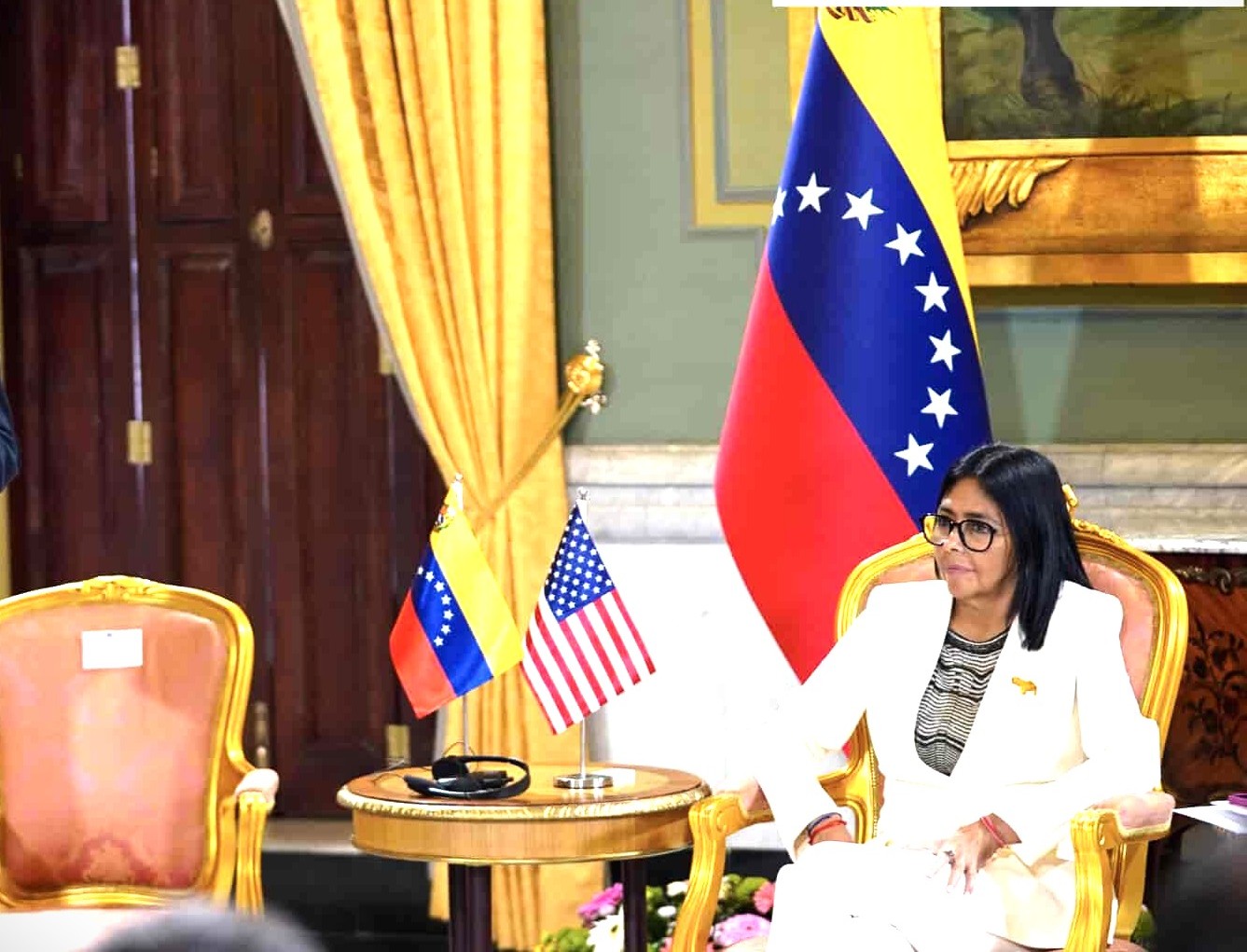
Delcy Rodriguez, interim President of the Republic of Venezuela.
Since the publication of the US National Security Strategy in 2017 and 2025, and above all in the wake of the military operation in Venezuela on 3 January 2026, which led to the capture and detention of President Maduro and his wife, Cilia Flores, and left around a hundred people dead, the situation in the country appears worrying: Trump openly embraces the neocolonial nature of his policy. “The United States will run Venezuela until such time as a safe political transition can take place,” he declared on 4 January 2026 from his Mar-a-Lago residence.
Why such an operation? From Washington’s point of view, Venezuela represents an existential threat to the petrodollar system and to the perpetuation of American hegemony in a region it regards as its sphere of influence. Since this military aggression, Venezuela no longer controls its hydrocarbon revenues. The United States now handles their collection, safekeeping and disbursement. This predatory situation is unprecedented and marks a new world disorder.
A report by KPMG dated 29 October 2026 and analysed on 10 November by the “New York Times” shed light on the movements in the bank account, managed by the US Treasury, through which the funds pass. But since then, one question has haunted Venezuelans: what has happened to the $12 billion the country has recovered over the past nine months? (Courrier international, 2026).
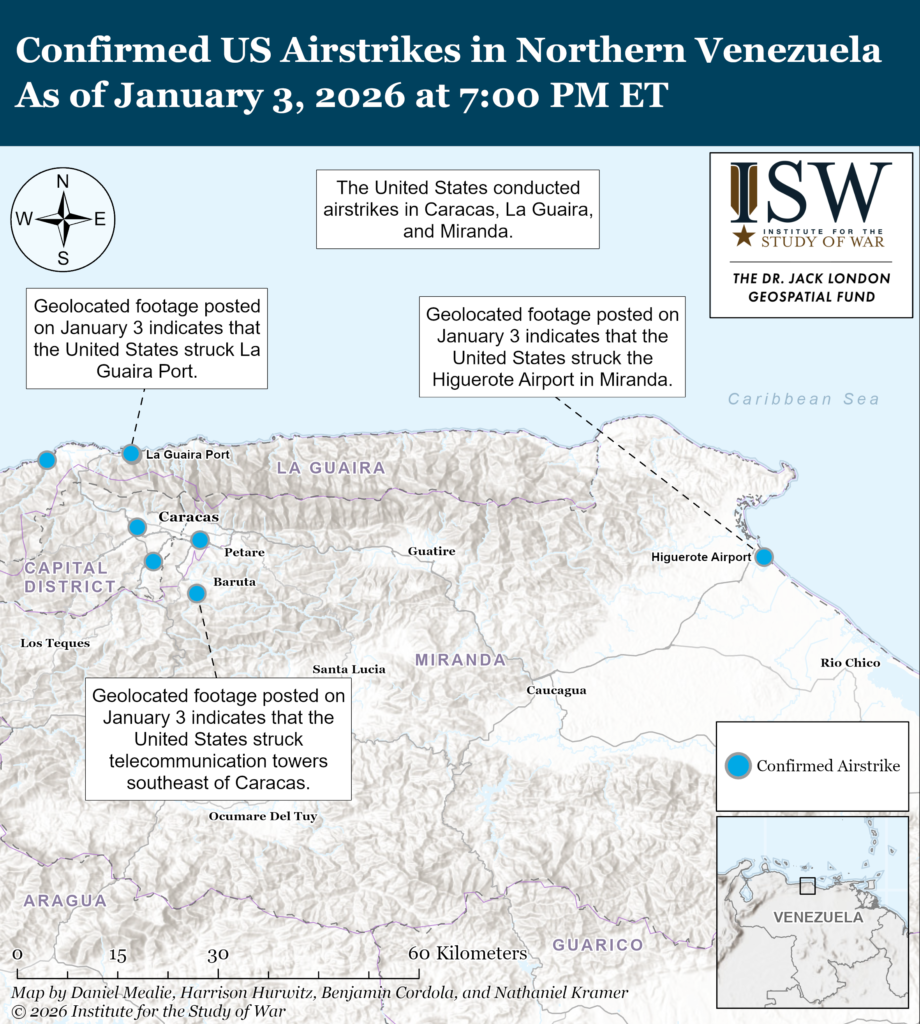
Map of the US military operation in Venezuela on 3 January 2026.
The collaboration of the sister and brother Delcy and Jorge Rodriguez – respectively Acting President of the Republic and President of the National Assembly – with the United States is not liberation. Donald Trump is claiming, through brute force, the right to decide who holds power and who does not. To open up Venezuela’s subsoil to his oil companies. To run a country of 30 million people from afar as though it were a concession (Izarra, 2026).
On the anniversary of President James Monroe’s 1823 doctrine, the White House’s presidential message of 2 December 2025 reflects the spirit of hegemony, even imperial dominion, over the Western Hemisphere: “Today, my administration proudly reaffirms this promise under a new corollary to the Monroe Doctrine: that the American people – not foreign nations nor globalist institutions – will always control their own destiny in our hemisphere […] As the 47th President of the United States, I proudly reaffirm this time-honoured policy. Since taking office, I have resolutely pursued a policy of peace through strength and America First. We have restored America’s privileged access to the Panama Canal. We are restoring American maritime dominance. We are combating anti-competitive practices in the logistics and international supply chain sectors” (The White House, 2025).
Priority is given to a Western Hemisphere of vague geography, which the United States would dominate using every means of American power. This policy is also tied to domestic and electoral considerations: to halt the flow of drugs by land and sea, as well as immigration, through incentives or deterrents, every instrument of economic power must be mobilised, with the support of Argentina, El Salvador, Ecuador and Guatemala. And military power must be used against Venezuela (Allard, 2025).
Overview of popular revolts
We consider it essential to understand the interplay between economic and political crises and the institutional reconfiguration of the state, on the one hand, and, on the other, the spiral of violence stemming from the United States’ policy of economic strangulation, and the consequences of the coercive pressure exerted by its allies against the interests of the people of Venezuela.
The pivotal moment that marked the end of the democratic exception was the Caracazo, the popular uprisings of February–March 1989 in response to the neoliberal-style reform plan adopted by President Carlos Andrés Pérez Rodriguez under pressure from the World Bank and the International Monetary Fund. The uprisings were met with heavy-handed police and military repression that left thousands dead. It was against this backdrop of deep questioning of the legitimacy of the state’s use of violence that Hugo Chávez burst onto the political scene, at the head of a clandestine military movement allied with civilian groups that had emerged from successive waves of guerrilla movements. Bearing the banner of the Bolivarian Revolution, Hugo Chávez’s rise to power raised great hopes of democratic renewal and social reform.
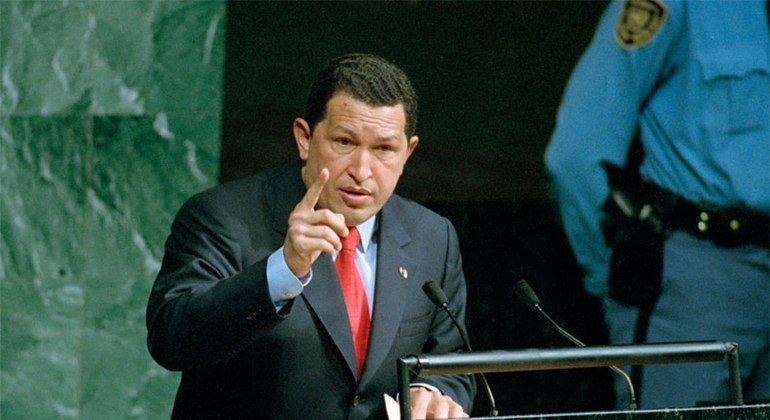
Venezuelan President Hugo Chávez addresses the UN General Assembly in 2001.
The cardinal idea of this Revolution: the “final settlement of the social debt” – owed by the state to the poorest – depends as much on a more “participatory” constitutional order as on the implementation of an updated and inclusive version of the “civic-military union” from the great chapters of the national story, namely the wars of independence against the Spanish Empire from 1810 to 1823, as well as the struggles to establish pluralism in the face of modern tyrants (Bracho and Andréani, 2023).
Hugo Chávez’s rise to power in 1999 changed the relationship between the United States and Venezuela. Chávez, who championed a radical left-wing agenda and a pronounced anti-imperialism, openly criticised the United States and introduced a raft of measures designed to curb its influence, including the nationalisation of certain industries, most notably the oil sector.
However, the establishment of a democratic system in Venezuela was marked by intense political conflict, which found expression in the mobilisation of armed groups seeking to challenge the legitimacy of the political authorities by force. The civilian authorities did not hesitate to crack down on such dissent, drawing a strong link between the use of the armed forces and the safeguarding of the democratic order as conceived under the Puntofijo Pact.
According to Linárez, the latter was a consequence of foreign interference: “The institution of civilian democracy after the fall of the dictatorship of Marcos Pérez Jiménez came about through a pact of consensual alternation, known as the ‘Puntofijo’ pact, between the parties Democratic Action (AD), the Independent Political Electoral Organisation Committee (COPEI) and the Democratic Republican Union (URD), which marginalised the Communist Party (PCV), despite its being one of the key actors in the democratic transition. This exclusion gave rise to a guerrilla movement backed by revolutionary Cuba, which was subjected to severe political and military repression, and not only in rural areas (en el monte)” (Linárez, 2007).
In April 2002, following deadly clashes on both sides at the points of contact between a mass demonstration calling for the president’s resignation and a rally of his supporters who had come out to defend the revolution, Chávez was ousted in a coup d’état in favour of a coalition of military and political, business and trade union, media and religious elites, with the blessing of Washington. He was nevertheless restored to office two days later, thanks to an equally massive protest by his supporters and loyal members of the military, as well as the collapse of the “democratic transition government”, which had been entrusted the day before to the head of the employers’ federation, who had dissolved all branches of government and unleashed an unprecedented wave of repression (Posado, 2023).
Following nationalisations in several strategic sectors (hydrocarbons, the food industry, electricity, finance, telecommunications, etc.), the Venezuelan government faced the International Centre for Settlement of Investment Disputes (ICSID) – the World Bank’s arbitration body, set up in 1966 to settle disputes between transnational corporations and states – over some twenty complaints from multinationals demanding colossal compensation.
After several announcements that came to nothing, it was the dispute with the US oil company Exxon that prompted Venezuela to decide to withdraw from ICSID on 24 January 2012, a decision that took effect on 25 July 2012 […] It should also be stressed that a state’s ratification of the ICSID Convention does not oblige states parties to submit systematically to international arbitration tribunals in disputes with foreign investors. States must have given their consent before a case is brought before ICSID, and a contracting state may require that local remedies be exhausted (“Article 26 of the Convention”) […] A government with the political will to do so can therefore lawfully refuse to apply bilateral free-trade and investment-promotion agreements that undermine the economic, social and cultural rights of its population and mortgage its sovereignty. It can denounce the legal “actions” brought by transnational corporations before ICSID by invoking the primacy of a hierarchy of international norms (Lamarque, 2012).
Nicolás Maduro succeeded Chávez after his death in 2013. He did not enjoy the same success as his mentor, and his years as head of state have been marked by a series of crises of social protest: localised demonstrations and riots, public-sector strikes, massive waves of opposition mobilisation in 2014, 2016 and 2017, and later, short-lived military mutinies and rebellions. Left in a clear minority in the National Assembly in 2015, the executive neutralised the legislature through its grip on the judiciary, and invoked a continuous state of emergency to govern alone (Bracho and Andréani, 2023).
According to Andréani, with Maduro’s controversial re-election in 2018 : ” The country’s situation took up more space in international arenas, as the parliamentary majority made the deputy Juan Guaidó – on the basis of a dubious interpretation of the Constitution – an ‘ interim president’ without a state, but backed by the Donald Trump administration and some 50 allies, including the European Union (EU) and the Macron government. But this so-called ‘ maximum pressure ‘ strategy essentially helped to entrench the authoritarian status quo ” (Andréani, 2021).
On 7 March 2019, before the Senate Foreign Relations Subcommittee, the Republican Senator Marco Rubio called on the United States to bring about regime change through a combination of three measures : widespread unrest, support for the Venezuelan military and elites, and international pressure.
Following the disputed 2024 elections, protests multiplied despite the crackdown. President Maduro and his wife Cilia Flores were seized by US forces on 3 January 2026 in Operation “Absolute Resolve”. A new chapter has just opened in the history of relations between Venezuela and the United States of America. In a statement dated 5 January 2026, read out at the opening of the meeting by the UN’s political affairs chief, Rosemary DiCarlo, the UN Secretary-General, António Guterres, said he was “deeply concerned at the failure to respect the rules of international law regarding the US military operation of 3 January 2026, and dismayed at the uncertainty hanging over Venezuela’s future and the risk of further destabilisation of the country, the Secretary-General states: ‘The law must prevail'” (UN, 2026).
The impact of economic sanctions
Under President Obama’s administration, the United States imposed the first sanctions on Venezuela. In December 2014, the US Congress passed the Venezuela Defense of Human Rights and Civil Society Act, and codified the law in 2015 by freezing the assets and suspending the visas of eight members of the Maduro administration. The law was subsequently extended until 2019 (Rendon and Price, 2019).
Meanwhile, the fall in oil prices began in July 2014 and continued until early 2016. Brent crude fell from around $110 a barrel in the summer of 2014 to a low of around $30 in early 2016. The recession that began in 2016 with this collapse in oil prices was identified towards the end of 2018 as one of the most dramatic of the past half-century. It resulted in a genuine collapse of everything from the productive base, infrastructure, administrations and essential public services to the currency and wages. Shortages of basic necessities and near-universal impoverishment created an extremely serious health situation.
This crisis also fuelled the wholesale expansion of illicit and often crime-generating economies and, with it, the deinstitutionalisation and fragmentation of public authority, both among various state bodies and between them and a plethora of irregular armed civilian actors (Figure 2). On 4 August 2017, the Trump administration adopted a package of sanctions barring Venezuela from access to financial markets : not only can the country no longer obtain financing on the US market, but the oil revenues of its oil company CITGO can no longer be repatriated. According to Mark Weisbrot, co-director of the Center for Economic and Policy Research in Washington DC, this is a deliberate move to prevent the country’s economic recovery. In an effort to evade the sanctions, Venezuela then tried to sell its oil in yuan.
“The unilateral sanctions imposed by the Trump administration are illegal under the Charter of the Organization of American States (OAS). The Charter contains numerous provisions prohibiting these sanctions, but among the clearest and most unambiguous are Articles 19 and 20 of Chapter IV. Article 19: ‘No State or group of States has the right to intervene, directly or indirectly, for any reason whatever, in the internal or external affairs of any other State. The foregoing principle prohibits not only armed force but also any other form of interference or attempted threat against the personality of the State or against its political, economic, and cultural elements.’ Article 20: ‘No State may use or encourage the use of coercive measures of an economic or political character in order to force the sovereign will of another State and obtain from it advantages of any kind.’ […] Vice-President Mike Pence has said repeatedly: ‘Maduro must go’” (Weisbrot and Sachs, 2019).
Such results are highly unusual in a time-series context and strongly point to a causal link. To use an analogy, it is as if a person suffered three separate anaphylactic shocks after eating seafood on three occasions. Had there been only one episode, one might reasonably question the cause of the reaction: a seafood allergy or some other external factor? That hypothesis is far harder to sustain in the face of several successive reactions to the same trigger. In other words, in a time-series context, this is the irrefutable equivalent of a smoking gun. Despite this evidence, it is not uncommon to find arguments in the political debate disputing the effect of sanctions on oil production (Rodriguez, 2022).
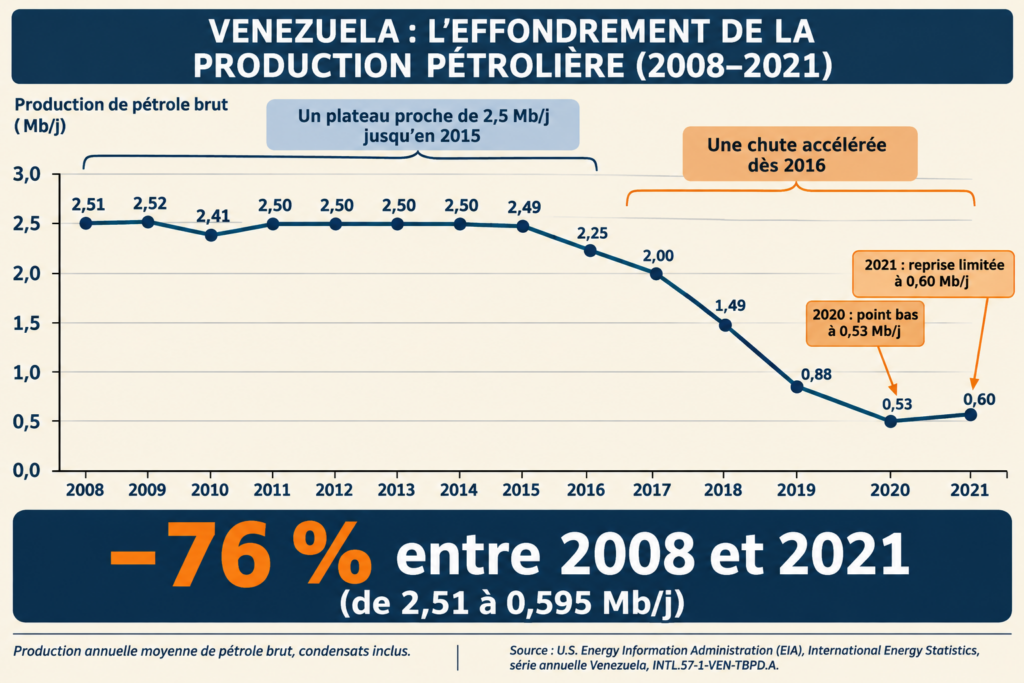
On the one hand, the United States embargoes on debt bonds in 2018, on oil and potentially on any dollar transaction with a state entity in 2019 (Bull and Rosales, 2023), together with the Bank of England’s retention of Venezuela’s gold reserves, deepened the economic crisis, the exodus and the population’s dependence on greatly diminished state aid. On the other, the freezing of assets and the travel bans imposed on dozens of Maduro’s senior officials both in the United States and across the European Union, combined with Donald Trump’s threats of armed intervention and a certain adventurism on Guaidó’s part, helped to close Chavista ranks around Maduro in the name of anti-imperialism. All these factors contributed to demobilising opposition activists and further tightening repression in working-class neighbourhoods.
The exodus of the population
Since the election of President Nicolás Maduro in 2013, Venezuelan society has experienced an unprecedented combination of socio-economic and political crises. The fact that, to date, more than a fifth of the population has scattered across Latin America alone, often via precarious and dangerous routes, is undoubtedly the most tangible mark of the deterioration in living conditions in the land of the Bolivarian Revolution.
This exodus has been compared to those of countries at war, and historians argue that one must go back to the fratricidal Federal War of 1859-1863 to find a comparable deterioration (Straka, 2018). The trends observed in emigration data support the view that the country’s economic contraction caused great hardship for the Venezuelan population. Emigration appears to have peaked in 2021, the year in which 5.6 million people left the country (Figure 3). Unsurprisingly, that year followed the second round of financial sanctions imposed by the Trump administration, the onset of the shock to Venezuelan oil production and the country’s descent into hyperinflation (Figure 2).
Amnesty International states in its report “Regularizar y proteger: Obligaciones internacionales de protección de personas venezolanas”: “Colombia, Peru, Ecuador and Chile host 70% of the 7.71 million Venezuelans who have fled the country because of the complex humanitarian emergency and the massive human rights violations there. The report analyses temporary protection measures, migration regularisation and refugee status determination procedures in terms of accessibility, scope and effectiveness. On the basis of these three criteria, Amnesty International concludes that none of these four states is meeting its obligation, under national and international law, to grant international protection or complementary protection to Venezuelans” (Amnesty International, 2023).
Indeed, globally, displacement caused by conflict, generalised violence or other factors is expected to keep climbing to new highs. Protracted, unresolved, recurrent or resurgent conflict and violence have led to a rise in the number of refugees around the world. A handful of countries do continue to provide solutions for refugees, but these remain wholly inadequate overall relative to global needs, so much so that the rate of refugees actually resettled is tending to fall (IOM, 2026).
The art of the deal or the illusion of an oil agreement?
This agreement is not a negotiation between equals. The terms are being dictated to a Venezuelan government that exists only because US special forces kidnapped its president and installed a “friendly” de facto new leader. The claim that this will double US reserves and deliver cheap petrol is a pipe dream […] To call this agreement a “deal” is to ignore the reality of how it was concluded. It is a transaction made at gunpoint. The United States invaded Venezuela, orchestrated a coup and abducted its democratically elected president, Nicolás Maduro, who is now held in a US federal prison. President Trump even boasted that Venezuelan oil was “one of the spoils” of the military operation (Adams, 2026).
Venezuela’s National Assembly, in which the government holds an absolute majority, on Tuesday 1st September 2026 ratified the “historic” oil agreement concluded with the United States, which will take control of 17 fields with an estimated potential of 65 billion barrels. Venezuela puts the wealth created over twenty-five years at $209 billion (around €180.5 billion) […] The opposition deputy Luis Emilio Rondon, for his part, called for greater transparency. “We have the need and the obligation to know what is written in the small print, the clauses”[…]“And, in the name of transparency, we demand that we be given the full and complete text of what has been agreed because this is no trivial matter: it is a long term, it is a large volume. We are announcing that, despite our agreement with the convention, we cannot vote for the text” […]
The agreement provides for a 35% stake in North American Blue Energy Partners, Venezuela’s second-largest private oil company, owned by the businessman Alejandro Betancourt, according to information provided by the White House. In return, the company will give Washington the option to buy 20% of its output at cost, which will then be processed in refineries in the United States specifically designed for this viscous oil (Le Monde, 2026)*.
According to a Reuters report (20/9), the transfer of 31 metric tonnes of gold, worth close to $4 billion, from the United Kingdom to the United States is designed to place control of and access to the funds under the supervision of the US Department of the Treasury. High-level talks in Caracas involve the opposition faction and the interim government led by Delcy Rodriguez, with a view to restructuring the massive debt and reopening the economy through the oil sector (Sekararum, 2026).
A fundamental question arises regarding this transaction following sanctions, the abduction of a President and then the diversion of 31 tonnes of gold : does it fall within the remit of the World Bank’s ICSID, or should it be dealt with judicially by the International Court of Justice or the International Criminal Court ?
25 October 2026 marks the return of Maria Corina Machado, leader of the Venezuelan opposition and 2025 Nobel laureate. The US Secretary of State and chief diplomat, Marco Rubio, said it was the direct result of a reconciliation process, declaring: “We expect all political actors to support these discussions, which represent the best chance Venezuela has had in thirty years of achieving, peacefully, not only free and fair elections but a lasting democracy” (Le Monde, 2026)**.
Maduro and his wife, both held in a federal prison in Brooklyn under a strict regime, without access to newspapers or the internet but able to speak by telephone with their family and lawyers, face heavy sentences. Their trial for conspiracy to commit acts of torture and drug trafficking will begin on 1 June 2027. With the presidential elections approaching, are we truly in a phase of reconciliation, or at the dawn of a new popular revolt?
The US Secretary of Defense, Pete Hegseth, announced a military agreement with Venezuela on 18 November 2026: “We hope to be able to put this into practice, deepening our defence cooperation and partnership in a way that draws on the expertise of the United States armed forces and the Department of War” (Le Devoir, 2026).
This declaration of military “cooperation” following the abduction and imprisonment of President Maduro removes any doubt about the hypothesis of a coup d’état through high treason. Our analysis of US foreign policy shows that predation is no longer merely visible but has become institutionalised under the Trump administration, and that uncertainty remains the watchword for the future of several Latin American countries, Venezuela among them.
Sources:
Courrier international, 2026, Économie. Où sont passés les 12 milliards de dollars pétroliers que le Venezuela a récupérés ? (Where have the $12 billion in oil revenue recovered by Venezuela gone?), 17 November 2026,
Izarra Andréas, 2026, Le changement de régime parfait. De l’autoritarisme au néocolonialisme ? (The perfect regime change: from authoritarianism to neocolonialism?), Nueva Sociedad, January 2026
The White House, 2025, America 250: Presidential Message on the Anniversary of the Monroe Doctrine, 2 December 2025.
Allard Léonie, 2025, Stratégie de Sécurité Nationale Américaine : Le Plan de la Maison-Blanche contre l’Europe (US National Security Strategy: the White House’s plan against Europe), le Grand Continent, 6 December 2025.
Bracho Yoletty, Andréani Fabrice, 2023, “Pour une sociologie politique des rapports ordinaires à la violence d’État, résistances et (dé)légitimations dans le Vénézuela contemporain” (Towards a political sociology of ordinary relationships to state violence: resistance and (de)legitimisation in contemporary Venezuela), Journals Openédition,
Linárez Pedro Pablo (ed.), 2007, El apoyo cubano a la lucha armada en Venezuela, Caracas, Universidad Bolivariana de Venezuela.
Posado Thomas, 2023, Venezuela : de la révolution à l’effondrement. Le syndicalisme comme prisme de la crise politique (1999-2021) (Venezuela: from revolution to collapse – trade unionism as a lens on the political crisis, 1999–2021), Toulouse, Presses Universitaires du Midi.
Lamarque Cécile, 2012, Et de trois : après la Bolivie et l’Equateur, le Vénézuela quitte le CIRDI (Three in a row: after Bolivia and Ecuador, Venezuela leaves ICSID), CADTM, 24 February 2012.
Andréani Fabrice, 2021, All options on the table?: US policy towards Venezuela under the Trump administration, Noria Recherche, 1 July 2021.
1UN, United Nations, 2026, Statement by the Secretary-General to the Security Council on Venezuela, 5 January 2026.
Rendon Moise and Price Max, 2019, Are sanctions working in Venezuela?, CSIS, 3 September 2019.
Weisbrot Mark and Sachs Jeffrey, 2019, “Economic Sanctions as Collective Punishment: The Case of Venezuela“, CEPR, April 2019.
Rodriguez Francisco, 2022, Sanctions, Economic Statecraft, and Venezuel’s Crisis, Sanctions and Security, The Fourth Freedom Forum, January 2022.
Bull Benedicte, Rosales Antulio, 2023, “How Sanctions Led to Authoritarian Capitalism in Venezuela”, Current History, no. 122 (841), pp. 49-55.
Straka Tomás, 2018, “Venezuela: de la crisis económica a la crisis humanitaria”, Nueva Sociedad.
Amnesty International, 2023, Growing exodus of Venezuelans highlights failures of Colombia, Peru, Ecuador and Chile, Amnesty International, 23 September 2023.
IOM, International Organization for Migration, 2026, World Migration Report 2026: Chapter 2 – Migration and migrants around the world, PUB2026/003/L*/2, 2026.
Adams Mike, 2026, Trump’s Venezuelan oil “deal” is pure fantasy: here is the reality you are not supposed to know, Mondialisation.ca, 1 September 2026.
Le Monde, 2026*, In Venezuela, the National Assembly approves the oil agreement with the United States, 2 September 2026.
Sekararum Putri, 2026, Venezuela transfers $4 billion in gold from the United Kingdom to the United States, IDN Financials, 21 September 2026.
Le Monde, 2026**, Opposition figure Maria Corina Machado announces she is back in Venezuela, 25 October 2026,
Le Devoir, 2026, “Pentagon announces military cooperation agreement with Venezuela”, 18 November 2026.
Translated from French. The French original prevails.





