The one-year postponement of the election of the Secretary-General of the International Organisation of La Francophonie (OIF), decided on 16 November 2026 in Cambodia, is unprecedented in the institution’s history. Behind this diplomatic compromise lies a confrontation between Kinshasa and Kigali, but also a struggle for influence over the political future of La Francophonie. The Congolese candidacy of Juliana Amato Lumumba, daughter of Patrice Lumumba, brought these tensions to a head.
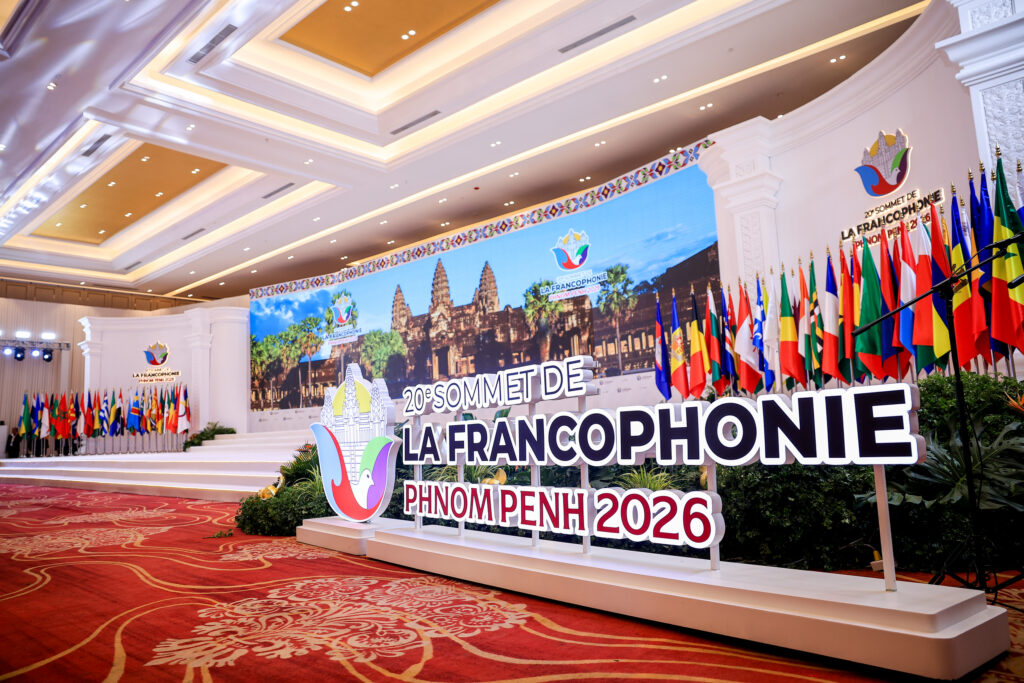
The 20th Summit of La Francophonie, held in Phnom Penh on 15 and 16 November 2026, was meant to renew the leadership of the International Organisation of La Francophonie. It ended instead in failure: member states were unable to agree on the choice of the next Secretary-General, or even on holding a vote to decide between the candidates.
To break the deadlock, the Cambodian presidency of the summit proposed a compromise: extending by twelve months the term of Louise Mushikiwabo, in office since 2019, and postponing the appointment of her successor until 2027. The decision, accepted by the heads of state and government, is a first in the history of the OIF. It averts an immediate rupture, but above all it exposes the difficulties of an organisation struggling to preserve its unity when national interests and regional conflicts intrude on its own decision-making mechanisms.
An election turned into a trial of strength between Kinshasa and Kigali
The main sticking point is the succession to Louise Mushikiwabo. The Rwandan Secretary-General, who has led the organisation since January 2019 and was reappointed in 2022, had been seeking a third term. That prospect ran up against opposition from the Democratic Republic of the Congo (DRC), which is locked in a diplomatic and military confrontation with Rwanda over the conflict in eastern Congo. Kinshasa had chosen to put forward Juliana Amato Lumumba, a former Congolese culture minister and the daughter of Patrice Emery Lumumba, the first prime minister of independent Congo and a historic figure of pan-Africanism.
Officially announced in February 2026, then presented by President Félix Tshisekedi to French-speaking ambassadors on 19 March, the candidacy carried significance that went far beyond the contest for an international post. It reflected the determination of the DRC, home to one of the largest French-speaking populations in the world, to strengthen its influence within an organisation in which it is a major demographic and cultural player. It also carried strong symbolic weight, drawing on the legacy of Patrice Lumumba, a figure of African independence and of the sovereignty of peoples.
But the candidacy soon found itself at the heart of the rivalry between the two Great Lakes countries. For Kinshasa, accepting Louise Mushikiwabo’s reappointment would have been hard to reconcile with its denunciation of Rwandan policy in eastern DRC. For Kigali, dropping its own national’s candidacy amounted to giving up an important instrument of its diplomatic influence. The negotiations thus went beyond the question of the OIF’s governance to become an extension of the political conflict between the two capitals.
France at the centre of the negotiations: mediation or influence diplomacy?
France has been no mere bystander in this crisis. As a founding member of La Francophonie and the organisation’s largest funder, Paris carries considerable political weight in the discussions. President Emmanuel Macron intervened directly with his Congolese and Rwandan counterparts in an attempt to find a negotiated way out. In particular, he called on both countries to favour consensus and to preserve the organisation’s unity.
But this French mediation was not interpreted in the same way by the parties involved. The Congolese Minister of Communication, Patrick Muyaya, defended Paris’s intervention, arguing that it helped to preserve the unity of La Francophonie. Conversely, the Rwandan Minister of Foreign Affairs, Olivier Nduhungirehe, accused France of putting pressure on certain member states to favour the candidacy of the former Romanian Prime Minister Dacian Cioloș.
These accusations, whose interpretation is disputed, illustrate how difficult it is for Paris to remain an arbiter in an organisation where its historical influence is sometimes viewed with suspicion.
France and Canada, the two largest financial contributors to the OIF, had nonetheless both called for unity. But their interventions failed to break the deadlock in the negotiations.
The affair exposes a fundamental contradiction: La Francophonie presents itself as a multilateral forum founded on equality among its members, yet financial and diplomatic power relations continue to weigh heavily on its decisions.
Four candidates, several visions for the future of La Francophonie
The contest was not limited to a duel between the DRC and Rwanda. Four figures were initially in the running:
- Louise Mushikiwabo, the outgoing Secretary-General, backed by Rwanda and seeking a third term;
- Juliana Amato Lumumba, a former Congolese minister and the DRC’s candidate;
- Dacian Cioloș, a former Romanian Prime Minister;
- Coumba Bâ, a former Mauritanian minister and special envoy to the OIF.
One of the most significant features of the negotiations was the flexibility Kinshasa eventually showed. According to Patrick Muyaya, the DRC had even said it was prepared to withdraw Juliana Lumumba’s candidacy to help build a consensus around Dacian Cioloș. However, the offer was not enough to break the deadlock. Rwanda, for its part, agreed not to field a candidate in the next election.
Juliana Lumumba’s candidacy nevertheless remains in the running for 2027, as do those of Dacian Cioloș and Coumba Bâ. Other candidates could also come forward. The Phnom Penh compromise therefore names no winner. It postpones the showdown and opens a new round of negotiations.
Electoral reform now essential
One of the most important aspects of this postponement concerns the rules for appointing the Secretary-General. Since 2022, the procedure has required member states first to seek a consensus. Failing that, a vote by simple majority of members present and voting may be held.
This provision, which was designed precisely to break a deadlock, was ultimately not used in Phnom Penh. Leaders preferred to avoid a vote that could have produced a contested victory and deepened divisions.
Several reform options are now on the table:
- Limiting the number of terms the Secretary-General may serve;
- Regional rotation in the allocation of the post;
- A move from a simple majority to an absolute majority for the election;
- Clarification of the arrangements for appointing and representing the various French-speaking regions.
These proposals are far from minor. They go to the heart of the organisation’s representativeness: how can an institution bringing together states with widely differing political, economic and demographic interests be sure of choosing a leadership that enjoys genuine collective legitimacy?
The extension of Louise Mushikiwabo’s term is intended precisely to pave the way for this reform. Member states will be able to submit amendments to her concerning the electoral procedure in force since 2022.
An organisation weakened by Africa’s crises
The crisis in Phnom Penh comes at a particularly delicate time for the OIF. The organisation officially has 92 states and governments, including 53 full members, five associate members and 34 observers. But its institutional weight should not obscure the political difficulties it is facing.
The withdrawal of Burkina Faso, Mali and Niger, which left the organisation in 2025, was already a significant setback. Their departures reflected, in particular, the deterioration in relations between several Sahelian regimes and international institutions, against a backdrop of growing challenges to French influence in Africa. The Congolese threat to leave the organisation in turn would have been a far greater shock. The DRC is indeed a major player in the French-speaking world, by virtue of both its population and its cultural and linguistic weight.
According to figures reported by AFP, it has some 57.3 million French speakers. Its departure would therefore have considerably weakened the OIF’s African representativeness and its legitimacy as an international organisation promoting the French language. The Phnom Penh compromise thus averted an existential crisis: a confrontation between two African states could have led to the departure of one of the organisation’s most important members.
It is telling, moreover, that the summit, held under the theme “Reinvesting in peace for shared prosperity and lasting stability”, was itself overtaken by the very tensions and conflicts it sought to help resolve.
La Francophonie: between an ideal of solidarity and geopolitical realities
Beyond the succession to Louise Mushikiwabo, the Phnom Penh summit raises a fundamental question: what kind of Francophonie do the member states want to build? The organisation was originally built around the French language, cultural and educational cooperation, political dialogue and solidarity between peoples. It gradually established itself as a forum for international consultation, engaging in particular on issues of democracy, peace, human rights and development.
The Phnom Penh final declaration reaffirms these ambitions. The leaders also adopted a resolution on crisis situations and peacebuilding, which refers in particular to the situation in the eastern DRC. But the gap between stated principles and diplomatic practice is now hard to ignore.
La Francophonie is riven by several fault lines: rivalries between African states, competition between powers, questions over the role of France, demands for a more balanced representation of the different regions and disagreements over the very concept of international solidarity.
The challenge is all the greater because French is no longer simply a language associated with its European history. It has become a language whose demographic and cultural future is being decided largely in Africa. African countries must therefore be able to carry more weight in the organisation’s political and institutional direction.
The next ordinary summit, scheduled to take place in Ottawa in 2028, will provide an opportunity to gauge the progress made. But the election of the Secretary-General, now expected in 2027, will be the first real test of member states’ ability to move beyond their rivalries.
2027: a fresh test for the organisation
The postponement of the election is therefore not merely an administrative interlude. It is a political warning. For the DRC, the challenge is to turn its demographic, cultural and linguistic weight into genuine diplomatic influence. For Rwanda, it is a matter of preserving its place in international institutions despite criticism linked to the conflict in the Great Lakes region. For France, the difficulty lies in retaining its capacity for influence without giving the impression that it wants to run an organisation that asserts the sovereign equality of its members.
As for the OIF, it must show that it can rise above the particular interests of its member states and once again become a genuine forum for dialogue and cooperation. The Phnom Penh compromise averted an immediate rupture, but it did not resolve the contradictions running through the organisation. Indeed, it laid bare the fragility of its decision-making mechanisms.
Can La Francophonie still claim to embody solidarity between peoples when rivalries between states take precedence over its shared ambitions?
The answer will depend less on the speeches delivered at forthcoming summits than on the ability of leaders to put the principles they proclaim into practice.
Sources
1. OIF – Official press release of 16 November 2026 : decision to extend Louise Mushikiwabo’s term of office, electoral reform and texts adopted in Phnom Penh. Closing of the 20th Summit of La Francophonie.
2. Le Monde – 16 November 2026 : analysis of the diplomatic tensions and the deadlock over the succession. 20th Summit of La Francophonie paralysed by diplomatic tensions.
3. RFI Afrique – 17 November 2026 : account of the behind-the-scenes negotiations, the positions of the Congolese and Rwandan ministers, reform proposals and the outlook for 2027. Election of the OIF Secretary-General postponed: tense negotiations and reforms pending.
4. AFP – 16 November 2026: French reactions, the DRC’s threat to withdraw and the potential consequences for the organisation. Francophonie: election of Secretary-General postponed by a year.
5. Actualité.cd – 16 November 2026: the Congolese reading of the compromise and an overview of the four candidacies. DRC presidency regards the Phnom Penh compromise as a positive outcome.
6. Presidency of the DRC – 19 March 2026: official presentation of Juliana Amato Lumumba’s candidacy. Official announcement of the Congolese candidacy.
Translated from French. The French original prevails.