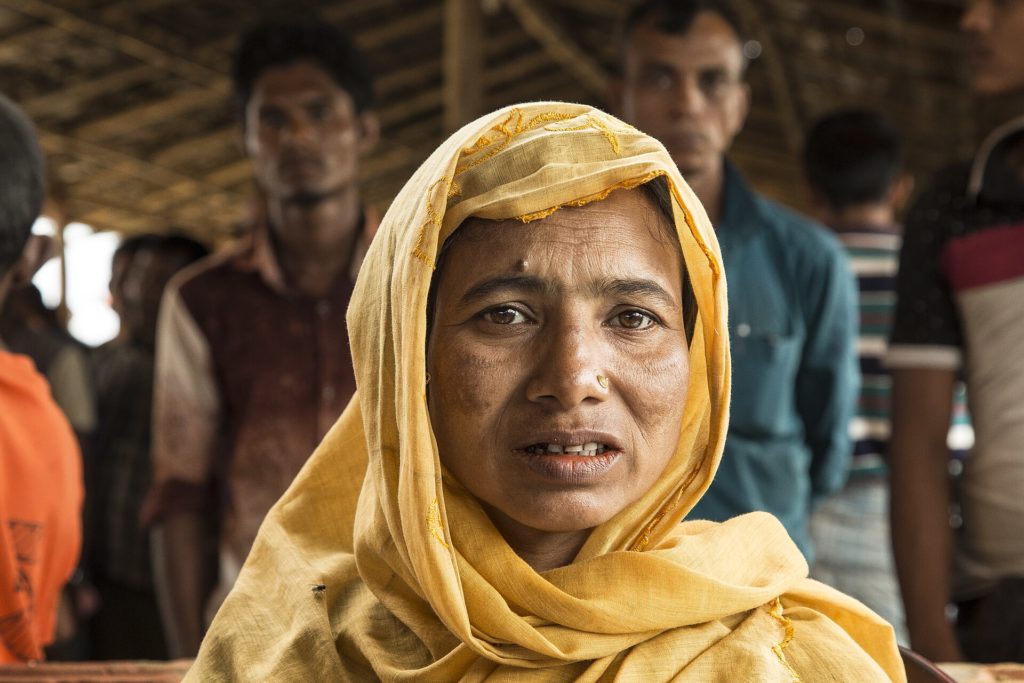
Fatema, 35, at the Kutupalong refugee camp. Credit: Anna Dubuis/DFID under CC.
The humanitarian crisis of the Rohingya people has been described by social scientists, political scientists and legal experts as a potential genocide, though it has not yet been confirmed as such by the International Court of Justice (ICJ). Yet in 2019 the Gambia filed a case over the massive human rights violations committed against this predominantly Muslim ethnic minority. It condemns a so-called “clearance” operation carried out by the Myanmar army in 2017, which constitutes a violation of the Genocide Convention and the 1998 Rome Statute of the International Criminal Court.
After the crackdown on pro-democracy protesters in 1988, the government of Burma, renamed Myanmar in 1989, which is predominantly Buddhist, refused to recognise the Rohingya as an ethnic group of the country. They have been stripped of their citizenship since 1982. Those living in Myanmar are confined to detention camps, ghettos and prison villages. Most Rohingya have been driven into a mass exodus by repeated acts of persecution, marked by massive human rights violations, and by the atrocities that the Myanmar army continues to inflict on them: the burning of villages and crops, executions, torture, sexual violence, enforced disappearances and the crime of apartheid.
Teams from the Office of the United Nations High Commissioner for Refugees (UNHCR) deployed in Asia interviewed 2,846 Rohingya refugees in the region’s six host countries – Bangladesh, India, Indonesia, Malaysia, Nepal and Thailand – which together host more than one million Rohingya refugees from Myanmar. A large majority (66%) say they want to return to live in Myanmar one day, despite the persecution and exclusion they have suffered. Most Rohingya refugees still feel deeply rooted in Myanmar (UNHCR, 2022). Nicholas Koumjian, head of the Independent Investigative Mechanism for Myanmar, summed up the security situation on 7 September 2026, at the 63rd regular session of the Human Rights Council: “All ethnic groups in Rakhine State have suffered from these crimes. Many Rohingya and other groups have been victims of aerial bombardment, artillery fire and obstruction of humanitarian aid. The Rohingya and other minorities caught between the combatants continue to take enormous risks to escape the violence. Since the beginning of 2024, more than 154,000 Rohingya have fled to Bangladesh, joining nearly one million others who cannot return home safely, as violence and insecurity persist in Rakhine State.”
The Rohingya journey in the past tense
This group of people, who had lived in Rakhine State since the 12th century, spoke a distinct language and identified themselves as Rohingya. In 1785, the kingdom of Rakhine came under the control of the kingdom of Burma. Burma lost the regions of Arakan and Ava after the First Anglo-Burmese War of 1824 to 1826, and in 1885 British colonisation completed the full annexation of Burmese territory, whose natural resources – chiefly oil, rubber and timber – the United Kingdom exploited. Buddhists accuse the Rohingya of having sided with the British during the Second World War rather than with the Japanese. This was the first rift and source of discord between the two communities. After Burma gained independence in 1948, many ethnic groups called for federalisation, while the Rohingya demanded unification with what was then East Pakistan, now Bangladesh, which constituted the second rift (Azeem, 2016).
Since the late 1950s, the Burmese army has entrenched itself at the helm of the state. A genuinely “praetorian” institution, it claims to be the indispensable actor in any decision-making process. Military intrusion into the political sphere has thus become the norm, and remains so today, notwithstanding the reforms that have been announced. Yet these military elites have never formed a monolithic bloc. Despite the prolonged dominance of two strongmen since independence in 1948 (Generals Ne Win and later Than Shwe), the army is divided into multiple rival factions and clans of officers (Egreteau, 2012).
The Rohingya Muslim minority has suffered systematic persecution and violations of its fundamental rights since Myanmar’s transition to military rule in 1962. The creation of Rakhine State under the junta’s 1974 constitution formalised the marginalisation of this ethnic group, effectively extinguishing any prospect of Muslim territorial autonomy. As a result, the Rohingya population has been subjected to forced displacement, and large refugee communities now live in Bangladesh, Malaysia, Thailand and other states in the region ( Iftekharul et al., 2026).
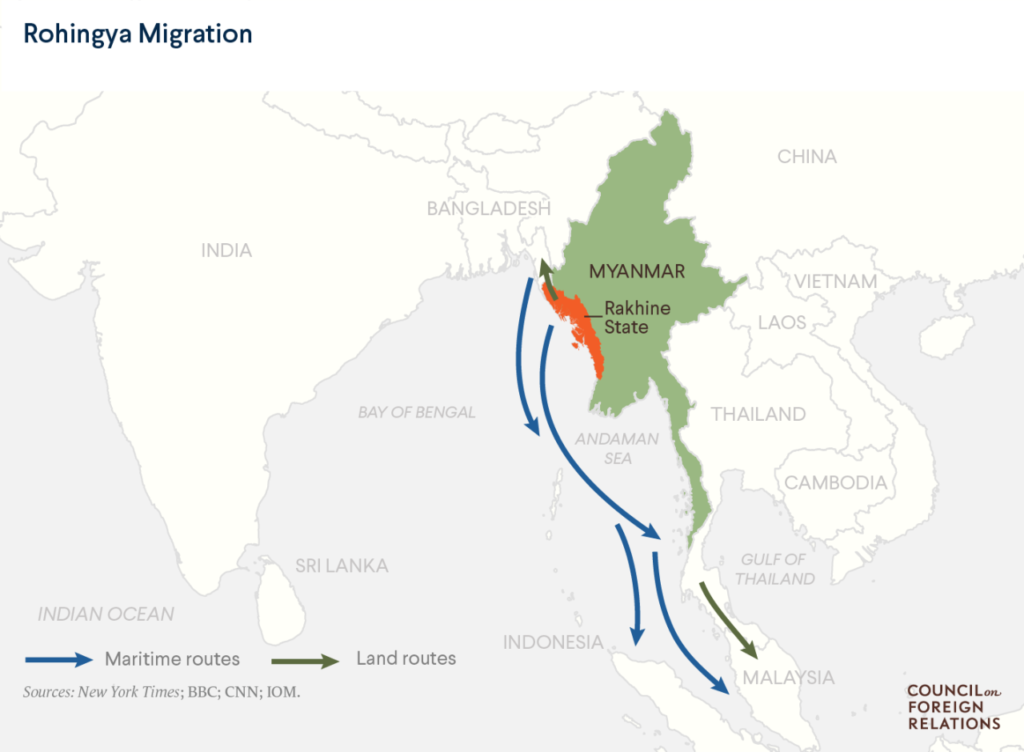
In 1978 the Burmese army launched the bloody Operation “King Dragon”, forcing some 250,000 Rohingya to flee Burma and seek refuge in Bangladesh (Azeem, 2016). More than one million Rohingya have been forcibly displaced during the army’s various military operations in 1978, 1991-1992, 2012 and 2017 ( Martuscelli et al., 2024). In 2017, 750,000 Rohingya fled the genocidal attacks carried out in Rakhine State during the ethnic cleansing operation conducted by the Burmese army.
An independent United Nations commission of inquiry confirmed in a report published in 2018 that, during this operation, some 100,000 Rohingya were killed in two months, 1,900 women and girls raped and 392 villages destroyed in Rakhine State. Bangladesh today hosts more than 1.3 million Rohingya refugees in 34 temporary refugee camps. There, survivors and victims of the genocide live with an atrocious past, a critical present and an extremely uncertain future (Nasir, 2026).
The recent escalation of violence in Myanmar’s Rakhine State began in October 2023, when the Arakan Army and two other armed groups launched a rebel counter-offensive that poses the greatest threat to the junta since the 2021 coup. Myanmar’s military responded by stepping up indiscriminate air strikes that kill, injure and displace civilians. The consequences for Rakhine State, still home to a large share of Myanmar’s 600,000 Rohingya, have been severe, with towns turned into battlefields (Amnesty, 2024).
When will the ICJ recognise the Rohingya genocide?
The ICJ hearings are under way, and the question of whether these events will be recognised or denied remains unanswered. Uncertainty over when the massacres will be recognised is causing anguish among Rohingya survivors in Bangladesh and other countries. Over time, the Rohingya genocide has become contested politically, legally, historically and socially. Denial and non-recognition are bound up with economic and strategic interests at every level. Acceptance or denial on the global stage often reflects geopolitical objectives rather than realities or the testimony of victims ( Nasir, 2026).
One of the questions raised by the crimes committed against the Rohingya is whether they constitute genocide. Establishing the specific intent to destroy a human group is what fundamentally distinguishes genocide from other international crimes. This notion of intent is what gives the term its distinctive character. Beyond intent, Daniel Feierstein describes the social dimension of genocide, which seeks to reorganise hegemonic social relations through the construction of a negative otherness; harassment, isolation, systematic weakening, material annihilation and the reification of human beings form the contours of the genocidal model.
This genocidal model can be found in South Africa’s application to the ICJ of 29 December 2023 concerning war crimes in Gaza, which refers to the “genocidal process”. Attacking the identity of a human group and trying to erase its culture are part of the genocidal process. Socio-political studies of refugees show that refugees continue to lose their collective identity in their host countries, and sometimes in their own country, as the example of the Rohingya demonstrates. “The Appeals Chamber of the International Criminal Tribunal for the former Yugoslavia expressly noted that the aim of the perpetrators of genocide is to ‘deprive humanity of the manifold richness its nationalities, races, ethnicities and religions provide’; in other words, it is the group as a cultural concept, a social structure, that the perpetrators of genocide seek to eliminate” (O’Brien and Hoffstaedter, 2020).
The expert declaration of 18 November 2025 submitted to the International Court of Justice by Professor Newton M.A, a retired US Army lieutenant colonel, sets out the notion of intent to destroy the Rohingya people : “The only reasonable conclusion to be drawn from the evidence is that the ‘clearance operations’ conducted by Myanmar cannot reasonably be explained or understood as counter-terrorism operations, since they violated every fundamental principle of counter-terrorism strategy and practice, including Myanmar’s own. The evidence shows that these operations were designed, coordinated and carried out with the intention of inflicting maximum harm on the civilian population. They can only reasonably be explained and understood as an organised and determined effort by the Tatmadaw to annihilate the Rohingya people as a group in Myanmar ” (Newton, 2025).
What stands out in the handling of the Rohingya genocide is that more is said about the victims than about the perpetrators of the crimes. Most Rohingya are Muslim, others Christian and Hindu, but the problem underlying the Rohingya crisis is not religion as such, but the political exploitation of religion by ultranationalist Buddhists who manipulate Buddhist monks. The crux of the problem lies in this far-right Buddhist political party, bearing in mind that Myanmar’s constitution prohibits inter-religious or inter-ethnic conflict.
The role of diplomacy in a political settlement
Since taking office in 2021, Myanmar’s President Min Aung Hlaing has pledged to bring about peace. On 27 August 2026 he set up a new advisory body to support the National Solidarity and Peacemaking Negotiation Committee. The new body is tasked with drawing up recommendations for implementing the Nationwide Ceasefire Agreement and identifying the stakeholders to be involved in the peace process, as well as liaising with the various ethnic armed organisations, civil society and national and international experts ( Irrawaddy, 2026).
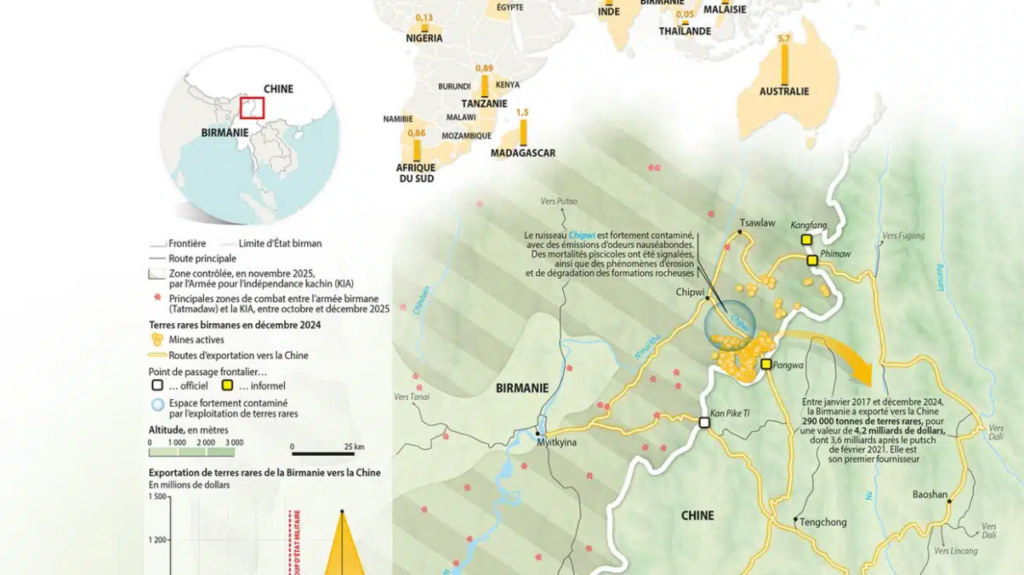
Over the past eight years (2017 to 2024), Myanmar has become China’s main supplier of rare earths, with the total value of Myanmar’s exports exceeding US$4 billion […], thereby becoming a major driver of environmental degradation, social harm and geopolitical tension. Rare earth resources, essential to the global supply chains needed for the energy transition, have become a crucial focus of exploitation, particularly in conflict-affected regions. The environmental impacts of rare earth mining, exacerbated by inadequate regulation and oversight, are devastating ecosystems and local communities. At the same time, competition for mining areas is fuelling armed conflict, heightening environmental and social instability (ISPMyanmar, 2025).
It would be worthwhile to seize this opportunity and use energy resources as a diplomatic asset during President Aung Hlaing’s many trips abroad in order to strengthen bilateral relations, particularly with the two neighbouring powers and BRICS members – China and India – which can play a constructive and proactive role through the development of economic and security relations with partners in regional organisations, including the Shanghai Cooperation Organisation (SCO) and the Association of Southeast Asian Nations (ASEAN). The emergence of a multipolar world could breathe new life into the peaceful settlement of conflicts and the establishment of a new international order that ensures respect for the work of international justice.
We conclude our analysis with Aurélie Devos’s remark on the civilisational dimension of the notion of crimes against humanity : “In the light of the trial of Klaus Barbie in Lyon, this phrase by Hemingway, translated on the memorial dedicated to the children of Izieu, was often quoted: ‘Every man is a piece of the continent. A part of the whole. Any man’s death diminishes me, because I am involved in mankind.’ As Prosecutor General Pierre Truche had urged, has the notion of crimes against humanity truly entered our civilisation?” (Devos, 2014). The loss of essential knowledge over millennia, long before the milestone of the Cyrus Cylinder, has complicated our understanding of human history. It is time for humanity to learn the lessons of its past.
References
- Amnesty International. Myanmar/Bangladesh: Rohingya community facing gravest threats since 2017. 24 October 2024. https://www.amnesty.org/fr/latest/news/2024/10/myanmar-bangladesh-rohingya-community-facing-gravest-threats-since-2017/
- Azeem, I. The Rohingyas: Inside Myanmar’s Hidden Genocide. London: Hurst Publishers, 2016. 256 pp. ISBN: 9781849046237 DOI: 10.1177/2347797018023978 https://www.academia.edu/104387740/Azeem_Ibrahim_The_Rohingyas_Inside_Myanmar_s_Hidden_Genocide?rhid=42328191323&swp=rr-rw-wc-32577187&nav_from=dfccc188-ffa4-4f49-bf3e-97d2ddc47c68
- Devos, A. Judging the past in the present: a promise for the future? Les Cahiers de la Justice. 2014; 4(4): pp. 553-563. https://doi.org/10.3917/cdlj.1404.0553.
- Egreteau, R. Burma: the granted transition. Etudes. 2012; 3, vol. 416, Editions SER: pp. 295-305 ISSN: 0014-1941 DOI: 10.3917/etu.4163.0295
- Iftekharul, A.K.M. Thowhidul M.D. Shamsuzzoha, A.T.M. et al., After Humanitarism: A comparative Study of the Muslim world’s Rohingya Policy. Journal of Muslim Philanthropy and Civil Society. 2026; V.X/Issue I: pp. 4-25
- Irrawaddy. Min Aung Hlaing revives Thein Sein-era team for new peace push. 2026. 10 September 2026. https://www.irrawaddy.com/news/burma/min-aung-hlaing-revives-thein-sein-era-team-for-new-peace-push.html
- ISPMyanmar. Unearthing the cost: rare earth mining in Myanmar’s war-torn regions. 2025. Accessed 10.06.2025. https://ispmyanmar.com/unearthing-the-cost-rare-earth-mining-in-myanmars-war-torn-regions/
- Koumjian, N. Head of the Independent Investigative Mechanism for Myanmar. Statement to the 63rd regular session of the Human Rights Council. 2026. 7 September 2026. https://iimm.un.org/en/statement-63rd-regular-session-human-rights-council
- Martuscelli, PN. Bayes, A. and Sammonds, P. Resisting genocide in Myanmar: Rohingya narratives of everyday resistance. Journal of Genocide Research. 2024; 26(1): pp 25-47. https://doi.org/10.1080/14623528.2022.2078074
- Nasir, U. Palash, K. and Bayes, A. Politics of Denial and Non – Recognition of Genocide: The case of the Rohingya. Palgrave Macmillan. 2026. 505pp. ISBN: 978-981-92-2765-5 https://doi.org/10.1007/978-981-92-2766-2
- Newton, Michael A., Lieutenant Colonel (retired), US Army, Professor of the Practice of Law, Director of the International Legal Studies Program at Vanderbilt University Law School. Written statement by Professor Michael A. Newton to the ICJ. 18 November 2025. https://icj-cij.org/case/178
- O’Brien, M. and Hoffstaedter, G. “There we are nobody, here we are nobody!”: The enduring effects of the Rohingya genocide. Soc. Sci. 2020; 9(11), 209, 16 November 2020. https://doi.org/10.3390/socsci 9110209
- UNHCR. 2022, Rohingya Refugees for Myanmar: A Regional Perspective, Regional Bureau for Asia and the Pacific. 17 March 2022. https://data.unhcr.org/en/documents/details/91422
Translated from French. The French original prevails.