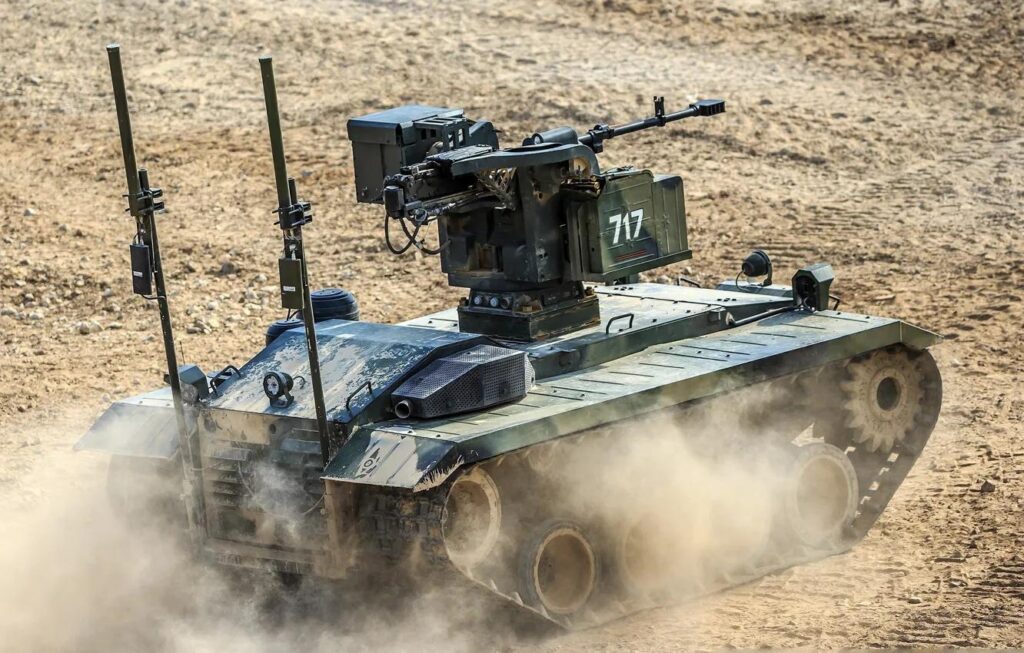
The Russian Nerekhta military ground robot. CC
States developing autonomous weapons want to go on setting the limits of their use themselves. Those that could one day be their victims are demanding binding rules now.
The failure of the Geneva talks to launch immediate negotiations on legally binding rules governing autonomous weapons is far more than another setback for arms control. It exposes a struggle over the fundamental question of who will define the acceptable limits of machine-driven warfare: the states developing these technologies, or a wider international community increasingly exposed to their consequences.
The Seventh Review Conference of the Convention on Certain Conventional Weapons (CCW) ended on 21 November with a compromise. States will prepare an instrument on autonomous weapons during 2027 and 2028, but whether it will be legally binding will be decided only once negotiations have concluded.
The outcome neither legalised autonomous lethal operations nor delivered the clear, immediate mandate for a binding treaty that most states wanted. Work on new rules will continue, without any prior commitment as to whether they will be enforceable. The central question therefore remains unanswered: which decisions on the use of lethal force must, without exception, remain under effective human control?
Adopted in 1980 and in force since 1983, the Convention on Certain Conventional Weapons is the international framework for prohibiting or restricting weapons that cause excessive injury or have indiscriminate effects. Its protocols cover several specific categories, including mines, incendiary weapons, blinding lasers and explosive remnants of war.
Autonomous weapons have been debated within it for more than ten years, and the pressure to reach an outcome has intensified. The United Nations Secretary-General and the International Committee of the Red Cross (ICRC) have urged states to conclude a treaty by 2026, while a large majority of UN members have come out in favour of action.
What was proposed in Geneva was not a ready-made ban. It was a mandate to negotiate a legally binding instrument that would prohibit certain autonomous systems, regulate others and ensure that human judgement and control are retained in the use of force. But the Convention operates by consensus, which gives every state the power to block progress.
Most states were in favour of opening negotiations on binding rules. However, the consensus requirement prevented the adoption of a clear and immediate mandate.
Russia leads the opposition
Russia was the most visible opponent. It rejected any commitment to a process leading to a legally binding treaty and called for references to such an instrument to be deleted. It also raised procedural objections to the participation of observers, including the European Union and civil society organisations, thereby disrupting the formal proceedings at the start of the conference.
The United States preferred to continue discussions towards a non-binding instrument and proposed five more years of debate. Its argument rests on the view that existing international humanitarian law already provides the necessary framework, and that new treaty obligations are therefore not essential.
Israel, the United Kingdom and Belarus also expressed reservations about committing to a legally binding treaty. Their positions are not, however, identical in every respect, nor do they mean that these countries reject all forms of regulation.
Switzerland, which chaired the conference, welcomed the agreement to begin drafting an instrument as a step forward, while acknowledging that most states had wanted a mandate for a binding instrument and that the consensus rule had prevented its adoption.
The convergence of these different positions should not be read as a strategic alliance. Rather, it reflects shared interests in preserving military room for manoeuvre. Their respective geopolitical rivalries do not erase a common reluctance to let international negotiations restrict military capabilities before their value on the battlefield has even been demonstrated.
The fairest reading of the outcome, therefore, is that the door to an agreement remains open, but that the decision on whether it will be binding has been postponed. For the Swiss presidency, this represents procedural progress. For the ICRC, it is a failure to launch clear and urgent legal negotiations.
For technologically advanced states, this delay keeps options open. For states without comparable capabilities, it prolongs uncertainty. As for the civilian populations likely to be exposed to these systems, it postpones safeguards that they have very little means of negotiating.
The strategic value of delay
Autonomous weapons are not synonymous with drones or military artificial intelligence. The decisive question is whether a system, once activated, can select targets and use force without further human intervention.
A remotely piloted aircraft is not autonomous simply because there is no one on board. Likewise, software that recommends targets does not necessarily control the decision to fire.
These distinctions matter, because imprecise terminology feeds two opposing distortions of the debate: equating every military algorithm with a “killer robot”, or presenting considerable transfers of power from humans to machines as mere technical improvements.
The debate is not about a general ban on military innovation. The ICRC advocates prohibiting unpredictable autonomous weapons and systems designed or used to target people directly. It recommends regulating other systems by limiting their targets, their duration of operation, their geographical scope and the scale of their use.
In this context, delay has strategic value. Once these capabilities are built into procurement programmes, training and operational doctrines, restrictions become institutionally and financially harder to accept.
This does not mean that every call for further discussion amounts to obstruction. Definitions must be precise, and unrealistic obligations could jeopardise implementation. But negotiations cannot be judged in isolation from their effects. A protracted process can keep diplomatic dialogue going while the very practices under discussion gradually become entrenched.
The danger is that states end up negotiating around capabilities they already possess, instead of setting limits on them before they shape military expectations.
Restraint at home, freedom of action abroad
Opposing a treaty does not necessarily mean rejecting all safeguards. A US Department of Defense directive adopted in 2023 requires autonomous and semi-autonomous weapons to allow “appropriate levels of human judgment” to be maintained over the use of force, while also imposing testing and safety requirements.
The geopolitical question is who decides what is appropriate.
National regulation leaves the interpretation, assessment and revision of the rules largely in the hands of the state that builds and uses the weapon. International law, by contrast, seeks to establish obligations that cannot be altered to suit national operational preferences.
This is where the real dispute over sovereignty lies, behind the technical language. A state may claim freedom of decision over its own weapons, but their effects cross borders, and those who bear the consequences have no say in defining what risks are acceptable.
Russia’s role in Geneva exposed another dimension of power: the ability to determine whether substantive negotiations can even take place. Moscow intervened on substance, demanding the removal of references to a binding treaty, but also on procedure, by objecting to the presence of observers. Institutional rules can thus become instruments of pressure.
Consensus can help keep states whose military capabilities are essential at the table. But when their participation depends on the absence of meaningful obligations, the mechanism protects the right of veto more than it does collective security.
Moving the negotiations to another forum is not an automatic solution. A treaty drawn up without the major military powers could establish valuable norms, but it would struggle to influence their behaviour.
The choice, therefore, is not simply one of consensus versus ambition. It is a matter of striking a balance between the legal force of the rules, the participation of states and their practical influence.
The coming competition
In the short term, it would be going too far to attribute any identifiable increase in military spending to the outcome in Geneva. Its immediate consequence is more limited: the loss of an opportunity to launch an urgent, legally binding negotiating process.
Persistent uncertainty may nonetheless fuel military competition. The development of autonomous systems could advance through the successive transfer of functions to machines — navigation, classification, prioritisation and target engagement — rather than through a sudden shift to fully autonomous warfare.
Each step may seem limited, but taken together they risk significantly eroding human control.
A second competitive cycle links offensive systems to increasingly automated defences. US Department of Defense assessments anticipate the development of uncrewed systems that are more capable, more affordable, autonomous and interconnected. They warn of their potential consequences for deterrence and the risks of escalation.
Uncrewed systems are a broader category than lethal autonomous weapons, but their development illustrates the pressures shaping military procurement policy.
If the proliferation of fast-moving threats demands ever faster defensive responses, speed itself becomes a requirement in weapons programmes. States can then justify greater automation by pointing to the shorter reaction times imposed on them by their adversaries’ automation.
In the longer term, this trend risks destabilising crisis management. Faster detection and engagement offer tactical advantages, but reduce the time available to verify an incident, interpret an adversary’s intentions or halt a confrontation already under way.
The risk is not that machines will start wars on their own. It is that human authorities will become less and less able to interrupt interactions whose speed and complexity exceed their capacity for oversight.
The ICRC’s emphasis on predictability, the possibility of human intervention and the deactivation of systems addresses precisely this problem: retaining control over operations.
Proliferation poses a distinct challenge. Wider access to less sophisticated capabilities could coexist with the continued dominance of the most advanced states in systems integration, sensors and testing.
The spread of these technologies will therefore not necessarily lead to military parity. On the contrary, it could widen exposure to risk while preserving existing hierarchies of capability.
Accountability beyond the human signature
Perhaps one of the most misleading assurances is the claim that a human will always remain “in the loop”. Formal authorisation does not necessarily mean that effective control exists. An operator may have the power to authorise a strike without having sufficient information, understanding or time to exercise genuinely independent judgement.
A truly meaningful standard must therefore answer several questions: what does the person supervising the system know? What capacity do they have to intervene? Can they intervene before the harm becomes irreversible? Existing international humanitarian law remains applicable. Autonomous weapons do not create a legal vacuum, and technical precision is not enough to make an attack lawful. Correctly identifying an object does not, on its own, determine whether it constitutes a military objective, whether an attack is proportionate or whether the necessary precautions have been taken.
Nor can responsibility be transferred to an algorithm. States and individuals remain accountable for violations of the law. The practical difficulty lies in reconstructing decisions spread across the design, programming, mission planning, activation and supervision of the system. A credible agreement must therefore go beyond a mere commitment to “responsible use”. It must turn restraint into precise prohibitions, operational limits and requirements that allow for effective oversight. Otherwise, overly loose wording could legitimise existing practices without genuinely changing them.
The fundamental lesson from Geneva is that technology does not, on its own, hold back the development of law. Political choices do. The decisive question now is whether states will manage to agree on common limits before military investment makes negotiating them harder, and whether the countries developing these systems will accept that defining acceptable risk is not theirs alone.
Translated from French. The French original prevails.