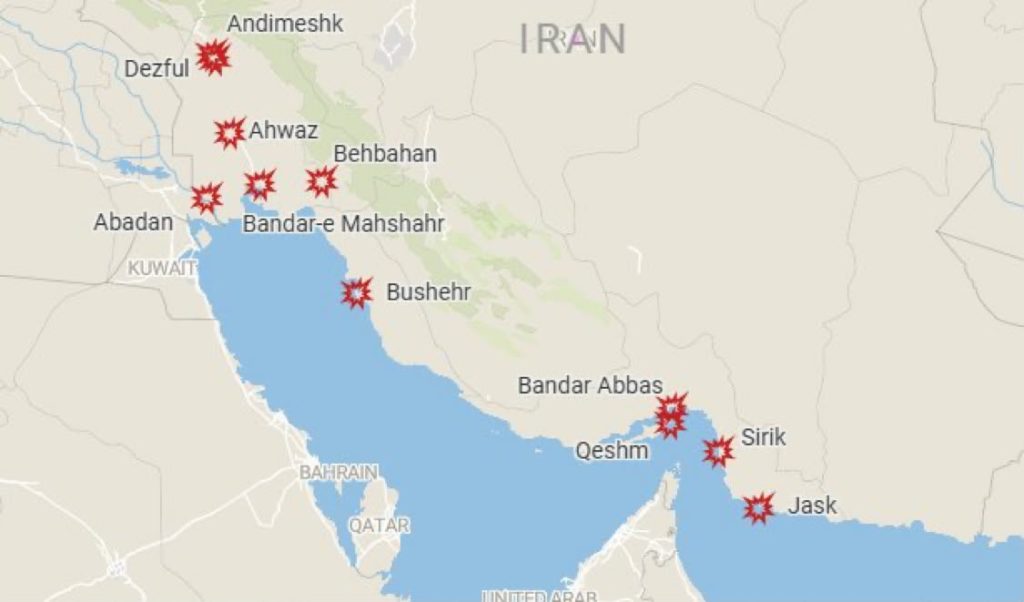
Map of the main areas of reported strikes along Iran’s coastline. Source: document provided by the author.
The resumption of US strikes on Iranian military capabilities and Tehran’s retaliation against states hosting US forces mark a strategic turning point. The dispute is no longer solely about Iran’s nuclear programme, but about political, military and commercial control of the Strait of Hormuz. Behind the military operations, what is now at stake is who defines the security rules for the world’s main energy corridor.
For a few weeks, Washington and Tehran kept up the illusion of a diplomatic process. The memorandum signed on 17 June was meant to allow the Strait of Hormuz to reopen, temporarily secure commercial shipping and pave the way for a resumption of negotiations. But the text rested on a fundamental ambiguity: the two sides had never agreed on the same definition of freedom of navigation.
For Washington, the strait was to remain an international shipping lane open to all vessels, free of any prior control by Iran. For Tehran, reopening the passage did not mean relinquishing its dominant role. The Islamic Republic intended to retain the power to determine which routes were permitted, to impose security procedures and, in time, to secure implicit recognition of its authority over navigation. This contradiction was not resolved. It was merely postponed.
A US campaign focused on Hormuz
The American strikes carried out since the beginning of July now make the objective very clear. US Central Command says it has targeted Iranian air defences, coastal radars, missile and drone installations and the fast attack boats of the Revolutionary Guards. The areas bombed stretch from Khuzestan to Bandar Abbas, Qeshm, Sirik and Jask, along the entire coastline linking the Persian Gulf to the Gulf of Oman.
It is therefore no longer simply a matter of retaliating for an attack on a merchant vessel or destroying a few isolated military capabilities. The United States is now seeking to neutralise the entire architecture that allows Tehran to exert pressure on Hormuz: maritime traffic surveillance, anti-ship missiles, drones, fast attack boats, radars and coastal defences.
The phrase used by Washington — “Iran does not control the strait” — is in fact as much a political statement as a military one. It means that the United States rejects not only any blockade of Hormuz, but also any form of de facto Iranian sovereignty over how it operates.
Iran’s retaliation goes regional
Tehran has responded by widening the theatre of the confrontation. The Revolutionary Guards have claimed strikes against US installations, or installations linked to the US military presence, in several countries across the region.
In Kuwait, the Ali Al-Salem and Ahmad Al-Jaber bases were targeted. The country reported several interceptions of missiles and drones. A few days earlier, an offshore oil platform and several border posts between Kuwait and Iraq had already been hit.
In Bahrain, Iran is directly targeting one of the main hubs of the US naval presence in the Gulf: the 5th Fleet and its command infrastructure. Air-raid sirens have sounded repeatedly, underlining the vulnerability of a state that has for decades been one of the pillars of the US military presence in the region.
In Qatar, the threats or attacks against installations linked to the US military presence send a particularly strong political signal. Doha hosts Al-Udeid air base, the main US air hub in the Middle East, while remaining one of the principal mediators between Washington and Tehran. By indirectly targeting Qatar, Iran is putting pressure on a strategic ally of the United States while undermining one of the few channels of dialogue still open between the two adversaries.
In Jordan, several Iranian missiles entered the kingdom’s airspace before being intercepted. Tehran says it targeted a base used by the US military presence.
The United Arab Emirates remains particularly exposed because of its strategic importance, its energy and maritime infrastructure, and its military cooperation with Washington. However, no direct strike on the Emirates has been confirmed during the latest clashes.
In Oman, several incidents have affected the maritime environment of a country that had until now played a central role as a mediator between Washington and Tehran. This development is all the more significant in that it comes after the failure of direct talks on the future arrangements for navigation in the Strait of Hormuz. Muscat has made it clear to Iranian officials that it opposes the introduction of any transit fee and any regulation that runs counter to international rules of navigation. Oman is thus defending freedom of navigation and refuses to accept that a coastal state could unilaterally impose its own rules in the strait.
Turkey must also be mentioned. It has not been targeted militarily. However, the Iranian Ministry of Foreign Affairs issued it with an unusually stern warning, calling on it to avoid any statement that could be used against Iranian interests. This warning goes far beyond a mere diplomatic reaction. It reflects Tehran’s growing concern over Ankara’s expanding regional influence.
This warning shows that, for Tehran, the confrontation is no longer confined to the Gulf states alone, but now extends to regional powers capable of influencing the new balance of power in the Middle East. Iran’s response follows a simple logic: any territory used by US forces can become a target.
This doctrine now confronts the Gulf states with a stark choice: limit their military cooperation with Washington or accept that their bases, their strategic infrastructure and at times their own territory will be drawn into the battlefield.
The Iranian paradox
Yet Iran’s strategy contains a major contradiction. Tehran is seeking to intimidate the Gulf countries into distancing themselves from Washington. But by striking them, it risks instead pushing them even closer to the United States.
Kuwait, Qatar, Oman and the United Arab Emirates had until now taken differing approaches towards Iran. Some favoured dialogue. Others strove to strike a balance between their partnerships with Washington and their relations with Tehran. The Iranian strikes have abruptly called all these strategies into question.
The more the threat is perceived as collective, the greater the incentive for the Gulf states to strengthen joint air defence systems, intelligence sharing, naval cooperation and their coordination with US command. Tehran could thus achieve the opposite of the effect it intended: not the withdrawal of the United States, but the lasting entrenchment of its military presence in the Gulf.
Diplomacy is also a weapon
The recent statement by the Iranian Ministry of Foreign Affairs nevertheless shows that Tehran is not entirely shutting the door on mediators. Iran says it is maintaining contacts with Qatar, Oman and Pakistan, while accusing Washington of continuing to destabilise the region through its plan to escort ships through the strait.
This duality is crucial. Iran is not choosing between war and diplomacy. It is using both at once. The missiles are meant to strengthen Iran’s hand. The mediators are then meant to turn that leverage into political concessions. The method is a long-standing one in Iranian strategy: create a crisis, control its intensity as far as possible, then negotiate on the strength of the danger it poses to others.
This time, however, the mechanism appears far more unstable. US strikes are directly hitting Iran’s means of maritime pressure, while Tehran’s retaliation is drawing in a growing number of countries. Each new strike now heightens the risk of an escalation that neither Washington nor Tehran would then be able to contain.
Oman: the mediator becomes a party to the dispute
Muscat has not merely passed messages between Washington and Tehran. A direct meeting between Iranian and Omani officials addressed the future of shipping in the Strait of Hormuz. It ended in failure. Iran intended to retain a leading role in organising the sea passage, notably through a route placed under its surveillance.
Oman, by contrast, championed freedom of navigation for ships, without transit fees and in accordance with international rules of navigation. The disagreement shows that the conflict is no longer just about reopening the strait, but about how it will be administered in future.
For Tehran, accepting the Omani proposal would mean giving up one of its main instruments of power. For Muscat, accepting the Iranian arrangement would enshrine de facto Iranian tutelage over a passage on which Oman also has a coastline.
The failure of the meeting therefore marks a turning point. Oman remains a diplomatic channel, but it is no longer a mediator entirely outside the dispute. It is now defending its own territorial, maritime and commercial interests in the face of Iranian ambitions.
This shift shows that diplomatic failure preceded military escalation. It also helps explain why Oman, until then shielded by its role as mediator, ended up being directly targeted.
Turkey: a warning that goes beyond words
Tehran’s warning to Turkey does not appear to be a mere statement for the occasion. It reflects growing mistrust of a power that is already benefiting from Iran’s regional retreat. The first source of irritation for Tehran lies in the close relationship between Recep Tayyip Erdoğan and Donald Trump. The political closeness between the two presidents gives Ankara privileged access to Washington at a time when the new balance of power in the Middle East is being discussed.
The second lies in Turkey’s growing influence in Syria. Since the fall of Bashar al-Assad’s regime, Ankara has established itself as one of the main players in the country’s political and security reshaping, automatically reducing the strategic depth that Iran had enjoyed until then.
Tehran has lost some of its strategic depth in the Levant. Turkey’s growing power in Syria, the difficulties facing its regional allies and the challenges to its influence in several countries now force it to defend its interests more directly.
Against this backdrop, the Strait of Hormuz takes on even greater importance. As Iranian influence recedes in certain theatres, its ability to exert pressure on this shipping lane is becoming one of its main levers of power.
Finally, there is an energy dimension directly linked to the Strait of Hormuz. Turkey could play a major role in developing new energy corridors linking the Gulf, the Mediterranean and Europe. In the longer term, these projects could reduce international markets’ dependence on the Strait of Hormuz and, with it, part of the strategic leverage Iran currently enjoys. The Iranian warning therefore takes on a much broader meaning.
Tehran sees a worrying combination taking shape around Turkey: closeness to Washington, dominant influence in Syria and possible participation in energy corridors bypassing Hormuz. Even though Ankara continues to condemn Israeli operations and says it wants to avoid a regional escalation, Iran fears that it is, in effect, contributing to the weakening of its position.
The warning to Ankara thus goes far beyond a mere diplomatic protest. It reveals Tehran’s concerns about a Turkey whose political, military and energy influence could, in time, durably alter the strategic balance of the Middle East.
Hormuz, the new centre of gravity
The war is no longer solely about Iran’s nuclear programme. What is really at stake now goes beyond mere freedom of navigation. The question is who will set the rules of security and authority over the world’s most important energy chokepoint. Hormuz has thus become far more than just a strait. It now brings together military, energy, commercial, diplomatic and legal stakes that extend well beyond the Gulf.
Every decision taken over this waterway is liable to affect energy markets, trade routes, regional balances and, more broadly, the balance of power between the major powers.
The mediators remain active, but they no longer set the pace of events. It is now the military balance of power that shapes the negotiations. The war began over Iran’s nuclear programme. It now continues over control of Hormuz.
Also on La Tribune des Nations
• Nuclear programme, Hormuz: Tehran and Washington do not speak the same language
• Oman: neutrality as a power strategy shaped by history and Ibadism
• Gulf states under pressure: an impossible balance between war and mediation
External references
• U.S. Central Command: press releases and updates on operations in the region
• U.S. Energy Information Administration: the importance of Hormuz for global oil and LNG flows
Translated from French. The French original prevails.