Riyadh-backed forces are abandoning positions near Bab el-Mandeb to defend Aden. Six weeks of counter-offensive have failed to secure the roads and the high ground. The setback threatens the Yemeni government’s temporary seat, but also the security of a sea passage on which trade between Asia and Europe depends.
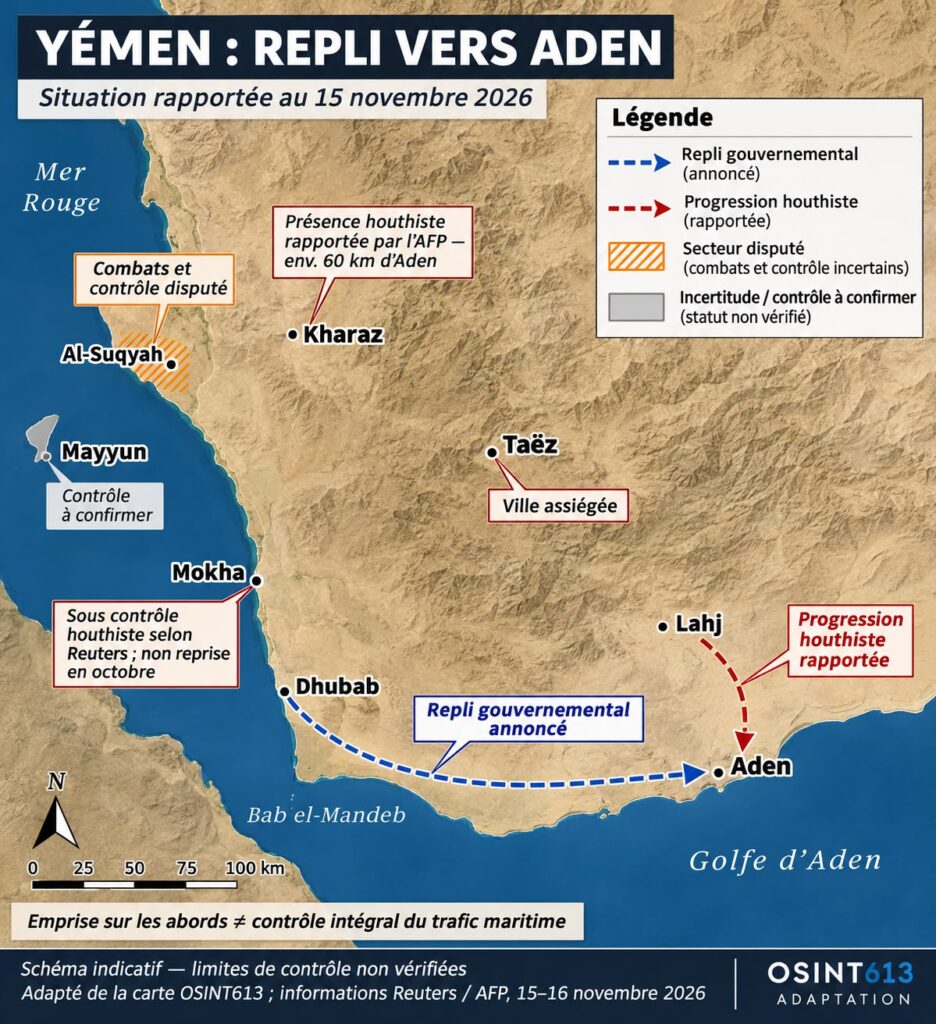
In Aden, defenders are laying sandbags and digging tunnels. According to military and government sources quoted by AFP, the Houthis have reached the Al-Kharaz area, around 60 kilometres from the city. On 15 November, forces from the government camp announced their withdrawal from Dhubab military airport and the Bab el-Mandeb area in order to protect Aden and the neighbouring provinces. The counter-offensive launched in October was meant to retake the coast; those taking part in it must now defend their rear. [1][7]
The stakes go beyond the fate of a single city. Bab el-Mandeb links the Indian Ocean, via the Gulf of Aden, to the Red Sea and then the Suez Canal. A deterioration in its security can force ships travelling between Asia and Europe to make the detour around Africa. The battle for Lahj, the province lying between the strait and Aden, therefore concerns economies far beyond Yemen. [12]
In our analysis of 9 October, we already drew a distinction between recapturing the coast and controlling the roads and high ground towards Taiz. Tactical gains could coexist with strategic vulnerability. The reversal in November shows that this threat has not been averted. [2]
From local advances to a threat to the rear
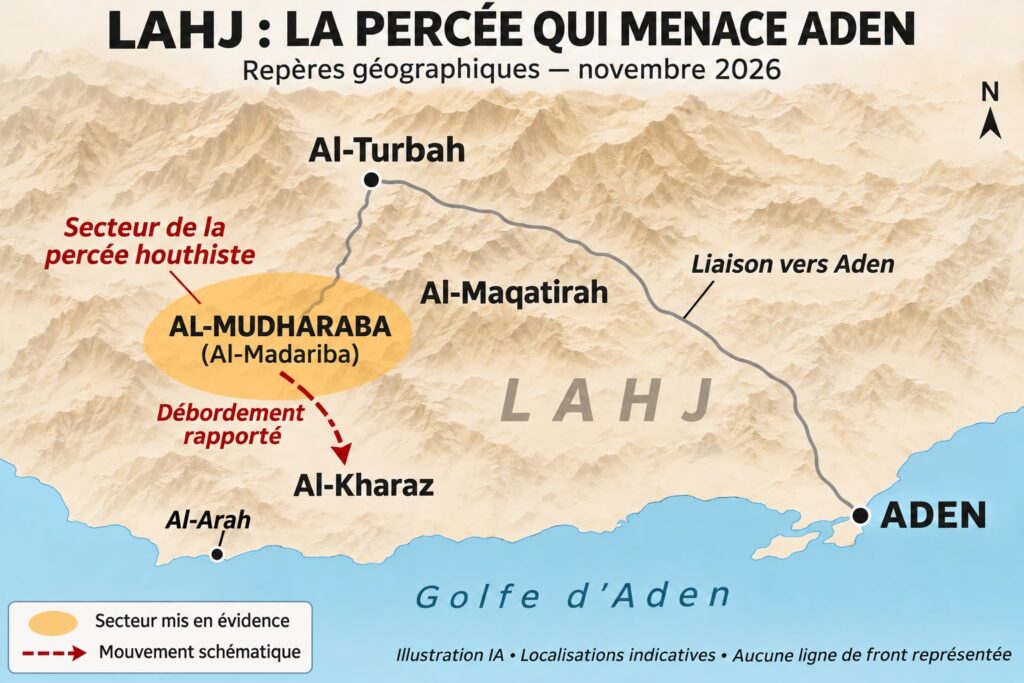
As recently as 4 November, news from the front had raised hopes that government forces were consolidating their hold. Asharq Al-Awsat, citing sources in the government camp, reported that positions had been retaken in Al-Maqatirah, north of Lahj. The Giants Brigades and the Nation’s Shield announced the capture of high ground overlooking part of the Aden–Al-Turbah road. The report nevertheless noted Houthi infiltrations and continued fighting near Al-Mudharaba. [3]
These successes did not mean the sector had been secured. According to three military sources interviewed by Yemen Monitor, on 10 November the Houthis launched an outflanking manoeuvre in Al-Mudharaba, threatening the lines of communication of units deployed in Dhubab, Kahboub, Al-Wazi’iyah and around Bab el-Mandeb. On this reading of events, the withdrawal was driven by the need to save these forces from the risk of being cut off by repositioning them further east. [4]
Critical Threats describes forces stretched too thinly between two roads: Mokha–Aden on the coast and Taiz–Aden inland. The Houthis are said to have exploited the poorly defended gaps between these routes to threaten the government rear. There was therefore no need to take each position head-on: endangering its supply lines could be enough to force its defenders to fall back. [5]
Giants among the forces pulling back
The “government forces” do not form a unified army. The Giants Brigades, a formation drawn mainly from the south of the country, have announced their redeployment from Dhubab and Bab el-Mandeb. Yemen Monitor also cites the Riyadh-backed Nation’s Shield, the Southern Resistance and the Zaranik brigades, which emerged from the Tihama resistance on the west coast. These units are repositioning between Khor Umayrah and Aden. [4][6]
Not all of them are therefore entering the city: some are defending its western approaches. Tarek Saleh’s National Resistance was also taking part in the fighting in the sector in early November, but it has not been established that all of its forces are moving towards Aden. [3]
On 18 November, Arabi21 reported, citing an anonymous Yemeni official, that commanders from these forces had arrived in Ataq, in Shabwa, to prepare for their regrouping. The number of troops transferred and their mission have yet to be confirmed. [20]
The coexistence of formations with differing political priorities and chains of command undermines their joint action. Critical Threats points out that their rivalries hamper coordination beyond one-off operations. A seasoned unit can hold its position yet become vulnerable if neighbouring sectors or its supply routes are poorly protected. [5]
Aden fortifies its defences as Riyadh replaces its commander
The reported advance at Al-Kharaz does not mean that Aden is encircled. It nevertheless brings the fighting closer to the temporary seat of the internationally recognised government. According to AFP, the Houthis have also gained ground in Al-Maqatirah and in the Al-Madariba and Al-Arah area. Pressure is being applied both on the coastal approaches and on the inland roads. [7]
On 17 November, reinforcements of troops and equipment were deployed around Tur al-Baha, some 85 kilometres from Aden, according to two military officials who spoke anonymously to the Associated Press. The district forms a first line of defence for the city. [18]
The agency also notes that the Houthis say they do not intend to attack Aden. This stated intention is no guarantee: the pressure on the city’s approaches is enough to force the government camp to concentrate its forces there. [18]
For the government camp, defending Aden means protecting its political centre in the south and the means of bringing in men and materiel. The emergency is tying up forces that were meant to contribute to the reconquest. It gives the Houthis the opportunity to dictate to their adversaries where and at what pace the next battles will be fought.
The defeat of the Yemeni government camp had immediate consequences for the Saudi command, according to two Western diplomats interviewed by Reuters. On 16 November, the commander of the joint forces, Fahd bin Hamad al-Salman, was appointed adviser to the Minister of Defence for military affairs. The Chief of Staff, Fayyad al-Ruwaili, was given responsibility for these forces in addition to his existing duties. The change of personnel comes as the coalition struggles to translate its firepower into control of the ground. [1][16]
The withdrawal does not, however, mean that the campaign has been abandoned. Reuters reported on 18 November that Riyadh is considering up to six more months of war to secure gains before negotiating. According to the agency’s sources, the reorganisation could combine the defence of Aden with a shift of the offensive towards the eastern fronts. These intentions have not been publicly confirmed by the Saudi authorities. [21]
Why air strikes failed to halt the offensive
Air support failed to thwart the Houthi advance. Strikes were nonetheless reported during this period: on 14 November, the Turkish agency Anadolu relayed a report from the government news agency Saba of air attacks on reinforcements in Al-Shamayatayn, in Taiz province. Their effectiveness was clearly not enough to prevent the withdrawal. [8]
The air response has since intensified: on 18 November, the coalition announced that it had destroyed 60 military targets in strikes launched the previous day on Sanaa, Hodeidah, Amran and Saada, including missile- and drone-related facilities. The Houthis reported at least 17 dead. These tolls remain attributed to the two sides; the four provinces named do not include Lahj. These strikes therefore do not show that the ground advance has been halted there. [22]
The Houthi advance also raises questions about the effectiveness of intelligence, even though the resources for it were not entirely lacking. As early as 2 October, Reuters reported, citing a Western diplomat, that Washington was providing advisers and targeting information to support Saudi air operations. On 22 October, the Jerusalem Post reported, citing a defence official, that Israeli military intelligence was also helping Riyadh against the Houthis through the United States. This reported cooperation demonstrates neither constant surveillance of the Lahj front nor any involvement of the Israeli air force in this battle. [13][17]
Given these resources, the advance of Houthi troops across stretches of open ground is surprising. But Lahj also includes mountainous terrain and valleys. Spotting a movement, identifying it and then striking it in time are separate operations; scattered infiltrations do not offer the same targets as columns of vehicles. These constraints may explain the limits of air power. Publicly available information does not, however, make it possible to determine to what extent they account for this setback. [5][7]
Months of bombing without decisive weakening
The bombing campaign has therefore not weakened the Houthi movement enough to strip it of its offensive capability. The Lahj operation shows that it still has the means to manoeuvre and to exploit its opponents’ weaknesses. This does not mean that it is fighting without losses: a battle-worn force can still concentrate its resources on a decisive sector, especially against a dispersed adversary.
Its weaponry might have been expected to dwindle, given its isolation and the difficulties of obtaining supplies from Iran. But that isolation remains incomplete. Security Council Report, which follows the work of the UN sanctions committee, reports that the experts describe an expansion of local assembly, the use of commercial components and diversified supply chains. This summary of a final report that had not yet been published at the time of writing suggests a gradual reduction in dependence on deliveries of complete weapons. Pressure on Iran is therefore not enough to halt the Houthi military effort. [9] According to senior Iranian officials quoted by Reuters on 18 November, the Houthis still benefit from advisers from Hezbollah and the Revolutionary Guards. This attributed information does not make it possible to determine their role in the Lahj breakthrough. [26]
Syrian reinforcements: for what mission?
The question of Syrian assistance, already raised, has taken on fresh significance. Reuters reported on 6 November that several dozen Syrian military personnel were in Saudi Arabia to advise and train units. On 8 November, the Associated Press reported plans to send around 600 special forces personnel to the kingdom, notably to its border. The following day, Damascus denied any deployment to Yemen and any immediate plans to that effect. These reports do not confirm the commitment of a Syrian contingent to the fighting in Yemen. [10][11]
The setback could prompt Riyadh to call more heavily on Damascus; we have not yet found any reliable confirmation that deliveries have accelerated. Syria would also have to weigh the cost of drawing on its most reliable units. Their experience of the civil war would not guarantee success against a seasoned adversary on unfamiliar ground. Their effectiveness would depend on their mission and on their integration into a command whose difficulties remain unresolved.
The global cost of a ground battle
Shipping continues. In its bulletin of 17 November, Windward recorded 42 transits through Bab el-Mandeb on 16 November. Tracking of vessels over 50 metres, however, shows 97 crossings from 13 to 16 November, compared with 115 from 6 to 9 November, a fall of around 16%. These observations do not allow the decline to be attributed solely to the government’s retreat. [19]
Windward recorded 44 transits on 17 November. Maersk and Hapag-Lloyd also plan to restore three services via Suez and the Red Sea, with the first departures from Asia from 4 December. Announced on 16 November, this schedule remains conditional on security stability; it does not reflect crossings already made. [23][24]
The information reviewed does not indicate that Bab el-Mandeb has actually been closed following the withdrawal of pro-government forces. But the strait need not be blocked entirely for trade to become more expensive: the threat alone is enough to push shipowners to change course. UNCTAD documented this effect during the Red Sea crisis. In an example published in 2024, the Shenzhen–Rotterdam voyage went from around 31 to 41 days when rerouted around the Cape of Good Hope. These durations illustrate a detour, not a delay measured on voyages made in November 2026. [12]
Ten extra days tie up ships and cargo for longer, increase fuel requirements and disrupt rotations. UNCTAD’s Review of Maritime Transport 2025 links the Red Sea diversions to the rise in operating costs and freight rates seen in 2024. The bill may be passed on to importing businesses and then to consumers; its scale depends on the flows affected and on market conditions. [14]
The oil precedent shows the extent of this vulnerability. According to the US Energy Information Administration, 9.3 million barrels a day passed through Bab el-Mandeb in 2023, compared with 4.2 million in the first half of 2025, following the disruption to shipping. These are not current volumes: they show how far insecurity has already altered energy routes. Saudi crude exported from Yanbu to Europe via Suez can avoid Bab el-Mandeb; cargoes travelling between the Red Sea and the Indian Ocean, however, remain exposed to the strait. [15]
This alternative route is itself under threat. On 17 November, the Houthis claimed to have sent five drones towards two stations on the Petroline, the East-West Pipeline that supplies Yanbu. Reuters reported no Saudi confirmation at the time. The impact, and any interruption to flows, have not been established. The threat therefore also extends to the overland infrastructure that makes it possible to bypass the straits. [25]
Yemen may seem peripheral in a regional crisis dominated by Iran. Yet the consequences of this battle can reach businesses and consumers thousands of kilometres from the front. Defending the approaches to Aden and the roads of Lahj involves more than the fate of the Saudi-led coalition. If the maritime threat intensifies, the economies concerned will be able to circumvent the danger, but at the cost of longer journeys and additional costs. The Yemeni front can thus weigh on global trade without the Houthis closing the strait or taking Aden.
Further reading from La Tribune des Nations:
Yemen: four fronts, one battle for roads and high ground
Yemen: the Southern Transitional Council, the other war behind the battle against the Houthis
Yemen: after the Mokha debacle, the war shifts to the heights around Taiz
Yemen: is Riyadh preparing to prevent a “Houthi Hormuz” at Bab el-Mandeb?
Saudi Arabia and the Houthis: a war of two encirclements
After Hormuz, Bab el-Mandeb: the land front that could reshuffle the cards
Yemen: a war on many fronts in which the Houthis remain the main beneficiaries
Surrounded by hostile forces, Saudi Arabia bolsters its defences
Follow the author on X: Seals Consulting
Translated from French. The French original prevails.