An investigation into oil trafficking has triggered a showdown between Iraq’s Prime Minister, Ali al-Zaidi, and a powerful Iran-backed faction. Behind the smuggling allegations lies a simple question: will he manage to impose his authority in a territory where men officially attached to the state retain their own power?
In Jurf al-Sakhar, south-west of Baghdad, the Iraqi government wants to regain control. Ali al-Zaidi has had security and administrative officials removed from their posts following an investigation into the diversion of oil. Kataib Hezbollah, which dominates the area, disputes the findings and denounces what it calls pressure designed to make it give up its weapons. The dispute now turns on the state’s ability to investigate, to prosecute suspects and to decide which forces provide security.
A territory sealed off since the war against Daesh
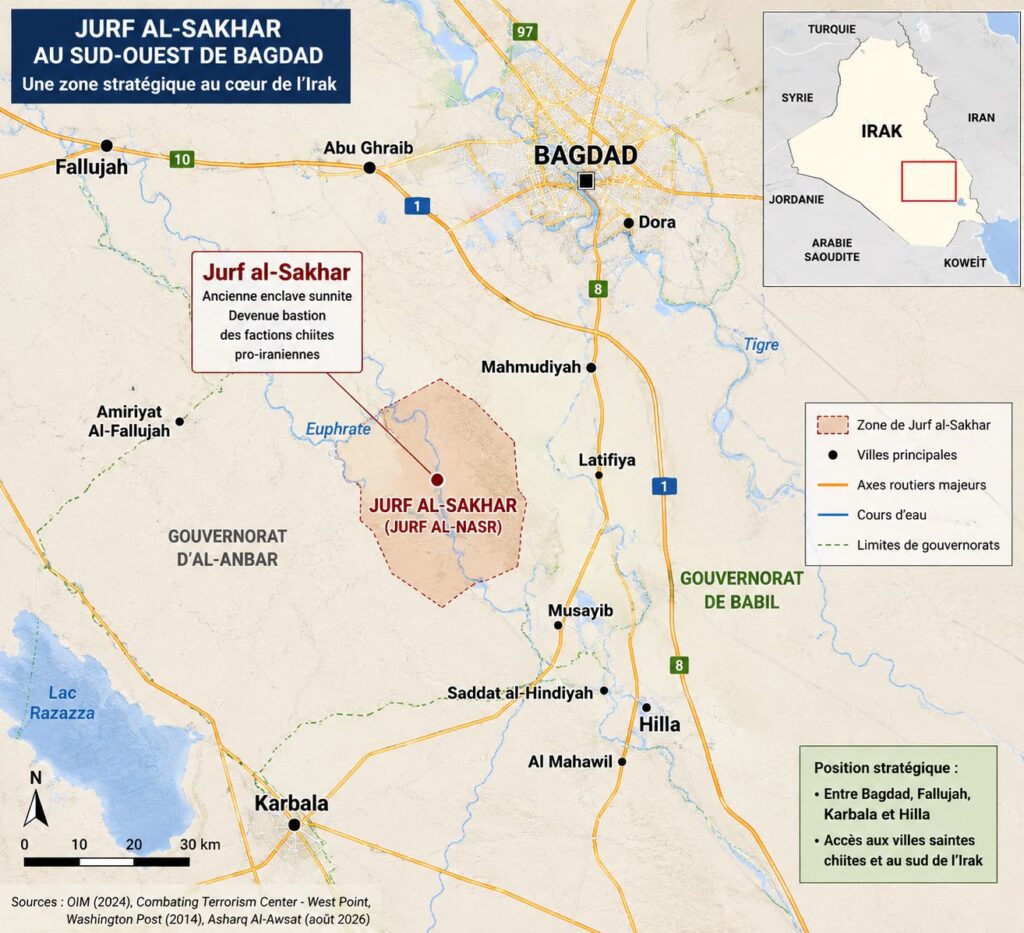
Jurf al-Sakhar, renamed Jurf al-Nasr, ‘the bank of victory’, is a farming area in Babil province, on the Euphrates. Lying between the outskirts of Baghdad, Musayyib and the approaches to Anbar province, it commands routes linking the capital to the south and west of the country. Holding this sector makes it possible to monitor roads, supplies and movements towards the Shia holy cities.
In 2014, Iraqi forces and the factions mobilised against Daesh retook the area from the jihadists. Military victory did not, however, restore ordinary administration. Kataib Hezbollah consolidated its presence there, while tens of thousands of displaced residents, most of them Sunni, remained barred from returning home.
Government commissions have been able to enter the area, but their visits require security and political coordination with the forces present, notably the Hashd al-Shaabi and Kataib Hezbollah. This requirement underlines how difficult it is for the Iraqi authorities to gain free access to sites, to investigate, to inspect facilities and to enforce public decisions there.
An armed faction within the state apparatus
Kataib Hezbollah is an Iraqi Shia organisation that took shape in the 2000s and is backed by Iran’s Revolutionary Guards. Its opposition to the American presence, and later its mobilisation against Daesh, notably to defend threatened Shia communities, strengthened its influence. It is part of the Hashd al-Shaabi, or Popular Mobilisation Forces. This structure brings together formations with differing loyalties: not all are aligned with Tehran. Under a 2016 law, the Hashd officially belongs to Iraq’s security apparatus and answers to the Prime Minister, the commander-in-chief of the armed forces.
This is the paradox of the Iraqi system: official membership of the state can coexist with loyalty to the faction and autonomy of command. A fighter can serve in a brigade recognised by the institutions while obeying the leaders of his organisation. For Baghdad, the difficulty therefore lies in giving practical effect to an authority that already exists on paper.
A Prime Minister born of the tug-of-war between Washington and Tehran
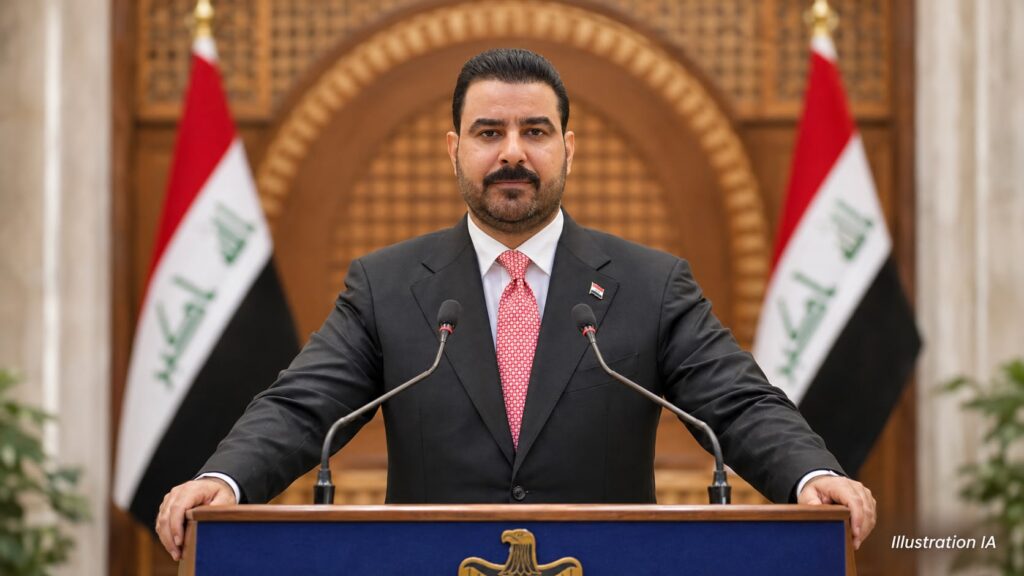
Al-Zaidi’s rise to power sheds light on this confrontation. On 27 April 2026, after several months of deadlock, the Coordination Framework, a coalition of Shia parties with varying ties to Iran, chose him as a compromise candidate. Tasked by the President of the Republic with forming a government, the businessman won a vote of confidence in Parliament on 14 May.
Washington had previously rejected the return of former Prime Minister Nouri al-Maliki, deemed too close to Tehran. Donald Trump had threatened to withdraw American support for Iraq. According to a Reuters investigation published on 23 January, US officials had also warned their Iraqi counterparts of possible sanctions affecting oil revenues if Iran-backed groups joined the next government. Access to the dollars earned from exports is a major source of financial leverage over Baghdad.
Al-Zaidi thus came to power through a compromise between Iraqi parties, against a backdrop of strong American pressure. The United States backed his appointment and expects him to curb the factions’ autonomy. His commitment to placing weapons under the authority of the state now pits him against some of the forces within the political camp that brought him to power.
The factions justified keeping their arsenals in particular by the American military presence. Yet on 30 September 2026, the US command announced the completion of the withdrawal of its troops from Iraq. That departure weakens the argument, without having led to their disarmament. It also confronts the government with its own responsibility: to ensure the country’s security and to prevent any single organisation from deciding on its own to drag it into a regional conflict.
Oil triggers the confrontation
The conflict crystallised around a technical report by Iraqi intelligence flagging suspicious activity observed since 2021. It refers in particular to the tapping of oil pipelines, tanker-truck movements and facilities that could be used for storage or refining. The economic stakes are obvious: oil diverted from official channels can generate revenues beyond public control.
On 13 November, a government commission accompanied by a military force assigned to protect it entered Jurf al-Sakhar. The following day, the authorities announced that its investigations confirmed the existence of trafficking and of refining facilities. Al-Zaidi ordered the matter referred to the courts and the dismissal of nine officials, including security officers in Babil and the director of the oil pipelines company.
Kataib Hezbollah rejects the accusations. It describes the equipment as storage tanks and a facility designed to improve the quality of the fuel used by its military vehicles. On 15 November, the government spokesman, Haider al-Aboudi, directly implicated the faction. Baghdad says it is defending public resources; Kataib Hezbollah denounces a blackmail operation aimed at securing its disarmament.
An order to enter and mediation to avert a clash
On 16 November, Haider al-Aboudi went a step further. In an interview with Iraq’s official news agency, carried by the NINA agency, he confirmed that al-Zaidi had ordered the armed forces to enter the area and had set Kataib Hezbollah a deadline to leave. He did not reveal the exact date, saying only that the deadline was near.
According to Shafaq News, citing anonymous government and political sources, the deadline falls at the end of the week. Deployment of Iraq’s Counter Terrorism Service (CTS) is reportedly being considered should mediation fail. Reinforcements and tighter controls at access points have also been reported. As of 16 November, no assault had been officially announced.
Officials from the Hashd and the Coordination Framework are acting as intermediaries. They are seeking to avoid a clash within their own political sphere. The crisis therefore runs through the Shia camp: it pits the government against a faction that refuses to give up its military and territorial autonomy, while belonging to a body officially placed under the Prime Minister’s authority.
Regaining control is not enough to disarm
The showdown is part of al-Zaidi’s plan to place weapons under the authority of the state. Initially set for 30 September 2026, the deadline has been pushed back to 30 June 2027. As we explained in our analysis of the shift from disarmament to the management of weapons (in French), the decisive criterion is control of the chains of command. Who authorises a troop movement, the use of a drone or the launch of a missile?
A negotiated transfer of control over Jurf al-Sakhar would be progress if it allowed the authorities to monitor access points, facilities and economic activity. So far, however, Kataib Hezbollah refuses to disarm or to cede control of the area. An agreement would have real significance only if the forces deployed actually obeyed the government.
American pressure adds a regional dimension to this showdown. It is not enough to explain the crisis: public revenues, the security of infrastructure and the freedom of action of Iraqi institutions are directly at stake. An armed intervention could, however, turn the investigation into a broader political and security confrontation.
To gauge the outcome of the conflict, one will have to look beyond the statements: will investigators be able to work freely, will court rulings be enforced, and will Baghdad truly control the chain of command? The return of displaced residents will be another concrete indicator. Sovereignty will also be tested by whether families are able to recover their land and their homes.
Further reading from La Tribune des Nations (in French):
Iraq: from disarmament to ‘the management of weapons’, the compromise taking shape with the militias
Iraq: Jurf al-Sakhar, the forbidden territory where Baghdad wants to restore its sovereignty
Facing the militias, Zaidi opens the corruption front
Iraq: two more Shia armed groups rally to al-Zaidi’s government
Follow the author on X
Seals Consulting — @Consulting4502
Translated from French. The French original prevails.