By Professor Hassan Hami, former diplomat, PhD in Political Science
A curious observation that raises questions: we live in a world where the powers that emerged in the aftermath of the Second World War and laid down the law during the Cold War no longer wish to govern alone. A claim that rings false, given the latest developments on the global strategic chessboard. No, not really. I shall endeavour to show that fast-food analyses do not nourish a community hungry to know everything without giving up a single crumb.
The international system has been turned upside down. The transition is not going as expected. Proof of this lies in leaders’ timid inclination to strike a salutary balance behind the scenes without appearing to have made costly concessions. Indeed, no one really seeks to lead an international system weakened by half-hearted recipes intended, in theory, to resolve endemic conflicts outside its own sphere of vital interest.
The leaders of the still-rising powers have come a long way. Other countries no longer accept this ascendancy as though it were inevitable. Domestic public opinion has also entered the fray. It no longer wants to hear about projecting influence abroad, about an image to be maintained at all costs, or about the obligation to turn a blind eye when things are not working on the economic and social fronts.
This assessment of developments chimes with that of public opinion in the rest of the world. There is admittedly no convergence of views on all the problems afflicting the planet, but the right to freedom of expression is gaining ground.
Responsibility or rout
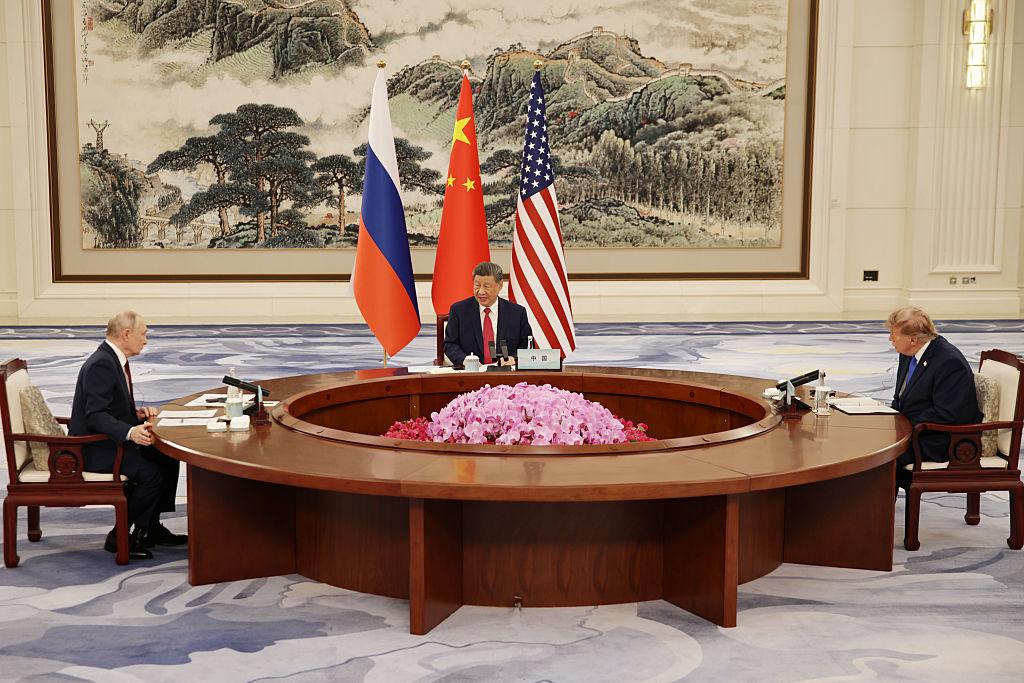
A tripartite summit on the sidelines of the 33rd Asia-Pacific summit (18 and 19 November 2026) took place in Shenzhen. It is giving partners, allies and adversaries of the United States, China and Russia cold sweats. The summit adopted a peace declaration in favour of strategic stability and international security. While it is premature to offer a proper reading of the summit’s outcomes, nothing prevents us from placing it within the structural transformations the international system is undergoing.
It is in this atmosphere that the search for new ideas acquires its full legitimacy. The cacophony of perceptions that the decision-making community finds repugnant when it is on cloud nine is now music to its ears. It turns its members into resident music lovers for the sake of the cause. And it is in this context that I share some thoughts on what I would call “the suffering of ideas in a poorly refined healing protocol”. The effort would be worthwhile in the light of events that have been unfolding since the start of this year.
The aim is to review and discuss certain ideas put forward recently in the United States. With that in mind, let us examine a few explanations promoted since last summer that deserve a careful reading, because they appear to anticipate strategic decisions being taken in Shenzhen. Two contributions have been selected in this regard.
First, the contribution of Robert D. Kaplan. In an article entitled “America Is Blundering Toward War with China”, in The New York Times, 21 September 2026, Kaplan, who belongs to the realist school with a multilateralist facelift, sets the tone by criticising the United States for having misjudged China long before its adventures in Afghanistan, Iraq and Iran. Yet an ambiguity in how Kaplan perceives the new realities of the international system is apparent. He offers a historical overview of relations between the United States and China. What emerges, in his view, is that the Americans missed the point entirely. And every time they tried to make up for it, they did so hastily and through improvisation.
Witness American conduct during the Chinese Civil War (1946-1949) and on the eve of the opening initiated by Richard Nixon and Henry Kissinger in 1972. The same goes for the overestimation of Chinese power in the aftermath of the disintegration of the Soviet Union (1989-1990).Kaplan criticises the United States for its leniency towards China, given that, in his view, Beijing is not a democratic country. He believes that the United States thought China would embrace democratic values after the fall of the Berlin Wall. Kaplan touches on the question of Taiwan, but only through a hasty reading. He says the opposite of what he means in order to draw out the truth, but for someone of his calibre, the manoeuvre falls flat. He criticises the policy of ambiguity pursued by successive American administrations since 1972, yet succumbs to the same perception. In short, without digging any deeper, the takeaway is that, in his view, China must be bashed for the sake of the cause, while at the same time doing business with it and drawing red lines.
Projection and insider dealing
Charles Kupchan is just as scathing as Kaplan. In an article entitled “The Case for Trump-Xi-Putin Summit, how to avoid another Yalta”, in Foreign Affairs on 13 November 2026, Kupchan begins with what some observers call the outline of a second Yalta. In his view, three things are evident. First, Trump is supposedly weak in the face of Putin and Xi Jinping. He is alluding to the meetings between Trump and Putin in Alaska (August 2025) and between Trump and Xi Jinping (May and September 2026) respectively. Second, Trump’s support for what Kupchan calls autocratic regimes. Here we find the obsession, shared by many American researchers and journalists, with making people believe that the United States intervenes beyond its borders to promote the values of democracy and human rights. These two values act as a kind of filter, without which those seeking American largesse must look elsewhere.
Third, the trend towards weakening European allies. Without really seeking to defend Europe, Kupchan laments that it is being left behind in the face of Russia and China, in security and trade terms respectively. In short, reading between the lines, Europe must remain the United States’ private preserve. From time to time, its ears must be pulled, without going so far as to tear them off and leave it deaf to the sirens of American warnings.
The two American political scientists’ arguments are bolstered by the idea of “carving up Europe”, which is circulating in certain academic circles close to the centres of power in Western Europe. In this respect, proponents of the idea of a Yalta 2 argue that at the first Yalta summit (February 1945), the United States, the United Kingdom and the Soviet Union had a single enemy: Germany. That is no longer the case. At the time, Europe was divided between East and West. Today, Europe is experiencing a new form of division that cuts across both East and West.
The views reviewed here call for a response on my part. That response will be divided into several points. First, as regards the Yalta 2 hypothesis, it is likely (Hami, l’Europe daltonienne et la phobie d’un Yalta 2, Medias25, 12 March 2025). Dividing up spheres of influence among the three countries is possible because the context allows them to aspire to do so. Their respective allies are in no position to stop them. Priorities have shifted. The post-Cold War arrangements have reached their limits.
Second, Kupchan proposes establishing a group of countries to manage the multifaceted transitions within the international system, modelled on the Concert of Europe of 1815-1914 (Austria, Prussia, Russia and the United Kingdom). To this end, a steering committee would be created, comprising the United States, China, Russia, the European Union, India, Japan and countries representing South America, Africa, the Middle East and South-East Asia. This proposal is utopian. The argument contains a contradiction between the idea of preventing three powers from dominating the world and the idea of granting them a decisive role in selecting the countries that would sit on the select committee to be set up.
Third, the proposal is an admission that the United Nations system has failed. It sidesteps the demands for reform of the Security Council. We shall see how, at the Shenzhen summit, the United States, China and Russia skimmed over the question, sprinkling it with Samaritan sentiments.
Keeping ambiguities alive
Fourth, it is an indirect call for the proliferation of small committees along the same lines, such as the Board of Peace set up by the United States for Gaza in January 2026. Audit experts agree that having several structures slows down the reform process rather than producing solutions, even intermittent ones. Moreover, the old structures develop resilience mechanisms that nip the new ones in the bud.
Fifth, the most surprising argument put forward by Kupchan is his call for coexistence between what he describes as democratic countries and autocritical countries so that they can agree on the best ways of settling conflicts. Surprising, because these countries already sit at the United Nations and are not advancing the cause of peace.
Sixth, the hypothesis that hierarchical proxies exist gains full legitimacy. Entrusting the management of international politics to a handful of countries destroys the idea of democratising decision-making at global level.
Seventh, what kind of stability are we talking about ? Strategic stability or strategic parity? The contradiction is glaring in a proposal that puts the former first and relegates to second place the latter, which is the principal condition for global peace and stability. Yet the United States, China and Russia are themselves divided on major issues in their immediate neighbourhoods and in secondary theatres of confrontation.
One of the explanations put forward is the perception that Western Europe is on course for a pre-ordained decline. An allied summit met in Berlin on 19 November 2026, in parallel with the Shenzhen meeting. Dubbed the “coalition of the willing”, the conference’s main agenda is coordinating support for Ukraine ahead of possible negotiations between Kyiv and Russia. It is a gathering of those shut out of the new strategic arrangements, making common cause without any illusions.
The news agenda has led commentators to focus on the four-point peace declaration that concluded the tripartite summit in Shenzhen. Its vagueness is staggering: reform of the United Nations system, energy security, a gentle rebuke of the International Criminal Court, which is told it must respect the immunity of heads of state and their representatives, and a warning against a devastating nuclear war. Yet a careful reading makes it possible to look beyond a text that sounds like wishful thinking. On at least three points, the differences run deep. The three countries are trying to buy time rather than offer solutions. Their concerns are above all domestic.
Some would say the concerns are rather personal ones. So much so that, in the Shenzhen declaration, the three leaders stress “the principle of state consent and respect for the immunities of their representatives”. They call on “the International Criminal Court and other similar bodies” to refrain from “abusing their jurisdiction”.
For China, taking part in the management of global affairs is not the top priority. China’s leaders are not prepared to take part in managing international crises. They do not want to. It is not in their interest to become entangled in international conflicts. Their seat on the Security Council has taught them what that entails. The priority for Chinese decision-makers is the succession to President Xi Jinping. Admittedly, the 2018 constitutional amendment abolished the limit of two consecutive presidential terms, but the 2027 deadline opens the debate on renewing Xi Jinping’s mandate and on finding a successor beyond that. While the renewal is a foregone conclusion, the choice of a successor for 2032 has yet to be made.
Inner compass, outer twin
For Russia, achieving calm at home. The nationalist card appears to have lost some of its impact. The sanctions regime is hitting the Russian economy hard, despite the financial acrobatics that still allow the country to get by. Russians who have had a taste of the Western way of life may not tolerate successive policies of autarky indefinitely.
For the United States, the reinvention of an America at peace with itself, beyond the slogans “Make America Great Again” and “Yes We Can”. Juggling interventionism, wait-and-see and isolationism no longer seems a winning game.
In short, this is not a second Yalta, as most commentators believe. The first Yalta was devised by countries belonging to the same geographical, cultural and civilisational sphere: the West. A second Yalta might have been possible had the United States and Russia alone formed the backbone, later to be joined by whatever survived the erosion of the European Union.
The new configuration includes China. China has a political and diplomatic culture that does not sit well with insipid coalitions. It is a country reputed never to have started a war unless forced to do so. The war China is currently waging is above all an economic one.
Moreover, growth projections for 2027 are far from matching the euphoria of the previous decade. On this point, neither the United States nor Russia views the future with optimism. A second Yalta is therefore hard to envisage in the short or medium term. Proof of this is that the three countries’ commitment to a more equitable multilateral system is more deceptive than a lure.
This hypothesis is all the more convincing given that the point on reform of the United Nations system contained in the Shenzhen Declaration is an empty commitment. The three countries’ proposals for reform of the Security Council involve a controlled enlargement of the permanent membership. Indeed, the potential new members would have no right of veto.
Likewise, the potential new permanent members would not be individual countries but regional organisations. The explanation put forward is to avoid candidacies dependent on regional balances of power, since these would perpetuate the struggle for regional leadership.
Nevertheless, one positive point to emerge from the tripartite summit between the United States, China and Russia is the conclusion that global energy security should not be the subject of diplomatic bargaining. That said, the commitment set out in the Shenzhen Declaration on peaceful international relations amounts to a multilateral altruism that fails to convince seasoned analysts. It entrenches a state of dynamic status quo, confined within a space shaped by the interests of the great powers and the middle powers.
The commitment confounds the understanding of emerging countries within what is known as the “Global South”. It also revives the race for a balance of power within regional subsystems, where perceptions of the new geopolitical realities are ambiguous, if not fanciful.
Translated from French. The French original prevails.