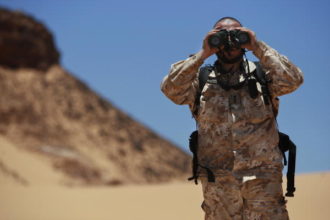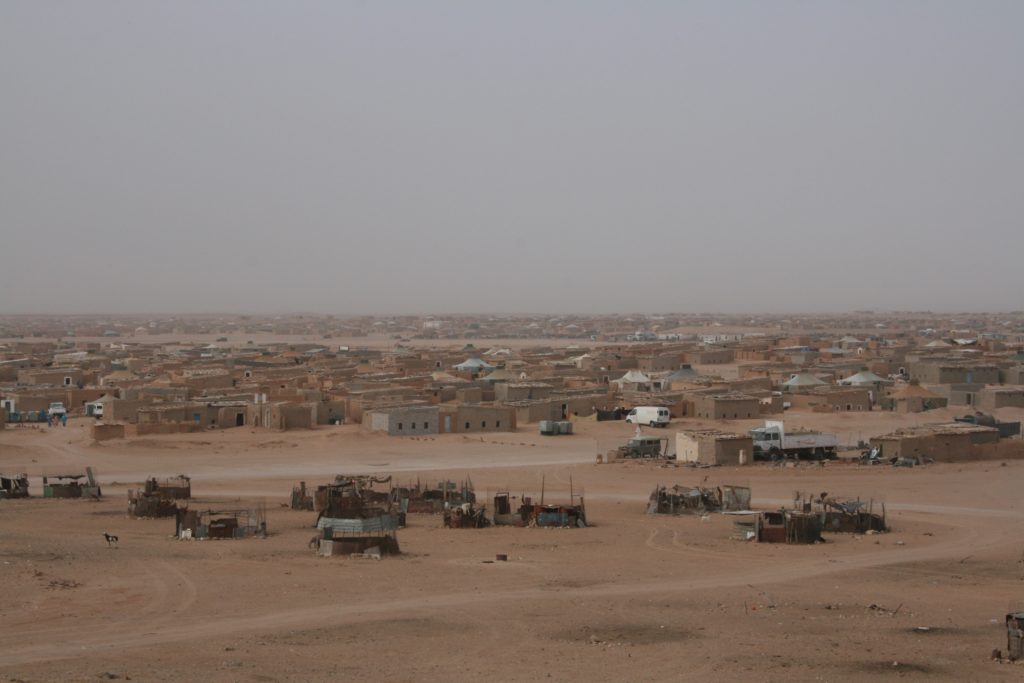
The Sahrawi refugee camp El Aaiún in Tindouf.
By Abdel Fattah Madmoune, Deputy Secretary-General of the Observatoire Géostratégique de Genève
With the referendum process deadlocked, Algeria strategically involved and the international balance of power shifting, the Sahara question is entering a new phase. The diplomatic impasse exposes the limits of a process that has become difficult to implement.
The expiry on 31 October 2026 of the mandate of the United Nations Mission for the Referendum in Western Sahara (MINURSO), without the Security Council adopting a resolution to renew it, marks a major turning point in the Moroccan Sahara issue. The two competing draft resolutions put forward by Washington and Moscow failed to secure the necessary approval, plunging the mission’s future into unprecedented uncertainty.
This episode does not, in itself, mark the definitive end of MINURSO, nor the settlement of the dispute. It does, however, reveal the exhaustion of an international mechanism.
More than thirty-five years after the ceasefire was established, one question is unavoidable: can we go on defending indefinitely a mechanism whose fundamental conditions for success have never been met?
The referendum: a promise that has become a political dead end
The referendum was originally intended to allow the populations concerned to choose their future freely. But very quickly, determining the electorate became the main obstacle to the process. Who is Sahrawi? On what criteria should membership of the population entitled to vote be established? Should it include those registered during the Spanish colonial period, their descendants, members of the tribes historically settled in the territory, or indeed populations with family and historical ties to the region?
These questions are not secondary. They lie at the very heart of the difficulty. The historical reality of the Sahara is rooted in a cross-border geographical space, shaped by migration, tribal ties and the movements of nomadic populations. Modern borders have not always matched the traditional areas through which Saharan communities moved.
The Tindouf camps, located on Algerian territory, are thus home to populations with diverse family and geographical backgrounds. Historical and family ties exist with several countries in the region, notably Mauritania, Mali and Algeria. More distant origins are also sometimes cited. It would therefore be simplistic to assume that everyone living in the Tindouf camps automatically shares the same territorial origin or the same electoral legitimacy.
The fundamental question remains that of an objective, consensual definition of the electorate. The experience of MINURSO has demonstrated precisely how complex this question is. Disagreements over identification criteria and electoral rolls gradually rendered the referendum originally envisaged practically unworkable.
Algeria: an indispensable player, but certainly not a disinterested one
It is now difficult to analyse the Western Sahara issue without examining the central role played by Algeria. Officially, Algiers says it supports the Sahrawi people’s right to self-determination and presents its commitment as a matter of principle. Yet its political, diplomatic, logistical and strategic involvement alongside the Polisario Front goes far beyond that of a mere outside observer.
Algeria hosts the Tindouf camps, backs the Polisario diplomatically and regularly speaks out in international forums to defend its positions on the issue. A legitimate question therefore arises: is this mobilisation purely a matter of political solidarity, or does it also serve Algeria’s own geopolitical interests?
The historical rivalry between Rabat and Algiers, ambitions for influence in North Africa and the Sahel, the regional balance of power and the question of leadership in the Maghreb are all factors that help explain the strategic dimension of Algeria’s involvement. It is therefore fair to acknowledge that, over the decades, the conflict has become a major instrument of the geopolitical rivalry between Morocco and Algeria. Algeria’s participation in international diplomatic talks, moreover, confirms that it cannot be regarded as a peripheral actor.
A demographic question that calls for transparency and rigour
One of the most sensitive aspects of the issue concerns the demographic make-up of the populations living in the Tindouf camps. The figures put forward by the various parties differ considerably. The Polisario Front and the Algerian authorities speak of more than 160,000 people in the camps, while UNHCR provides assistance to around 90,000 vulnerable refugees, according to figures reported by Reuters on 2 November 2026.This discrepancy underlines the need for an independent, transparent and up-to-date census.
Such a census should make it possible to distinguish between people originating from the territory, their descendants, displaced populations and people whose historical and family ties lie in other regions. The aim is in no way to arbitrarily challenge the Sahrawi identity of populations who have lived in the camps for several generations. It is to ensure that any political process based on the will of the people rests on reliable and verifiable data.
The question is all the more important because the referendum, as originally conceived, presupposed an electorate that was clearly identified and accepted by all parties. Without agreement on these criteria, the risk is that the right to self-determination becomes a claim with no concrete mechanism for implementation.
Morocco faces a new diplomatic landscape
As the referendum process ground to a halt, Morocco gradually consolidated its diplomatic strategy around its autonomy initiative, unveiled in 2007. The proposal provides for broad management of local affairs by the territory’s population, within the framework of Moroccan sovereignty. Security Council Resolution 2797, adopted in 2025, had already placed the Moroccan proposal at the heart of the negotiations, regarding it as a basis for discussion towards a final, mutually acceptable political solution consistent with the principle of self-determination.
The developments of October 2026 nonetheless show that international differences remain significant. The Russian veto of the US draft and the failure of the rival Russian draft illustrate how difficult it is to reach a consensus on the future of the UN mission.
For Rabat, this development is an opportunity to press its political approach further and to highlight the limitations of the referendum. But it also entails a responsibility: to demonstrate that the proposed autonomy can be a credible, inclusive and lasting political solution, capable of meeting the aspirations of all sections of the population concerned.
Breaking out of the logic of permanent conflictAfter almost half a century of confrontation, the Sahara question cannot reasonably remain hostage to political calculations and regional rivalries. The people of the Tindouf camps are entitled to tangible prospects, to dignity and to a future free of uncertainty. The inhabitants of the Moroccan-administered Sahara are likewise entitled to stability, development and effective political representation.
Algeria, for its part, cannot indefinitely avoid reflecting on the regional consequences of its involvement in this conflict. Normalising relations with Morocco would benefit the Maghreb as a whole, whose economic integration remains heavily hampered by this rivalry. The expiry of MINURSO’s mandate should therefore not be interpreted as a definitive victory for one side over the other. Rather, it should serve as a strong signal: the time has come to re-examine the diplomatic instruments, the mechanisms of representation and the conditions for a realistic political solution.
The real question is no longer simply whether a referendum can still be held. It is whether the international community can continue to cling to a mechanism whose conditions of application remain deeply contested, at a time when a new diplomatic momentum is taking shape around autonomy.
Translated from French. The French original prevails.