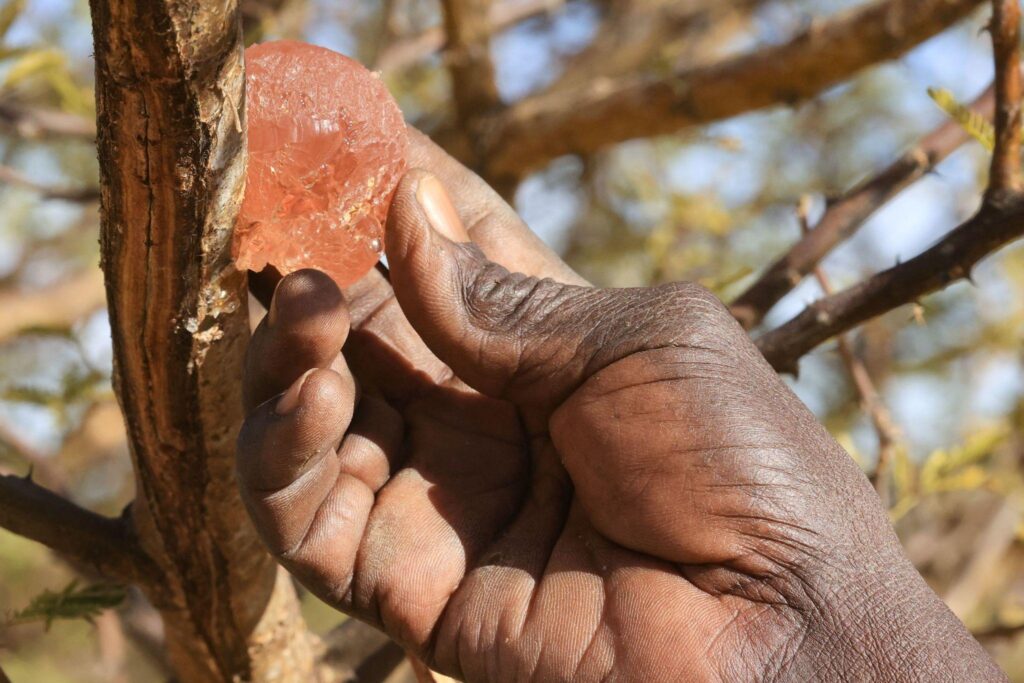
Harvesting gum arabic, one of the stakes and drivers of the war in Sudan. CC.
Sudan’s war is not being fought on the battlefield alone. It also feeds on control of territory, natural resources and trade routes. By shining a light on the role of gum arabic, the United Nations raises an essential question: how far can global supply chains be implicated in the financing of a conflict and in human rights violations?
Three years after hostilities broke out in April 2023, Sudan remains gripped by a war whose economic drivers are becoming ever more important. The confrontation between the Sudanese Armed Forces, led by General Abdel Fattah al-Burhan, and the Rapid Support Forces, commanded by Mohamed Hamdan Dagalo, known as Hemedti, is no longer merely a military contest for power. It is also part of a struggle for control of the country’s economic resources.
This is one of the main findings of the report by the Office of the United Nations High Commissioner for Human Rights published this summer. Its conclusion is particularly worrying: revenues derived from the exploitation of territory, raw materials and trade routes enable the belligerents to finance their military operations. In turn, continued fighting offers them new opportunities for economic predation. This dynamic is helping to entrench a genuine war economy, in which the financial survival of the armed actors depends in part on the prolongation of hostilities.
The conflict is thus becoming increasingly difficult to stop. Resources that could contribute to the country’s development are being diverted to serve military ends, while civilians bear the consequences.
Gum arabic, a revealing case of a globalised economy under influence
The choice of gum arabic as a case study is particularly telling. This natural resin, harvested mainly from acacia trees, is used in many industrial sectors, notably in the manufacture of soft drinks, food products, cosmetics and medicines. Before the war, Sudan accounted for between 70 and 80% of global exports of raw gum arabic. This gave it a strategic position in an international supply chain whose geographical origin is often unknown to consumers.
For millions of Sudanese, this activity is an indispensable source of income. It supports producers, collectors, traders, transporters and many rural families. But the war has profoundly disrupted this economic system. Control of production areas, warehouses and commercial infrastructure has become a prize for the armed forces. Looting, extortion and threats against workers are disrupting the sector and depriving people of their livelihoods.
The example of En Nahud, in West Kordofan, is particularly striking. In May 2025, the Rapid Support Forces reportedly looted the gum arabic exchange and its warehouses when stocks were ready for export. Behind this episode lies a broader reality: commercial infrastructure and civilian economic activities can become instruments of financing or targets of predation in an armed conflict.
Territorial fragmentation fosters opaque channels
The division of Sudan into areas controlled by the two rival forces has also transformed trade routes. Goods produced in territory held by the regular army are channelled in particular to Port Sudan, which has become a key hub for exports.
In regions dominated by the Rapid Support Forces, by contrast, some goods travel along cross-border routes and smuggling channels. This fragmentation makes tracing raw materials particularly difficult.
The United Nations report draws attention to a major risk: the laundering of products’ commercial origin. Gum arabic harvested in an area controlled by an armed group can be transported to a neighbouring country, absorbed into local trade channels and then re-exported under another label. Its Sudanese origin then becomes hard to establish.
This opacity is a major problem for international companies seeking to ensure that their supplies are compliant. It also makes it harder to identify who may ultimately profit financially from the transactions. The issue therefore extends well beyond Sudan’s borders. It concerns neighbouring countries, transit states, international traders, manufacturers and, ultimately, consumer markets.
International companies and their duty of vigilance
One of the most important aspects of the report concerns precisely the responsibility of business. Global supply chains are never entirely independent of the political and military realities of producing countries. When a territory is controlled by armed groups, the purchase of a raw material may contribute, directly or indirectly, to the financial resources of those actors.
This does not mean that every company buying Sudanese gum arabic is necessarily financing the belligerents. But it does mean that it cannot ignore the risks associated with its sourcing. The United Nations is therefore calling on companies to strengthen their human rights due diligence procedures.
In practical terms, this means verifying the true origin of goods, identifying intermediaries, checking trade routes and carefully examining customs documents. Any relabelling intended to conceal the provenance of products must also be closely scrutinised. This requirement raises a fundamental question: does a company’s responsibility end with its direct supplier, or must it extend to its entire supply chain?
The report clearly argues for a broad understanding of that responsibility. Companies must take account of the consequences of their activities, even when human rights violations occur far from their production sites and consumer markets.
Neighbouring states and importing countries also concerned
Responsibility does not, however, rest with companies alone. States also have a decisive role to play in monitoring trade. Sudan’s neighbours, in particular, must ensure that their territories do not become transit zones used to conceal the origin of goods from conflict areas.
Importing countries and the major economic powers also have regulatory and customs levers at their disposal. Strengthening traceability, monitoring re-exports, improving information-sharing and penalising fraudulent practices are all ways of limiting the revenues that could sustain armed groups.
But these measures must be accompanied by mechanisms enabling victims to assert their rights and obtain redress. The challenge is also to avoid further penalising the rural populations who depend on gum arabic for their living. An indiscriminate suspension of purchases would risk depriving producers of their last outlets, without necessarily stopping clandestine channels from operating.
The difficulty therefore lies in distinguishing supplies that support local communities from those that help to finance armed actors.
Breaking the economic cycle of war
Beyond the gum arabic sector, the United Nations report highlights a structural problem: in contemporary conflicts, control of natural resources and trade routes can become as decisive as military control of territory. Sudan offers a particularly worrying illustration. Its resources, which should be a lever for development and reconstruction, are becoming instruments for financing the war.
Gum arabic is only one example of this predatory economy. It shows how a raw material found in everyday consumer products can be linked to violence committed thousands of kilometres from the markets where it is sold.
The message sent by Volker Türk from Geneva to the international community is therefore clear: it is not enough to denounce human rights violations and call for a ceasefire. The economic mechanisms that allow the conflict to drag on must also be tackled. This requires coordinated action by states, companies and international institutions to make trade more transparent and to prevent Sudanese resources from continuing to fuel the violence.
For as long as the war remains economically profitable for those waging it, the prospects for lasting peace will remain fragile.
Translated from French. The French original prevails.