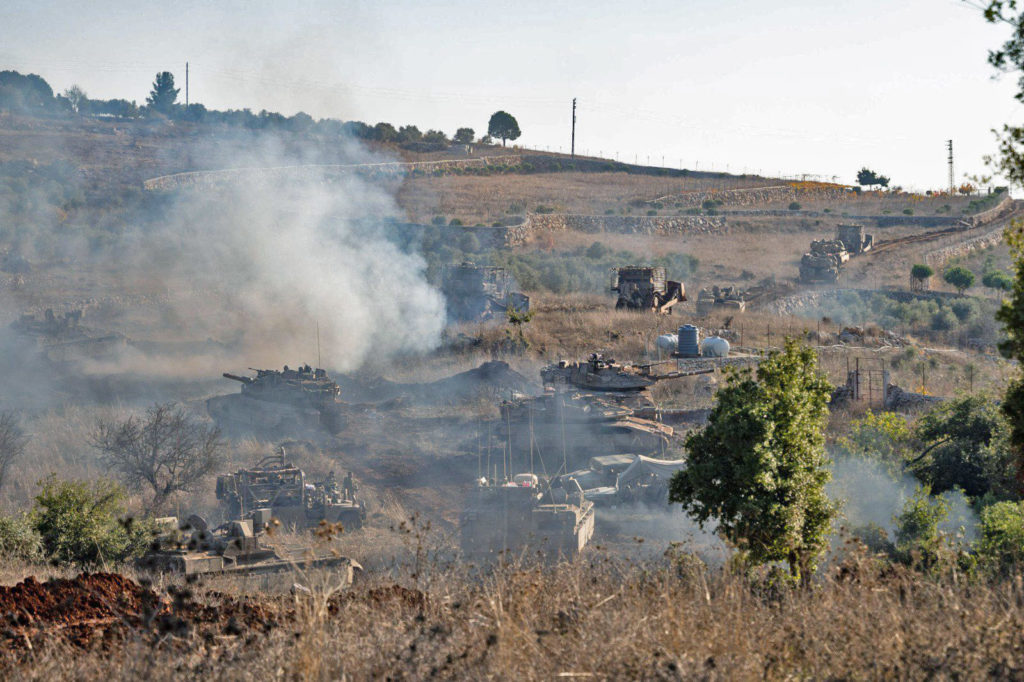
The Israeli army in action in southern Lebanon.
The US State Department has just issued a statement saying that Israel and Lebanon have reached a ceasefire agreement, conditional on a complete halt to Hezbollah attacks and the withdrawal of all its members from the area south of the Litani.
The two sides agreed to speed up the creation of buffer zones in which the Lebanese army would assume exclusive control of the territory, to the exclusion of all non-state armed groups. Washington stressed its continued support for the Lebanese army to strengthen its capabilities and enable it to extend the authority of the state over the whole of Lebanese territory.
Lebanon affirmed the need to respect internationally recognised borders and to implement the ceasefire in full while preserving national sovereignty.
The core of the agreement targets Hezbollah. It is not presented as unconditional. Its implementation explicitly depends on an end to Hezbollah attacks and the withdrawal of its members from the area south of the Litani.
A stronger role for the Lebanese army
The “pilot zones”, or buffer zones, are to be controlled exclusively by the Lebanese Armed Forces. The stated aim is to exclude non-state armed groups from these areas.
Washington reaffirms its intention to help the Lebanese army extend the authority of the state over the whole of the country. This forms part of a strategy to strengthen Lebanese state institutions in the face of independent armed actors.
The parties agreed to continue political and security talks in the coming weeks.
The statement presents these measures as a step towards a broader peace and security agreement.
Major point of uncertainty
The agreement was negotiated between the US, Israeli and Lebanese governments, but Hezbollah was not a party to the talks. Several sources therefore stress that the viability of the ceasefire will depend on the Shia movement actually accepting these conditions and on their implementation on the ground.
In practice, the statement represents a political framework for stabilising the Israeli-Lebanese border rather than a definitive settlement of the conflict. The decisive test will be the ability to enforce the provisions concerning the area south of the Litani and effective control of the zones in question.
Translated from French. The French original prevails.