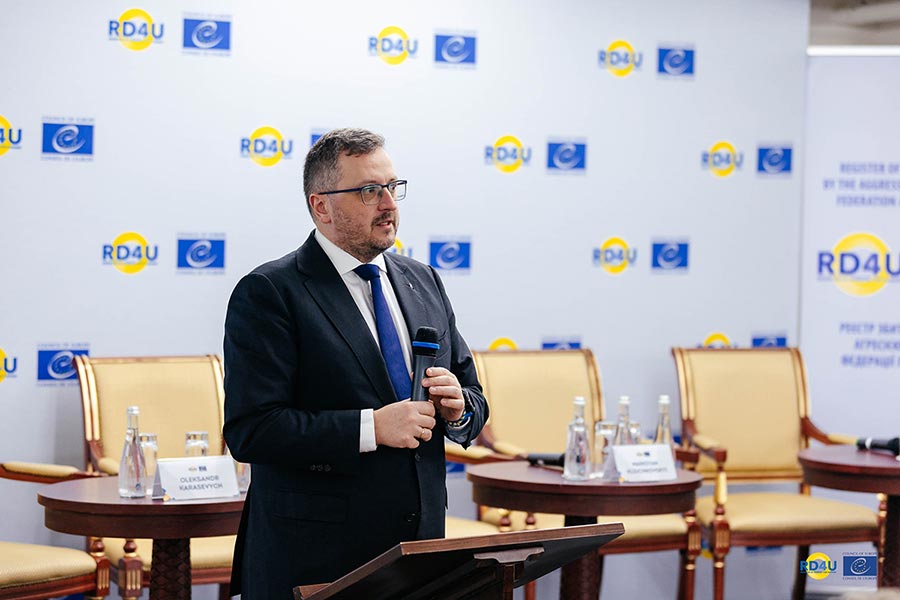
Photo RD4U
By Janet H. Anderson (The Hague correspondent for Justiceinfo.net)
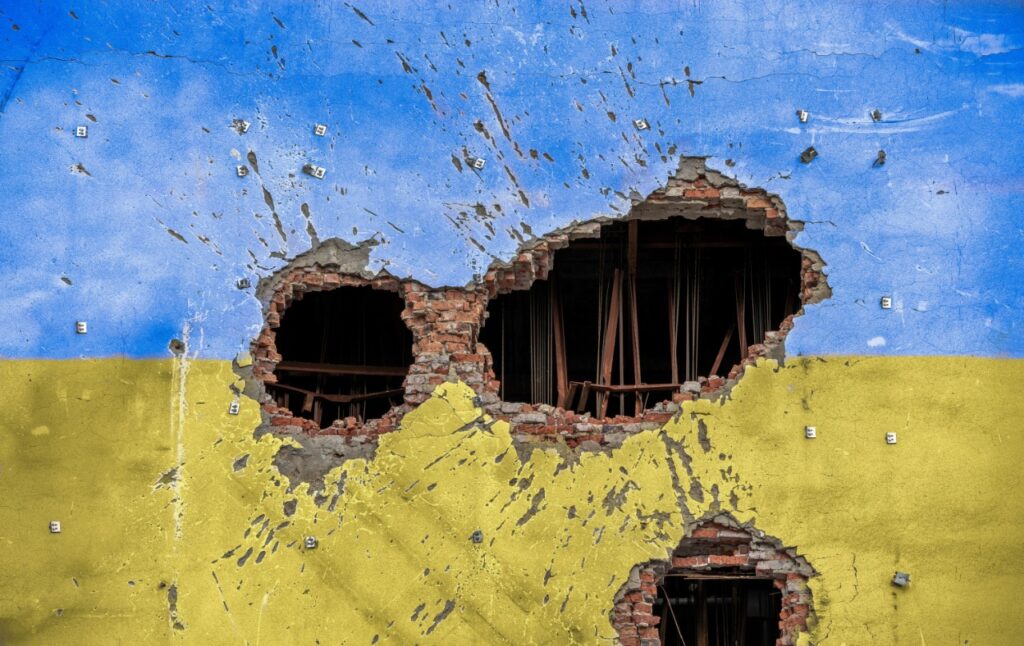
With an acronym worthy of Star Wars – RD4U – the “Register of Damage Caused by the Aggression of the Russian Federation Against Ukraine”, to give it its official name, is now fully operational. Claims in all 43 categories for “damage, loss or injury caused by internationally wrongful acts of the Russian Federation in or against Ukraine, since 24 February 2022” can now be submitted by individuals, businesses or the Ukrainian state.
The Register was launched in April 2024 and forms part of a complex, interconnected set of structures, including a “Claims Commission” which, once it has obtained the necessary ratifications from states, will absorb the Register into a single body, continue processing claims and then rule on them, pending the establishment of the final cog in the mechanism: a payment system.
There is little basis for comparison with other treaty-based claims mechanisms set up over the years, except perhaps in terms of scale with the United Nations Compensation Commission, which processed more than 2 million claims over 11 years following Iraq’s invasion of Kuwait. The Register, for its part, has been set up at a breakneck pace. It stands out in particular because it is being created during hostilities rather than afterwards, and because it operates digitally, via an app.
“This is perhaps one of the underestimated aspects of our work,” says Markiyan Kliuchkovskyi, executive director of the Register. “We have no precedent to draw on for setting up a mechanism while the war is not only continuing but is, in many respects, as intense as at any point in the past five years.” Among the various challenges are the availability of documentation and the fact that “some evidence has simply been lost”, he notes. “It is already sometimes difficult to reconstruct the events of the beginning of the war, in 2022. From that point of view, I therefore find it entirely justified that we started working early.”
The RD4U is based in The Hague, where much of the architecture of international justice, old and new, has been built. It is entirely separate from the new Special Tribunal for the Crime of Aggression against Ukraine, “politically and in practically every other respect”, says Kliuchkovskyi. “They have different mandates, different objectives, different compositions.” He acknowledges that both bodies come under “the auspices of the Council of Europe” and are located in The Hague. But the special tribunal “is a mechanism of individual criminal responsibility, whereas the compensation mechanism, including the Register, seeks to establish state responsibility for violations of international law”.
Kliuchkovskyi is sitting in a small office in the Dutch city’s international zone, a stone’s throw from Europol, Eurojust and the former premises of the International Criminal Tribunal for the former Yugoslavia. When we remark on the simplicity of the furniture visible in the Zoom window, he replies: “I don’t know if it’s from IKEA. We inherited it from the previous tenant and didn’t bother changing it, because it’s all we need. Our physical presence is deliberately kept to the bare minimum. As we say, half-jokingly, our magic happens in a digital world.”
In that world, the register has so far received more than 200,000 claims. There are now 21 categories open to individuals, 11 categories for legal entities and 11 categories for the Ukrainian state. “If someone had told me that three and a half years after our creation we would be where we are, I would have been very happy. We are no longer a concept, we are no longer a project, we are an organisation that works and is beginning to fulfil its mission in earnest,” says Kliuchkovskyi.
200,000 claims may seem few compared with the millions expected. Nevertheless, “that is the population of a medium-sized city. These are 200,000 people who have suffered real harm, genuine suffering, losses, and who have made a leap of faith to gather their testimonies and supporting documents, follow the procedure and submit a claim for compensation to a new mechanism, a new organisation. So this should in no way be regarded as negligible,” argues Kliuchkovskyi, who expects “the number of victims to run into the millions”.
Limited mandate and security concerns
Experts in transitional justice in Ukraine are working with the mechanism while voicing some criticisms. “The biggest concern” is “the glaring injustice” arising from the fact that the Russian invasion began in 2014 while the Register only covers the period from 2022 onwards, explains Kateryna Busol of the International Center for Transitional Justice (ICTJ), an NGO. She nonetheless finds it “admirable that survivors have managed to respond in a very nuanced and empathetic way, continuing to believe in the institution and in its good faith and goodwill”, while campaigning for the Register to extend its temporal jurisdiction back to 2014.
“Whether we like it or not, our statute gives a very clear answer and sets a very precise limit on our mandate. We simply cannot deal with events prior to 24 February 2022,” explains Kliuchkovskyi. “Our member states are aware of this and understand it. As for the Claims Commission, some steps have been taken to address this by stating expressly in the text of the Convention that the Commission’s mandate may be extended to include events after 2014. But that is a matter for the future, and a decision that will have to be taken at that point.”
All Ukrainians who have suffered damage can submit a claim, including those currently living under Russian occupation. “A digital, electronic system for submitting compensation claims is part of the answer to security concerns,” Kliuchkovskyi explains, “because you do not need to be physically present to access it. It is not necessarily always easy to do, and it requires at least some technical skills, including using a VPN.” He adds that he nevertheless receives claims from the occupied territories, even if their “density” is not quite the same as that of claims from government-controlled territory. Given the dangers, these statistics are not made public for security reasons. “We know that the Russian authorities have designated the Register an undesirable organisation under Russian law. This means that anyone who interacts with us even in the slightest way could potentially face sanctions, penalties and other measures. Our message to people in the occupied territories is therefore that their safety must come before everything else. People should not compromise their safety simply to try to submit a claim to us. We remind them of this constantly. For now, and for as long as the war continues, there will be no deadline for submitting a claim. There may be a more opportune moment to submit one, when security is a concern.”
Getting the message across
Raising awareness of the Register while the conflict is still under way is “a challenge”, says Chiara Giorgetti, a law professor at the University of Richmond in the United States and vice-chair of the Register’s Board. “What matters is letting potential claimants know that this procedure exists. People may have other priorities at the moment, because they first have to make sure they have enough to eat, then shelter, and electricity is limited; so I understand that it may be hard for them to find the time, but I think it is important” that they submit a claim for compensation.
“This is really one of the underappreciated aspects that puts that figure of 200,000 into a particular context,” says Kliuchkovskyi. “There is certainly value in submitting a claim now, while memories are still fresh and evidence is still available. But there will also be a time for this in the future, when people have more distance, so to speak, to file these claims. This is a long-term process, and what we are doing now is really making use of the time we have been given, when no other mechanism would even consider embarking on what we are doing.”
“These are important steps,” says Yelyzaveta Sokurenko, documentation officer at the Ukrainian human rights NGO Zmina, but “we also need to stay realistic about what these mechanisms can achieve… and about expectations. People have already been waiting for justice for years, and we must be careful not to give them the impression that submitting a claim means they will necessarily receive compensation, or that this will happen in the near future.”
Busol explains that perceptions of the Register vary among survivors. “If you compare Ukraine with the rest of the world, survivors of conflict-related sexual violence have been very active in terms of visibility, involvement in policymaking and international advocacy. They are much better informed about the various avenues of justice, including the Register.” She cautions, however, about how to help a victim of a sexual crime submit a claim. Kliuchkovskyi says that, according to the feedback they receive from Ukraine, the categories of damage relating to sexual and gender-based crimes “are not easy categories, and we did not expect them to be”. The Register has “made the claim submission procedure and the requirements regarding what can or must be provided as simple and flexible as possible, without imposing any strict requirement for a particular form of documentation or evidence. It is literally whatever a claimant feels able to provide, even if it is just a personal recollection of events. We understand that physical evidence may not necessarily be available at the time the claim is submitted. So, in short, whatever can be provided, in a form that is, we hope, as humane as possible within a legal procedure.”
He acknowledges that civil society organisations can “provide support to these people in the form of advice, information, or even gestures as simple or as meaningful as sitting next to the applicant while they fill in the form and submit their claim”. “We know that, in these categories, people are not always willing to come forward and submit these claims and, when they do, they may not be willing to repeat the same information,” he continues. “So we are also striving to minimise the need for applicants to recount what happened to them again and again. If the person has already made a statement to law enforcement, to the UN monitoring mission or to an NGO, they should not be forced to repeat those facts; rather, we should use the material they have already provided about what happened to them.”
Towards the establishment of a commission
The next stage in processing compensation claims will be the establishment of a commission on the basis of the convention signed in The Hague in December 2025. To date, the convention has 41 signatories – 40 states and the European Union. It is now up to each state to ratify the convention in accordance with its national legislation. Eleven of these ratifications have already been completed, Kliuchkovskyi says. “The magic number here is 25.” That is, the number required for the convention to enter into force. “So we are waiting while these national procedures run their course.” Pressed for a date, he tentatively suggests early 2027.
Finally, there is the financial aspect. Busol stresses that Ukraine’s budget is very tight, with many competing priorities for the funds currently being lent by the EU. Kliuchkovskyi explains that the Commission’s costs are known, since they amount to the Register’s annual budget. But the decision the Commission’s member states must take is whether 25 accessions constitute a number “large and robust enough to guarantee funding”. Giorgetti looks to the “major countries”, such as the United Kingdom, France, Germany and Italy, as well as the EU. “When they are confident about it,” Kliuchkovskyi explains, “they will be able to take a decision that will trigger the actual operation of the commission, marking the transition from the Register to the commission, at which point my team will change hats and begin presenting itself as a commission.” Ultimately, however, the plan provides for Russia to fund the compensation in question.
“Once the war is over, there will be a reasonable period in which to file a compensation claim. There is no ‘first come, first served’ principle, and no particular priority is given to claims filed early,” the executive director says. But he also wants the future commission not to become “an unbearable burden for our member states. And that implies a very sharp, very clear and unambiguous understanding: we will be neither a permanent tribunal nor a permanent organisation. We have our mandate, and once we have fulfilled it, we will have to wind up our activities. So we are acting with that in mind, knowing that we will have to cease our activities at some point.”
This article from Justiceinfo.net is republished under a Creative Commons licence.
Translated from French. The French original prevails.