Martin Lagarde, Geneva Geostrategic Observatory
France’s geostrategic position is constantly debated. Pushed back in West Africa yet at the forefront of a Europe more united than ever, France operates in every strategic arena. However, despite the pressing headlines, the French presence in the Middle East appears unclear to the general public.
As I write these lines, the controversial reception of Syria’s transitional President, Ahmed al-Sharaa, at the Élysée Palace is inflaming opinion across the political spectrum. Yet this event reflects precisely the subject at hand: the complexity of France’s diplomatic strategy in the Middle East.
France’s influence in the Middle East took root in the early 20th century under the Sykes-Picot Agreement of 1916. This carve-up of the Levant redrew the map of the region: the creation of Greater Lebanon, the attachment of Mosul to the British Mandate, and promises made to the Arabs of an independent kingdom, which were largely abandoned. Later, the Second World War proved decisive for French authority, as the rivalry between the Vichy regime and the Free French Forces spilled over into Syria and Lebanon. This turmoil would lead to recognition of the sovereignty of both nations in 1944. The Cold War sidelined France, which struggled to find its place in a region dominated by American and Soviet influence. The Suez Canal affair of 1956, marked by the nationalisation of the waterway by Egyptian President Gamal Abdel Nasser, came to symbolise the decline of the former colonial powers. Unable to act without the help of the United States, France and the United Kingdom saw their authority and legitimacy in the Middle East seriously undermined. By the end of the 20th century, a more cautious and multilateral France was operating in the region. Aware that it could no longer act alone in the Middle East, it chose to make its mark through inaction, deciding not to join the United States in fighting in Iraq in 2003.
I. The state of play of France’s military presence in the Middle East
France currently maintains a significant military presence in the Middle East. Successive white papers have consolidated the aim of establishing a permanent strategic base in the United Arab Emirates, which opened in 2009 and has around 700 troops. The French Forces in the United Arab Emirates (FFEAU) are a major foothold in a key region and take part in regional and bilateral cooperation through joint exercises. The base also gives the French command extended operational authority over a maritime area covering the entire Indian Ocean, as part of the responsibilities of the ALINDIEN command, at the crossroads of strategic and diplomatic interests and in direct contact with major players such as India and Indonesia.
In addition, the continuation of Operation CHAMMAL, launched in 2014 at the request of the Iraqi government as part of the fight against terrorism, allows the French Air Force closer bilateral cooperation and illustrates the importance of French forces in the region. This arrangement falls within the framework of Partner Nation Integration (PNI), whose regular training sequences help strengthen interoperability between France and Iraq.
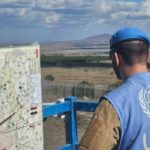
Finally, France deploys troops alongside the United Nations Interim Force in Lebanon (UNIFIL), which has been present since 1978 and was reinforced in 2006. Its missions are mainly passive: monitoring the Blue Line, carrying out land and maritime patrols, and working in direct cooperation with the Lebanese Armed Forces. Since the 7 October attack and Israel’s successive responses, UNIFIL has been warning of the risk of the conflict spreading across the region.
II. Diplomacy through arms sales, a key sector of the French presence
Building on a long tradition, the defence industry is a high-tech sector of excellence and of major importance to Paris’s international standing. It is structured around large groups such as Thales, Dassault Aviation, Safran, Naval Group and MBDA. In a world in perpetual crisis, arms sales are a necessary evil, in the sense that, beyond the economic dimension, this trade is the concrete expression of French foreign policy.
For several decades, the Middle East has been a strategic market for arms exporters. Since the Russia-Ukraine conflict, France has become the world’s second-largest arms exporter, with nearly 34% of its sales going to Middle Eastern states. An unstable region marked by recurring conflicts, persistent geopolitical tensions and a regional arms race, it is also an area where military budgets are among the highest in the world.
Over the years, France has carved out its place as an exporter, built a lasting customer base and established itself as a partner to the Gulf powers. In practice, Egypt, Qatar and the United Arab Emirates are its main partners in the region, with landmark contracts:
- Qatar: 24 Rafale jets ordered in 2015 (€6.3 billion) and a further 12 in 2018.
- Egypt: 24 Rafale jets delivered from 2015 (€5.2 billion), followed by 30 more aircraft ordered in 2021 for nearly €4 billion.
- United Arab Emirates: a historic contract for 80 Rafale jets signed in December 2021 (estimated value €16 billion), together with MBDA air-to-air missiles and other equipment.
Together they accounted for more than 50% of French exports between 2014 and 2023, according to the latest report to Parliament on France’s arms exports, published in 2024. The Emirates stand out as the main customer, with total purchases of more than €14 billion. Egypt follows closely, with a very similar figure of nearly €13 billion over the same period.
Behind the economic significance of these contracts lies a strategic assertion of Paris’s presence. These are long-term bilateral relationships: behind every sale of the Rafale, the flagship of the French arsenal, lies a wider web of political and military ties. In practical terms, this means the transfer of expertise, personnel training, modernisation and the construction of infrastructure. This follow-up benefits France in that it allows regular dialogue between states, fostering cooperation, be it military or cultural. France, for example, organises or takes part in naval and air exercises with Saudi Arabia, Qatar and the UAE. Arms sales therefore appear to be an essential component of French defence diplomacy, ensuring a definite presence without stationing troops on the ground. The objective is clear, as the Report on Exports also underlines, presenting these contracts as a necessary lever for stabilisation: “In a regional context marked by high tensions, French exports to certain countries in the Middle East form part of an approach of supporting partners committed to regional security. These exports are governed by a rigorous licensing procedure, based on EU Common Position 2008/944/CFSP and in strict compliance with international law, in particular international humanitarian law.”
Under a policy of so-called “responsible” exports, licences are assessed against the criteria of the EU Common Position and subject to compliance with international humanitarian law.
Finally, although arms sales help to strengthen France’s international standing, they project an ambivalent image. The trade is contested by some NGOs, media outlets and parliamentarians over its implications in current conflicts (the war in Yemen). The ambiguity of a France that might fail to honour its international commitments damages Paris’s image as a humanist power.
III. La Francophonie in the Middle East: the language of Molière as a tool of influence
The MENA (Middle East and North Africa) region has five full members of the International Organisation of La Francophonie (OIF), namely Egypt, Lebanon, Morocco, Mauritania and Tunisia, as well as two associate members, the United Arab Emirates and Qatar. The growth of La Francophonie has suffered something of a setback with the recent withdrawal of three West African countries. It is therefore necessary to examine this cultural pillar in the Middle East.
The case of Lebanon
As a legacy of history, Lebanon maintains close relations with France, its former mandatory power. With nearly 38% of the population French-speaking, French is taught as a second language in Lebanese schools and universities. Although widely spoken, the language of Molière is losing ground to English and Arabic. Nevertheless, cultural ties and the presence of institutes and language centres keep French in a strong position.
Academic and cultural cooperation
France has a vast cultural network abroad, and the Middle East is no exception, with some thirty entities. These range from the embassies’ SCACs (Cooperation and Cultural Action Services) to the Instituts Français, as well as research centres such as the IRMC in Tunis and the DEAC in Cairo. This network greatly eases the integration of French students in these countries, offering full immersion and the chance to learn customs, cultures and, above all, a language rich in dialects. Finally, mention should be made of the international cooperation agreement between Paris IV University and the Ministry of Higher Education and Research of the emirate of Abu Dhabi, which created Sorbonne University Abu Dhabi in 2006. The initiative grew out of the emirate’s determination to develop its higher education, taking advantage of Beirut’s decline as a bastion of the French-speaking world.
IV. Economic cooperation and industrial growth
The economy is an essential pillar of the understanding between France and the Middle East. Beyond arms sales, many French companies are established in the region. TotalEnergies is a mainstay of the energy sector, present in Qatar through gas production and in the Emirates. Vinci, Alstom and Bouygues are also developing infrastructure projects such as metros, stadiums and airports. This cooperation also involves the services of the French state: institutions such as Business France and the embassies actively support companies through economic summits.
By way of illustration, the Vision Golfe 2024 initiative, held at the Ministry of the Economy in Paris, marked an important milestone in strengthening economic relations between France and the Gulf Cooperation Council (GCC). It produced a clear determination to forge closer ties between France and the countries of the region, as well as concrete initiatives such as the agreement signed between the Saudi Ports Authority (MAWANI) and the Grand Port Maritime de Marseille Fos, aimed at strengthening maritime links. Likewise, the creation of the “France Lab” at the Mohamed bin Zayed University of Artificial Intelligence in Abu Dhabi underlines the importance of the Franco-Emirati relationship on innovative subjects. The conference closed with the words of the CEO of Business France, Laurent Saint-Martin: “In a world facing crises of all kinds and serious tensions in the Near and Middle East, Business France, alongside its Gulf partners, has chosen to build bridges. Drawing on the sharing of expertise, cultural exchanges and mutual investment opportunities, Vision Golfe seeks to create a resilient and prosperous future with our exceptional Gulf partners, with whom France maintains bilateral cooperation of the highest quality. I hope that we will be able, individually and collectively, to meet the expectations and needs of our Gulf partners, whose high standards should give us pause. Competition is fierce. Let us rise to the challenge”
V. Paris at the centre of the game: mediator or player?
France’s diplomatic strategy appears to centre on dialogue: a willingness to talk to everyone, without taking hasty or irreversible decisions. In short, the role of mediator. In a Middle East that is constantly being reshaped, Paris has been quick to assert itself as a credible intermediary, particularly as American and British influence in the region recedes.
The French stance, set by President Emmanuel Macron, has taken the form of a series of targeted interventions. The 2017 Lebanese political crisis introduced the head of state’s vision on the Middle Eastern stage: he personally received Prime Minister Saad Hariri and helped to calm the escalation between Saudi Arabia and Iran. The French approach stands out for its readiness to engage diplomatically with all the parties involved, without adopting a rigid ideological line. Paris has maintained a dialogue with Saudi and Israeli leaders as well as with the Iranian authorities, signalling its determination to keep channels open and to preserve the Iran nuclear deal, despite the reluctance of Washington, which ultimately withdrew from it in 2018.
Finally, on the Israeli-Palestinian conflict, which dominates the international news agenda, France supports a two-state solution (United Nations General Assembly Resolution 181), according to official sources at the French Ministry for Foreign Affairs. It is stepping up its humanitarian aid to the Palestinian population. As of 30 September 2024, its contribution to Palestinian civilians stood at €200 million. Relations between France and Israel have also come under some strain, particularly since Emmanuel Macron voted in favour of UN resolutions calling for an end to the Israeli occupation of Palestine. France’s stance on the conflict illustrates the complex position Paris is seeking to maintain in the region, as it asserts its wish to act as a mediating power.
In conclusion, the Middle East remains a key region for Paris. Its strategy rests on a discreet military presence, strong economic ties and long-standing cultural and academic cooperation. Positioning itself as a mediating power is an ambitious undertaking, given how difficult it is to make one’s mark in such a shifting arena. France must recognise that its credibility hinges on its ability to propose solutions and build bridges rather than take sides.
SOURCES
• Actualités CCI: Franco-Arab Chamber of Commerce calls for stronger economic relations between France and the Gulf States
• Conflits: What remains of French influence in the Middle East?
• Fondation Jean-Jaurès: Why France has a role to play in the Middle East
• Libération: La Francophonie in the Middle East: a question of civilisation
• Ministry of the Armed Forces: Training of the fourth Iraqi Desert battalion by Task Force LAMASSU
• Ministry of the Armed Forces: France–Iraq bilateral cooperation –
• Ministry of the Armed Forces: 2024 Report to Parliament on French arms exports
• Ministry for Europe and Foreign Affairs: A network for cultural exchanges
• Ministry for Europe and Foreign Affairs: Peace process / Israel–Palestine file
• Ministry of the Economy, Finance and Industrial and Digital Sovereignty: France–Emirates: a fast-growing strategic partnership
• International Organisation of La Francophonie: North Africa and the Middle East
• Public Sénat: France seeks a mediating role in the Middle East
Translated from French. The French original prevails.