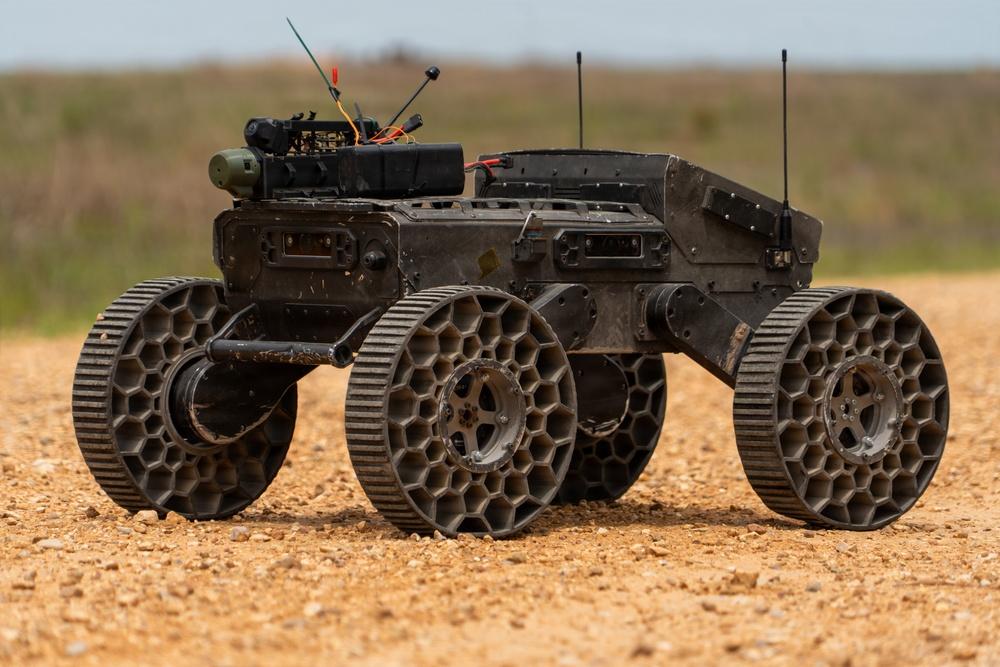
This AI-enabled robotic military vehicle, developed by Swarmbotics AI, was photographed during a US Army exercise in April 2026. . Sandy Vera Vazquez / U.S. Army.
The Seventh Review Conference of the High Contracting Parties to the Convention on Certain Conventional Weapons is exposing divisions over autonomous weapons, the authority of international rules and who should take part in drawing them up.
The Seventh Review Conference of the Convention on Certain Conventional Weapons opened in Geneva on Monday with a procedural dispute carrying immediate political consequences. Russia’s objections to the arrangements for the participation of observers, notably the European Union, prevented the agenda from being adopted at the outset. At the end of the first day, the President of the Conference, Swiss Ambassador Julien Thöni, acknowledged the continuing lack of consensus and launched informal consultations on autonomous weapons. The debate over the rules of negotiation had thus come before the debate over the rules of war.
Scheduled to run from 16 to 20 November, the conference brings together the States Parties to one of the principal instruments of international humanitarian law dealing specifically with weapons. The central political question is whether several years of discussions on lethal autonomous weapons systems will lead to a genuine negotiating mandate or to yet another extension of the experts’ work, without resolving the fundamental question of their legal status.
On 4 September, the Group of Governmental Experts adopted a report containing elements that could serve as the basis for a possible legal instrument, “without prejudging its nature”. This wording made it possible to reach agreement on certain substantive elements while leaving open the main source of disagreement. The choice is not simply one of permitting or prohibiting a technology. States differ on which systems should be prohibited, which should be regulated, what requirements should apply to human control, and whether safeguards should take the form of binding international obligations or of non-binding recommendations and national measures.
Behind these legal questions lie calculations about military flexibility, asymmetric constraints and technological competition.
Regulating the effects of weapons rather than disarming the world
The Convention on Prohibitions or Restrictions on the Use of Certain Conventional Weapons Which May Be Deemed to Be Excessively Injurious or to Have Indiscriminate Effects rests on a selective approach. Conventional weapons are not banned as a whole. Rather, the framework targets certain characteristics, effects and uses, through protocols covering non-detectable fragments, mines, booby-traps and other devices, incendiary weapons, blinding laser weapons and explosive remnants of war.
This architecture allows new rules to be added without having to renegotiate the entire convention. However, it results in uneven obligations: joining the convention does not automatically mean joining each of its protocols.
According to United Nations figures from May 2026, the convention had 128 States Parties, with differing levels of participation across its protocols. Assessing its effectiveness therefore requires strengthening the implementation of, and compliance with, existing commitments, and not merely negotiating new rules.
The focus of the debate on the weapons of the future must not obscure the harm being done today. In its recommendations to the conference, the International Committee of the Red Cross (ICRC) placed mines, incendiary weapons and explosive remnants of war on the same footing as explosive weapons used in populated areas, the protection of the natural environment and new technologies. The relevant humanitarian criterion is the nature of the harm and the scope for reducing it, not the novelty of the weapon.
Disagreement over whether existing law is sufficient
The United States and other countries reluctant to open legally binding negotiations argue that existing international humanitarian law already provides the applicable framework. Washington favours non-binding recommendations and has proposed a five-year mandate to work towards such an outcome. Russia and Israel are also among the states opposed to new binding restrictions, although Moscow had not yet fully set out its detailed position on the negotiations when the conference opened.
The argument based on existing law rests on genuine legal foundations: the autonomous nature of a weapon exempts neither the weapon itself nor its users from compliance with the applicable rules. Proponents of a new instrument do not generally dispute this principle. The ICRC nevertheless considers that general obligations are insufficient to address the specific risks that arise when a system selects and attacks targets without further human intervention.
The disagreement therefore turns on a fundamental question: is applying the existing general rules sufficient, or should more precise limits be set in advance? The ICRC recommends prohibiting systems whose effects cannot be sufficiently understood, predicted and explained, as well as those designed or used to apply force directly against people.
Other autonomous weapons should be subject to restrictions on targets, geographical scope, duration, circumstances and scale of use. They should also be subject to effective human supervision, with the ability to intervene or deactivate them. This is therefore an approach combining prohibition and regulation, not a proposal to ban all automated military functions or all military applications of artificial intelligence.
Precise terminology matters. A remotely controlled weapon is not necessarily autonomous. Likewise, human decision-making assisted by artificial intelligence does not automatically mean that the selection of targets and the triggering of attacks are delegated to a machine. Conflating these categories risks exaggerating the scope of the proposed restrictions or obscuring precisely the function that raises legal and ethical concerns.
Washington and Moscow: convergence without a common strategy
The issue reveals a surprising convergence between the United States and Russia, despite their confrontation on other matters. Both powers oppose the adoption of new legally binding constraints on autonomous weapons.
This convergence is not, however, evidence of coordination, and their approaches are not identical. Washington advocates a non-binding approach, whereas Moscow opened the conference with a procedural objection that hampered the formal proceedings.
Strategically, both positions may be explained in part by the interest of the major military powers in preserving room for manoeuvre to develop their capabilities before legal limits are set on them.
Early rules could restrict capabilities whose operational value has yet to be established. Delays buy time to test the technologies, explore their applications and determine their military usefulness.
This is an interpretation of the interests at stake and of the possible effects of these positions, not proof that the legal concerns are merely a pretext. Questions of definition, implementation and the allocation of obligations are also genuine issues in the negotiations.
Russia’s objection to the participation of observers also goes beyond the mere question of speaking arrangements. At a short conference, the failure to adopt the agenda reduces the time available for substantive negotiations and diverts diplomatic efforts towards procedural matters.
An objection concerning the participation of the European Union also brings the wider political confrontation into a humanitarian forum, although it cannot, on its own, account for all of Moscow’s motives.
Europe between regulatory ambition and the search for consensus
The European position cannot be reduced to a unanimous call for a binding treaty whose form has already been decided. In conclusions adopted in October, the Council of the European Union called for an ambitious negotiating mandate for an instrument “without prejudging its nature”.
It backed a two-tier approach: prohibiting systems that cannot be used in compliance with international humanitarian law and regulating the others, while maintaining human control and judgement throughout their entire life cycle and ensuring responsibility and accountability.
The United Kingdom, Germany and France proposed negotiating an instrument without prejudging whether it would be legally binding. This position differs both from an explicit mandate to negotiate a binding protocol and from a prior decision requiring the outcome to take the form of voluntary recommendations. It seeks to carve out room for negotiation between the two camps, at the risk of postponing the most significant disagreement.
Europe’s dilemma is as much institutional as it is substantive. Keeping an international forum effective requires a degree of flexibility towards the powers that raise objections. But keeping regulation credible means that this flexibility must not turn into an indefinite extension of the talks. The European Union’s official language reflects this tension: firm on human control and accountability, but less certain about the legal form of the future instrument.
China and the limits of a binary divide
China resists an overly simple division between supporters and opponents of regulation, adopting a position of calculated ambiguity. In this debate, supporting “regulation” in principle leaves open questions of its scope, timing and legal form. It should therefore not be assumed that China’s reservations match those of the United States. Likewise, statements in favour of establishing rules should not be read as prior agreement to any particular binding protocol.
More broadly, states can support the principle of human control while differing over how it is defined. They can accept a ban on uses already prohibited under existing law without accepting new limits on the development or deployment of these technologies.
Support in principle does not necessarily specify the obligations envisaged, the functions concerned, the timetable or the means of demonstrating compliance with the rules. The compromise wording adopted by the group of experts thus illustrates how consensus can coexist with unresolved tensions.
Support for binding negotiations is not confined to Western countries. More than 70 states, including Switzerland, have backed this approach. Positions therefore do not divide along a simple fault line between the West and the rest of the world. Rather, they reflect overlapping humanitarian concerns, interests tied to technological rivalry and differing views of proliferation risks.
Ukraine and the changing security environment
The conference is taking place at a time when the international security environment is putting growing pressure on arms control mechanisms. In its preparatory conclusions, the European Union linked the deteriorating security situation, the intensification of fighting on its borders and the acceleration of technological change.
The same document addresses mines, explosive remnants of war, harm to civilians and the destruction of infrastructure. It also condemns Russian violations in Ukraine. The convention’s deliberations are thus clearly not insulated from the confrontation between Europe and Russia. This context exerts conflicting pressures.
The intensification of fighting and the scale of harm inflicted on civilians strengthen the case for clearer safeguards and better enforcement of the rules. But growing insecurity can also stiffen states’ resistance to constraints they consider likely to weaken their defence or their deterrence capability.
The sense of danger that fuels calls for regulation can at the same time feed opposition to that very regulation. This tension is evident in the coexistence of security concerns and humanitarian commitments within the European position itself.
Nor should every report of a weapon using artificial intelligence in Ukraine or elsewhere be taken as proof that a fully autonomous system exists. The available information also concerns semi-autonomous capabilities and algorithmic assistance tools, which must be distinguished.
These developments nonetheless help to explain why the debate has shifted from a distant technological possibility to a concrete question: how can limits be set before the deployment of these systems spreads?
Delay as the outcome of negotiations
The timetable has itself become a subject of negotiation. While Washington is proposing a five-year process leading to a non-binding outcome, reports indicate that the president of the conference has put forward a proposal for a two-year mandate to negotiate a binding protocol. Humanitarian organisations, for their part, are calling for swifter action.
These differences are not only about meeting schedules. They also concern what might happen to technologies, military doctrines and investment during that period. A step-by-step approach may be necessary to develop rules suited to evolving technologies. But it must rest on a clearly defined objective and measurable milestones. Otherwise, it risks prolonging the discussions without creating any new obligations.
Extending the group of experts’ mandate is therefore not automatically a step forward, just as disagreements over its duration are not merely administrative matters. The formula “without prejudging the nature” of an instrument serves two purposes. It can help bring positions closer together and prevent the dialogue from collapsing. But it can also absorb political pressure without resolving the central legal question. Its value will depend on whether it allows negotiations on concrete provisions, rather than ushering in yet another round of preliminary discussions.
The September agreement made it possible to identify common elements. It did not settle the question of the next step.
Consensus: a guarantee of participation or a power of veto?
The consensus principle gives objecting states considerable power to prevent any move towards negotiations. The rule follows a practical logic: rules on weapons carry greater operational weight when the powers that develop and possess these systems take part in drawing them up. But that same requirement allows a small number of states to block an initiative backed by many others.
The conference therefore faces a difficult trade-off. Very broad participation may require narrowing the scope of the provisions under consideration. Conversely, more ambitious rules may require moving ahead without the participation of all states. The number of countries alone does not determine the balance. The military and technological weight of the opponents, and the willingness of supporters to proceed without them, matter just as much.
Should the negotiations fail, several options are conceivable: continuing the discussions within the framework of the Convention, taking the issue to the United Nations General Assembly, or opening negotiations outside the framework of the Convention on Certain Conventional Weapons.
Changing forum would not automatically alter the preferences of the major powers. It would, however, change the decision-making procedures and reduce opponents’ ability to block progress, at the risk of their remaining outside any future agreement.
The choice of negotiating framework is therefore part of the substantive debate, rather than a mere matter of organisation.
Keeping existing obligations in sight
For all its importance, the issue of autonomous weapons must not overshadow the Convention’s other work. The European Union has called for matters relating to Protocol III on incendiary weapons to be put back on the agenda and for discussions on mines other than anti-personnel mines to continue. It also stressed that explosive remnants of war hamper reconstruction and development and can cause lasting environmental damage. These are not merely technical concerns.
The consequences of a weapon persist when contaminated land prevents people from returning home, resuming farming or repairing infrastructure. Compliance must therefore be assessed not only at the moment weapons are used, but also in the light of the relevant obligations concerning the recording and sharing of information, clearance and assistance to those affected.
A final declaration on military artificial intelligence would not be enough to make the conference a success if the implementation of existing obligations remained politically marginal. The credibility of efforts to regulate new weapons also depends on the ability to show that the rules already in place work and that states are prepared to examine their shortcomings.
A battle over when the rules will be set and what they will limit
As of 17 November, the final outcome of the conference remained uncertain. The main fault lines were already visible: whether existing law is sufficient, the need for new obligations, the time required to negotiate them, the role of human beings in the use of force and even the arrangements for taking part in the negotiations. Acceptance, rejection and postponement are not always distinct positions.
A state may accept the principle of regulation while rejecting binding obligations, or support negotiations without agreeing on their legal outcome. The fundamental question is whether the rules will be set before these technologies are widely deployed.
Supporters of a binding instrument want to establish common limits before military investment and practice become harder to change. More cautious states favour flexibility and a gradual approach, while the technologies and their applications continue to evolve.
In Geneva, then, the question is not merely whether international law can describe a new form of warfare, but whether international institutions are capable of regulating it before doing so becomes more costly and more difficult to implement.
Translated from French. The French original prevails.