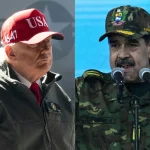
The Trump administration keeps saying it: it wants to get its hands on Greenland, by any means, including by force. What are its options, and why has Greenland become Donald Trump’s new designated target after the abduction of the Venezuelan president, Maduro? The White House is putting forward various arguments, which we will review. But first, let us look at the scenarios that have been raised and their consequences.
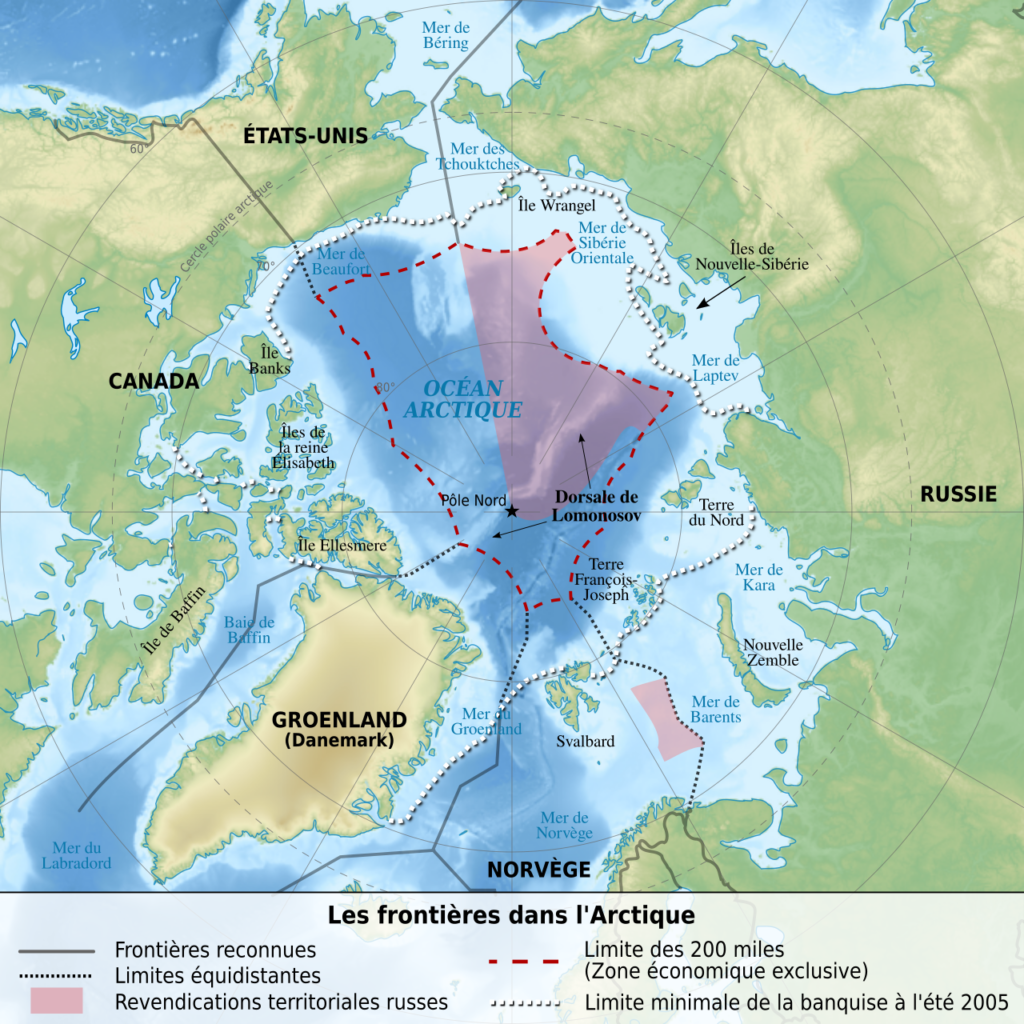
This island, whose Inuit name is Kalaallit Nunaat or “green land“, covers an area of two million square kilometres and lies to the north-east of Canada. Greenland is an autonomous territory with 57,000 inhabitants, 85% of them Inuit, who have enjoyed political autonomy since 1979, extended in 2009. In January 2025, 85 % of Greenlanders said they were opposed to becoming part of the United States in the future, according to a poll published in the Greenlandic daily Sermitsiaq.
The first scenario, which is also the least likely, is an armed intervention to secure the Arctic region on national security grounds. Yet the United States already has a military base there, Pituffik Space Base, known as Thule Air Base until 2023. It is run by the United States Space Force, the branch of the armed forces responsible for military operations in space. As the northernmost US base on the globe, it offers excellent conditions for monitoring satellites on the shortest trajectory between Russia and the United States.
Such an operation would be costly for the United States, both in terms of investment and politically. Contrary to what has been written elsewhere, such a military operation would probably not spell the end of NATO, of which Denmark is a member. The conflict in Cyprus between Greece and Turkey, two other NATO members, did not blow apart the North Atlantic Treaty Organization. It would, however, have disastrous consequences for trust between allies. But Trump’s America seems to care little about that, assuming it still regards the countries of Europe as allies at all, even as the European Union is held in contempt.
One of the arguments reportedly put forward by Washington is Denmark’s incapacity, even amateurism. The Danish Prime Minister, Mette Frederiksen, has stated that in 2025 her country allocated around 90 billion kroner, or €12 billion, to Arctic security, under a defence agreement that includes the acquisition of several Arctic vessels, long-range drones and satellite capabilities. The plan also provides for the creation of an Arctic unit with a dedicated emergency response capability. A naval base is planned in the Greenlandic capital, Nuuk. Denmark has also bought 16 American F-35 fighter jets. One of Europe’s responses to American ambitions, for its part, would be to bolster this Danish deployment with European military assets. NATO could also take the initiative by announcing reinforcements on the island.
In the New York Times, David Baker, a former Fed economist, estimated the cost of a US purchase of Greenland at between $12.5 billion and $77 billion.
The other option, the one now being put forward by White House spokespeople and by Trump himself, is the purchase of Greenland. This is how the United States historically expanded its territory, with Louisiana bought from France and Alaska bought from Russia. Buying Greenland has already been considered by several US presidents, and by Trump during his first term. What is more, in 1917 Washington bought the Virgin Islands from none other than the Kingdom of Denmark. Purchasing Greenland would require funding approved by Congress and the backing of two-thirds of the US Senate, as well as, under international law, the consent of Denmark and the EU. Unlikely. In 2019, the Washington Post put the cost of buying Greenland at $200 million. Last year, in the New York Times, David Baker, a former economist at the Fed, estimated the value of the transaction at between $12.5 billion and $77 billion.
Another option: influence. As he did with Argentina, Trump could promise Greenlanders the earth if they vote to join the United States. To do so, he would need to encourage the creation of a pro-American party, since the country’s two main political parties have currently come out against it. Buying 57,000 votes is well within the reach of American power, which could also hammer home anti-Danish sentiment among the local population by highlighting on social media the shameful sterilisation campaigns against Indigenous people, which continued until 1976 and are believed to have affected between 4,500 and 9,000 women in Greenland.
Why Greenland is a coveted prize
For Europe, Greenland holds strategic value for industrial sovereignty in the face of China. Of the 34 critical raw materials (including rare earths) that the European Commission considers strategically important for European industry, 25 are found in Greenland. In 2023, the EU also signed a raw materials partnership agreement with Denmark. These resources are also of interest to the United States and Russia, which want to avoid depending on China for rare earths.
For now, the polar climate and the transport routes prevent these raw materials from being exploited. Indeed, only two mines are currently operating on the island, extracting gold and anorthosite. Moreover, since 2021, Denmark has had a moratorium on oil and gas extraction in place. But that could change if the United States takes possession of the island.
The Arctic routes are closer to economic centres, more reliable and, above all, shorter. They cut journey times between Europe and Asia by between 20% and 40%.
The main issue at stake in the region is the shipping routes opening up in the north as the climate warms. And Greenland is geographically well placed to control them. In a world where maritime trade is growing fast, and where the southern route round the three capes, including the Cape of Good Hope, lies far from the world’s main economic players, skirts countries or passes through regions considered unstable and seas where piracy poses dangers, the Arctic routes are closer to economic centres, more reliable and, above all, shorter. Indeed, the Arctic routes cut journey times between Europe and Asia by a third.
Strategically, faced with Russia’s substantial Arctic installations (icebreakers, military and naval bases), the United States wants to strengthen its own. With this in mind, it has notably expanded the port of Nome. Greenland would obviously be an advantage against the Russians.The boarding of a ghost ship linked to Russia in the North Atlantic, carried out between Iceland and Scotland after a lengthy pursuit, shows that tensions between Washington and Moscow in the north are running high despite the recent rapprochement between President Trump and Putin.
Translated from French. The French original prevails.