By Professor El Hassane HZAINE
The Strait of Gibraltar is, as Paul Pascon (the French-Moroccan ethnologist) would have put it, a composite place whose waters carry the layered memories of centuries-old historical periods. As early as the 9th century BC, the Phoenicians forged the first links between Africa and Europe, followed by the Carthaginians and then the Romans, who turned this passage into a vital artery for human and commercial exchange.
The first geopolitical shock came in AD 711, when the military commander (Umayyad? See comment) Tariq Ibn Ziyad and his Muslim army crossed the strait, ushering in seven centuries of Muslim presence marked by a flourishing Andalusian culture on both shores.
The second shock was the Christian Reconquista and Spain’s annexation of the two presidios, Melilla (1496) and Ceuta (1580), Moroccan enclaves that became enduring symbols of a disputed border. The third shock came in 1704 with the British capture of the Rock, confirmed by the Treaty of Utrecht (1713): Gibraltar then became the “gateway to the Mediterranean”, a logistical and intelligence hub of the British Empire, particularly after the opening of the Suez Canal in 1869.
The 20th century brought its share of geopolitical upheavals: the French and Spanish protectorates in Morocco (1912–1956) fragmented the southern shore, while Tangier was made an international zone (1923–1956). Morocco’s independence in 1956 restored national sovereignty, but left unresolved the question of the Saharan provinces, Ceuta, Melilla and the Chafarinas Islands.
Today, the strait exists in a fragile “triadic equilibrium” between Morocco, the United Kingdom and Spain, governed by the 1982 Montego Bay Convention but weakened by persistent disputes.
The strategic importance and vulnerability of maritime straits vary according to their geopolitical environment, the nature of the political regimes of the coastal states, the volume and sensitivity of the flows passing through them, and the availability – or absence – of viable alternative routes. In this respect, a distinction can be drawn between “bypassable” chokepoints, such as the Suez Canal, where a detour via the Cape of Good Hope remains possible, albeit at the cost of significant delays, higher freight costs and major logistical disruption, and “non-substitutable” chokepoints, such as the Strait of Hormuz and, to a certain extent, the Strait of Gibraltar, whose closure would trigger immediate systemic shocks, affecting global energy markets, supply chains and the world economy.
Geopolitical tensions and the growing importance of the Strait of Gibraltar
Fifty-eight kilometres long and narrowing to 14.4 km, the Strait of Gibraltar is the only natural link between the Atlantic and the Mediterranean, as well as a natural border between Europe and Africa. The depth of its sills (up to 900 m) allows ballistic missile submarines to pass through (Brown, 2009). The liberal regime of innocent passage, codified by the 1982 Montego Bay Convention (UNCLOS), prohibits coastal states from obstructing navigation, thereby guaranteeing the freedom of passage essential to global trade.
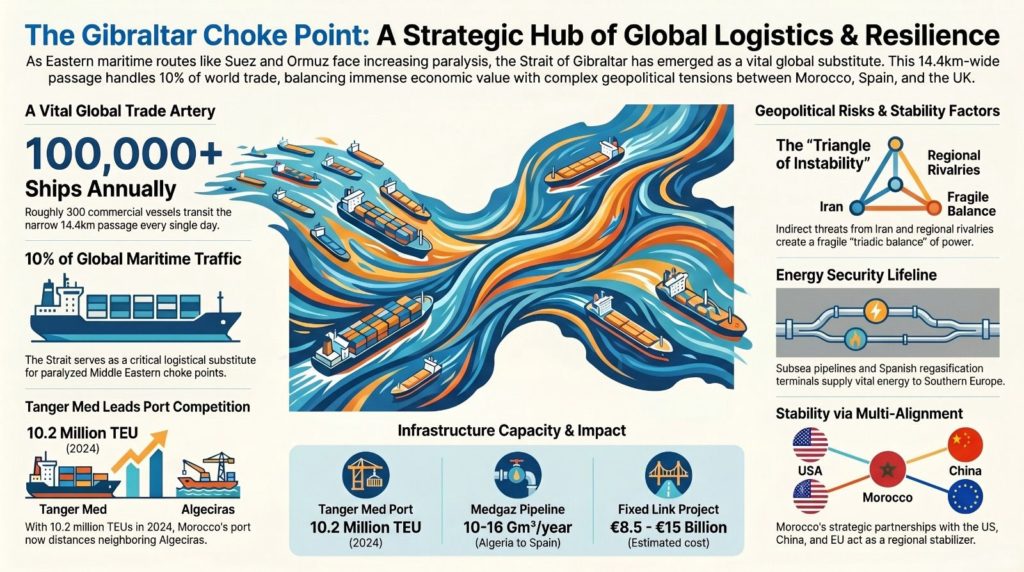
The strait is one of the busiest shipping lanes in the world. On average, more than 100,000 merchant vessels pass through it each year, or around 300 a day. This traffic includes oil tankers, container ships, roll-on/roll-off (ro-ro) vessels and ferries. On the Algeciras–Tanger Med route alone, for example, lorry traffic reached 44,426 units in February 2026, while the total number of crossings across all routes in the strait runs to several thousand a month.
With the eastern straits paralysed in March 2026 (traffic through Hormuz down 95%, and down 60% through Suez), the Strait of Gibraltar has emerged as a global safety valve: shipping lines including Maersk, Hapag-Lloyd and CMA CGM have announced that they are rerouting their vessels via the Cape of Good Hope.
Beyond maritime logistics, the strait has also become a vital route for European energy security, linking African fields to southern Europe via subsea gas pipelines. Yet this artery is also a theatre of multiple geopolitical rivalries, where the interests of local and extra-regional powers intersect.
Indeed, the Hormuz crisis and recurring conflicts in the Middle East have consolidated the position of the Strait of Gibraltar as an essential sea passage. The large-scale diversion via the Cape of Good Hope has enhanced the strategic value of Gibraltar and the surrounding ports – notably Tanger Med and Algeciras, as well as Valencia, Cádiz and Nador West Med (soon to be operational). The strait now handles around 10% of global maritime traffic, confirming its role as a logistical alternative to the paralysed Middle Eastern chokepoints.
Geoeconomics: ports and energy corridors
The maritime centre of gravity has shifted westwards. Morocco’s $7 billion investment in Tanger Med (10.2 million TEU in 2024) has seen it overtake Algeciras. At the same time, the Strait of Gibraltar has become essential to European energy security. Spain operates six regasification terminals (40% of EU capacity). Two gas pipelines run across the seabed: the GME (Algeria-Morocco-Spain, suspended in 2021) and Medgaz (Algeria-Spain, 10 to 16 billion m³ a year). Any disruption would have an immediate impact on energy prices in Europe.
Morocco and Algeria are also pursuing rival naval modernisation programmes, which are shaping the balance of surveillance capabilities. The two countries are locked in competition over ports (Tanger Med versus Djen Djen and El Hamdania), gas (Medgaz versus the Nigeria-Morocco project) and diplomacy. Algeria’s exclusion from the planned Morocco-Spain fixed tunnel link reinforces its sense of encirclement. This rivalry continues to hold back Maghreb integration.
On the energy front, Morocco is positioning itself as a future green hydrogen hub (the Sila Atlantik project), while the fixed tunnel link project (€8.5 to €15 billion) aims to create structural interdependence between the two shores.
Vulnerabilities and sources of tension: the triangle of instability
Several factors could destabilise the Strait of Gibraltar, starting with Iran’s growing influence. Although Iran has no direct access to the Mediterranean, its threats to close sea lanes are part of a strategy of deterrence and diplomatic leverage.
Tehran is thus seeking to strengthen its bargaining power, notably with the United States over its nuclear programme, by extending its influence over strategic straits, including through proxies.
Iran’s capacity for indirect power projection in the Mediterranean is not hypothetical: it was behind the diplomatic rupture between Morocco and Iran in May 2018, when Rabat presented evidence of drone and missile deliveries to the Polisario Front via Hezbollah.
In December 2023, a commander of the Revolutionary Guards explicitly threatened to close “the Mediterranean Sea, the Strait of Gibraltar and other waterways”. Such a threat could be carried out by allied non-state actors (the Polisario, Hezbollah, the Houthis) or through indirect naval harassment.
In 2025, the Washington Post revealed that Polisario fighters had been trained in Syria by Hezbollah, illustrating the existence of a “triangle of instability” (Algeria–Iran–Polisario) on the approaches to the strait.
Moreover, the rivalry between Rabat and Algiers is the region’s oldest structural tension: borders closed since 1994, the dispute over the Moroccan Sahara, and competing geopolitical ambitions.
Territorial crises and political exploitation: a sword of Damocles
Two further factors, linked to Spanish-Moroccan relations, could destabilise the strait. The exploitation of the “Moroccan threat” by the Spanish right, notably the far right (such as Vox), is fuelling potential tensions.
However, several constraints would limit their impact: Spain’s European commitments, its obligations within NATO and, above all, the strategic alliance between Rabat and Washington, strengthened in April 2026.
The Perejil Island episode (2002) is a reminder that a minor incident can quickly escalate and require international mediation.
Morocco’s multi-alignment strategy: a stabilising factor
In a multipolar world, Morocco has developed a strategy of multi-alignment, acting as a bridge between rival powers. This approach makes it a pivot between the United States, China, Europe and the Gulf states.
Morocco also has soft-power and geoeconomic assets: 70% of the world’s phosphate reserves, a well-developed car industry, a nearshoring position and a green hydrogen strategy.
New synergies for greater stability
Despite the tensions, positive dynamics are emerging: the Morocco–Spain undersea tunnel project, the co-hosted 2030 World Cup and progress on the Sahara question. These initiatives could strengthen interdependence and reduce the risk of rupture.
The Strait of Gibraltar stands out as a strategic space where logistics, energy and geopolitical rivalries converge. Its stability depends on the management of multiple tensions. In this context, Morocco, through its strategy and positioning, emerges as a key factor of stability. A regional détente and the development of major structural projects could significantly reduce the risks facing this corridor, which is vital for Europe.
References
1. O’Reilly, J. G. (1988). The regional geopolitics of the Strait of Gibraltar. Durham University.
2. Hzaine, E. H. (Moroccan World News, March 2026). Straits under tension: crossroads of world trade and theatres of strategic rivalry.
3. Brown, J. A. O. C. (2009). Anglo-Moroccan Relations and Gibraltar. Cambridge University.
4. Hzaine, E. H. (Morocco World News, 2026). “Morocco, a Strategic Pivot in a Multiplex World”.
5. Shatha Abdul Rahman Al-Saadi et al., The regional and international geopolitical dimensions of the Gibraltar region.
Translated from French. The French original prevails.