In a report on GlobUs, the French agency VIGINUM describes an operation that allegedly combines media outlets, training courses, influencers, cultural events and youth movements to spread narratives favourable to Moscow in Africa. In Cameroon and the Republic of the Congo, this alleged strategy illustrates how Russian influence has changed since the death of Yevgeny Prigozhin: less visible as a centralised operation, it now apparently seeks to take root more deeply in local societies. But the report also cautions against confusing the scale of an operation with its actual effectiveness.
The information war is no longer fought solely on social media. It is also waged in training rooms, television programmes, exhibitions, associations and initiatives presented as grassroots civic efforts. That is one of the main findings of VIGINUM’s report on GlobUs, a Russian organisation that presents itself as an international club of experts but which the French agency describes as a platform for influence and information interference.
According to the French investigation, GlobUs is reportedly run by two Russian political strategists, Youlia Berg and Andreï Gromov, who emerged from networks linked to Yevgeny Prigozhin. The organisation allegedly combines digital operations with activities on the ground, particularly in Cameroon and the Republic of the Congo. It is said to help spread narratives favourable to Russia, critical of the West and, more specifically, hostile to the French presence and French interests on the continent.
The significance of this investigation extends beyond the case of a single organisation. It sheds light on how Russia’s influence apparatus has changed since Prigozhin’s death in August 2023: pre-existing networks have been reorganised and brought closer to structures linked to the Russian state, and intermediaries have been used to give a local appearance to operations pursuing strategic objectives.
After Wagner, a market for influence is reshaped
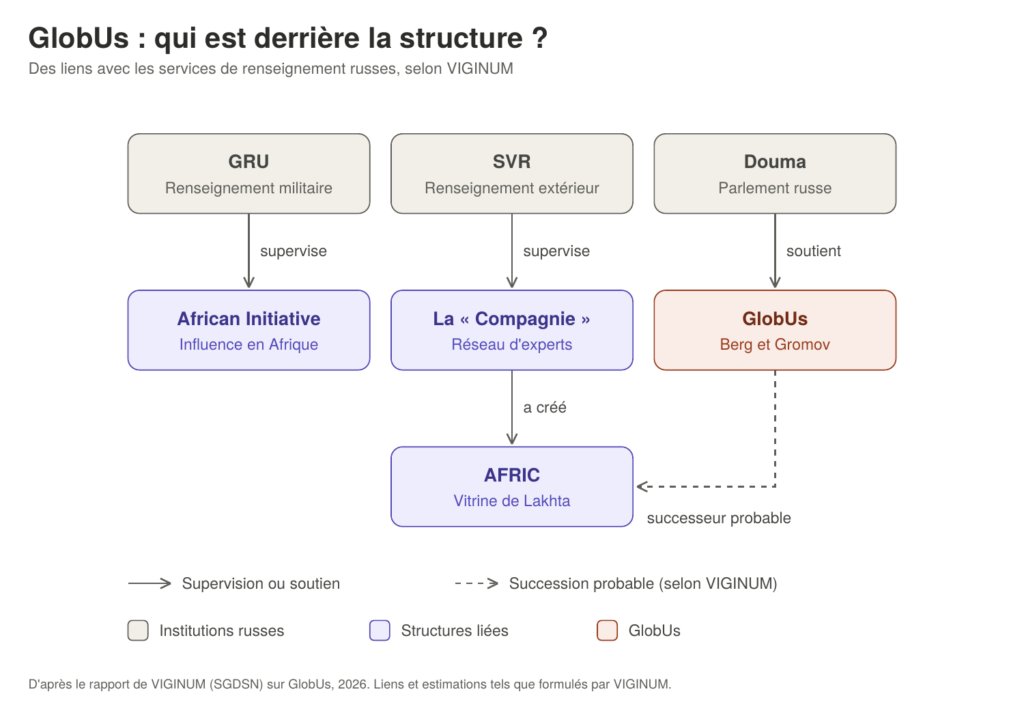
The death of Prigozhin, head of the Wagner Group, did not put an end to the influence activities associated with his circle. It ushered in a period of restructuring during which, according to VIGINUM, part of the former apparatus’s networks and resources was reorganised to the benefit of structures more closely linked to the Russian state and its intelligence services.
The report identifies several components of this environment, including Russian military intelligence, associated in particular with Africa Corps and African Initiative, and Russia’s Foreign Intelligence Service, to which certain structures inherited from Project Lakhta are said to be linked. GlobUs is thought to form part of this reshaping, though it is not presented as a mere administrative arm of the Russian state.
The French agency considers it likely that the organisation was identified and used by the Russian authorities or their services to facilitate influence operations. This conclusion rests on the profiles of its leaders, their ties to earlier networks and the activities observed. It does not mean that every GlobUs initiative was directly ordered by an intelligence service.
This distinction is crucial. The system described also operates as a marketplace for influence in which political entrepreneurs seek to secure funding, build their networks and pursue objectives that may converge with Moscow’s. The personal interests of the organisers and Russia’s geopolitical objectives can thus be mutually reinforcing, without necessarily being part of a single chain of command.
The approach is that of a flexible structure, able to change its name, partners or methods. An organisation can promote international cooperation, youth training or cultural exchanges while also taking part, according to the evidence gathered by VIGINUM, in an information manipulation strategy. It is precisely this overlapping of functions that makes the system difficult to identify from its public communications alone.
The local relay strategy: getting Africans to carry the narratives
At the heart of the mechanism described by VIGINUM lies the search for local relays. A pro-Russian message disseminated directly by a Russian media outlet or an official representative of Moscow may be perceived as foreign propaganda. The same narrative, taken up by a television presenter, an influencer, an activist or an association presented as independent, may enjoy a different kind of credibility with the public.
This strategy consists of “Africanising” the narratives, following the logic highlighted in the report. It is not simply a matter of translating messages into French or local languages, but of embedding them in existing political and social debates: sovereignty, colonial memory, criticism of former powers, rejection of outside interference and the search for new economic or security partnerships.
Russia thus presents itself as a partner that would respect the sovereignty of African states, unlike the Western powers it accuses of maintaining relationships of domination. This narrative strikes a genuine chord and cannot, as a whole, be dismissed as a foreign fabrication. Criticism of French policy in Africa has its own historical and political causes. The problem raised by the report is rather the organised exploitation of these grievances, when misleading or selective narratives are spread to serve outside interests.
VIGINUM thus describes programmes sponsored by GlobUs on pan-African media outlets, in which speakers presented as experts relay claims deemed inaccurate or misleading about France, Ukraine or relations between Paris and the countries of the Sahel. The aim is not merely to win an audience over to a particular position: it is also to delegitimise competing sources of information and to establish an interpretive framework in which Russian interests systematically appear compatible with those of local populations.
The effectiveness of this approach, however, depends on the trust placed in those relaying the message. Networks can multiply accounts and content without managing to shift opinions in any lasting way. A digital presence is an indicator of reach, not automatic proof of support.
Cameroon: the media as a testing ground
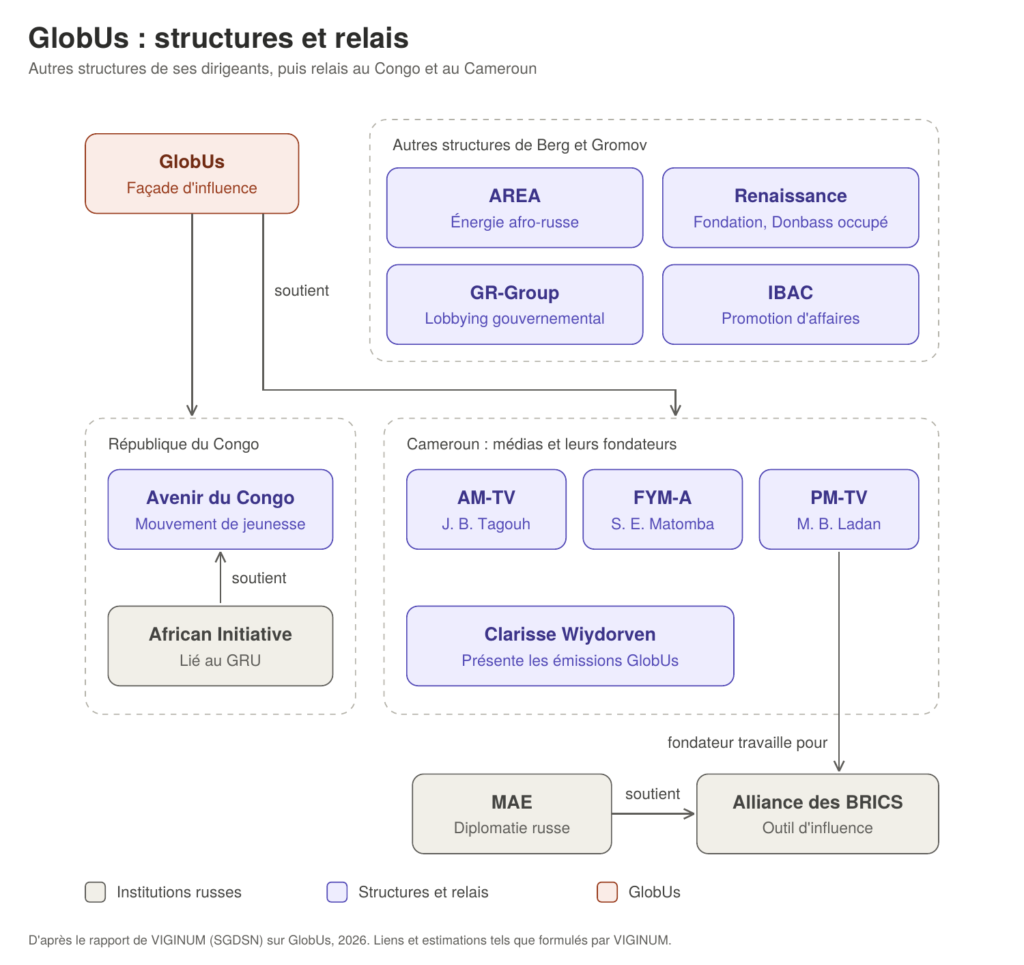
In Cameroon, the report highlights the use of pan-African media outlets as dissemination platforms. GlobUs is said to have sponsored programmes on Panafrican Média TV in particular, while bringing in figures already active in pro-Russian media circles.
The mechanism relies on an apparent separation between those who produce the narrative and those who disseminate it. The organisation that funds or organises a programme is not necessarily presented as its sponsor. Contributors may be introduced as political analysts or independent specialists, while the same arguments then circulate on social media and in other outlets.
This circulation allows messages to cross the boundaries between digital and broadcast spaces. It also complicates the work of observers: a single piece of content may resemble an ordinary political opinion, whereas its coordinated repetition across several channels may reveal a broader strategy.
The report links some of these practices to earlier Russian influence networks, notably AFRIC, an organisation presented as a community of experts and election observers. According to VIGINUM, these networks allegedly served to support political actors favourable to Russian interests and to intervene in electoral debates.
The material on South Africa’s 2019 and 2024 elections cited in the document illustrates how these networks may have sought to influence political campaigns. A distinction must nevertheless be drawn between the documents and activities identified, the attributions made by investigators and the actual extent of their impact on election results, which cannot be inferred from the mere existence of an operation.
Republic of the Congo: training, organising, securing loyalty
It is in the Republic of the Congo that the report describes most precisely how the digital presence ties in with a physical foothold. In the run-up to the presidential election of March 2026, GlobUs reportedly stepped up its initiatives in Brazzaville: an exhibition on international relations, socio-economic surveys, the opening of a “Media School”, sporting activities and the creation of a youth movement called “Future of Congo” (“Avenir du Congo”).
These activities may serve several purposes. Public events give the organisation visibility and help to present Russia as an active partner. Field surveys make it possible to gather information on people’s expectations and on local networks. Training courses can give young participants practical skills, but can also forge lasting ties with the organisers and help to build a network of relays.
The “Media School” holds a special place in this alleged strategy. According to VIGINUM, it was reportedly used in particular to train future presenters and content creators, some of whom went on to take part in the digital ecosystem of “Avenir du Congo”. The French agency believes that this structure, presented as a movement of young Congolese, was largely conceived and driven by GlobUs.
The report also points to technical evidence concerning the movement’s digital infrastructure: hosting in Russia, Cyrillic-language elements in the website’s source code and links to accounts or addresses associated with GlobUs. On this basis, VIGINUM assesses with a high level of confidence that people linked to GlobUs took part in creating this digital environment.
The strategic advantage is clear: a movement that appears to emerge spontaneously from civil society can lend local legitimacy to messages that would otherwise be identified as foreign. The movement does not merely relay content; it can also organise activities, attract new participants and produce its own publications.
Finally, the report describes links between GlobUs and African Initiative, notably around the promotion of the AFree social network and events held in Brazzaville. What emerges is a picture of an ecosystem made up of several structures, sometimes separate, but capable of supporting one another and pursuing convergent goals.
Influence is not limited to disinformation
Reducing this strategy to the spread of false information would fall short. The report stresses the interweaving of communication, training, public diplomacy, sporting initiatives and projects presented as humanitarian.
This diversity can make influence more lasting. An exhibition or a sporting competition creates a tangible experience; training provides skills and contacts; a social initiative can meet a local need. These activities help to establish a positive image of Russia as a partner, which can then be drawn upon in political and media debates.
Even so, not every cultural, educational or economic partnership with Russia should be regarded as an influence operation. African states have their own diplomatic interests and are seeking to diversify their partnerships. Local actors may also genuinely support certain initiatives. The central question is whether activities are transparent, whether their funding and sponsors are known, and whether they serve to manipulate public debate or to conceal political interference.
This distinction is crucial if one is not to reproduce, in reverse, a view in which African societies are mere passive arenas for rivalry between powers. Politicians, journalists, associations and citizens have their own strategies and their own capacity for judgement. A rigorous analysis must acknowledge this autonomy while examining the documented mechanisms of influence.
France faces competition that is not played out solely online
For Paris, the report highlights a strategic difficulty. The response to influence operations cannot be limited to removing accounts or issuing denials. When narratives draw on historical grievances, social frustrations or criticism of French foreign policy, a purely technical response risks missing the heart of the problem.
Transparency about funding and affiliations, stronger media literacy, support for independent journalism and content verification are all important levers. But they must be accompanied by reflection on why certain narratives strike a chord. France’s credibility also depends on the consistency between its statements and its practices, and on its ability to accept an open debate about its role in Africa.
The same standard applies to the authorities of the countries concerned. They may seek to protect their political processes from interference without turning that fight into an instrument for controlling public opinion. The distinction between covert foreign influence, legitimate cooperation and local political expression must be drawn on the basis of verifiable evidence, with due respect for press freedom and pluralism.
Finally, the GlobUs case is a reminder that digital platforms are only one part of the infrastructure of influence. Social media accelerate the spread of messages, but their potential effectiveness rests on offline relationships, training, funding and human intermediaries.
Not overestimating the operation’s power
VIGINUM itself issues an important caveat: the actual effectiveness of GlobUs on the targeted populations has yet to be established. Influence operators have an interest in presenting their campaigns as successes, whereas the number of posts, accounts or followers does not necessarily demonstrate a shift in opinion.
This caution avoids portraying Russia as omnipresent and all-powerful, an image that could, paradoxically, reinforce the narratives it seeks to promote. An operation can be technically sophisticated without being politically decisive. Measuring its impact would require independent studies on audience exposure, how the messages are received, shifts in perceptions and any effects on political behaviour.
The report also raises a more serious issue concerning Cameroon: it mentions the case of Cameroonian nationals who were allegedly recruited with false promises of employment before ending up fighting on the Russian front line in Ukraine. The document does not make it possible to hold GlobUs directly responsible for these recruitments. It nevertheless calls for close scrutiny of the possible links between influence networks, promises of cooperation and Russian interests in the country.
Beyond the GlobUs case, what is at stake is information sovereignty. This does not mean closing societies off from foreign ideas, nor treating all criticism of the West as suspect. It requires that citizens be able to identify the interests at play, know the sources of funding of organisations taking part in public debate, and distinguish a freely held opinion from a coordinated, covert campaign.
The report’s main lesson, then, is less that of a Russia capable of controlling everything than that of an apparatus seeking to make its influence local, everyday and hard to distinguish from ordinary public life. It is precisely this boundary, between visible cooperation and covert interference, that today constitutes one of the major challenges of geopolitical competition in Africa.
Translated from French. The French original prevails.