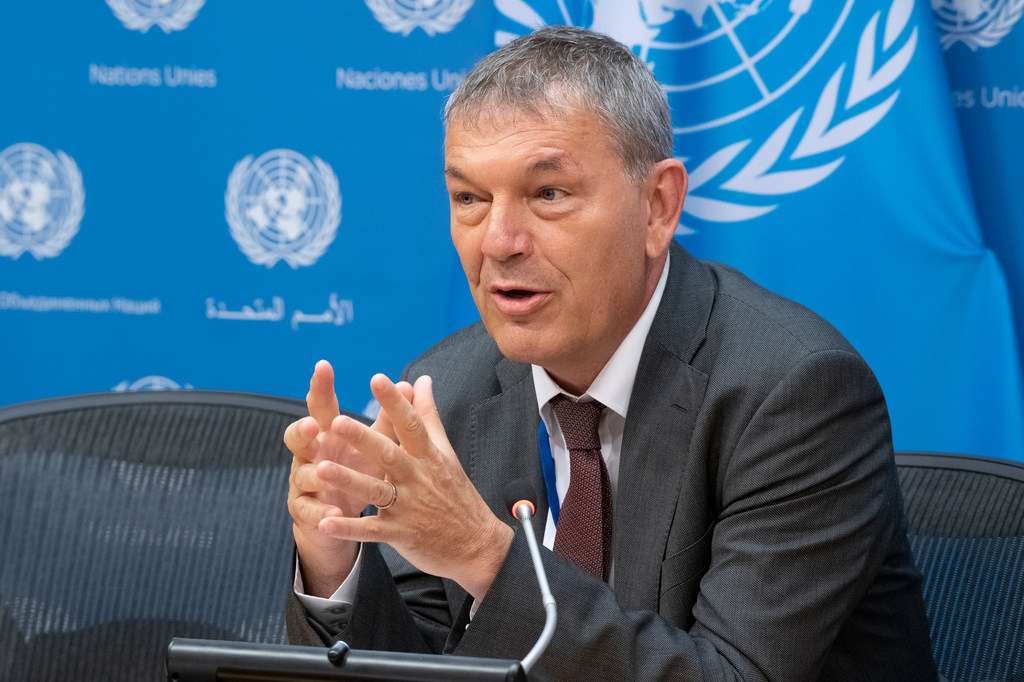
The UNRWA Commissioner-General, Philippe Lazzarini, speaking to the press in New York (file photo). Photo/Evan Schneider
Asking , is perhaps an unfair question.
“There is no doubt that I have mixed feelings today.” Philippe Lazzarini, a Swiss veteran of humanitarian action, is reaching the end of his second term at the head of UNRWA, the United Nations Relief and Works Agency for Palestine Refugees in the Near East. “I feel bitterness, because over the past two years I have had a front-row seat to extraordinary violations of international law, and have witnessed atrocities and attacks against the United Nations; sadness, because many of our colleagues have been killed — nearly 400 in two years — a toll unprecedented in the entire history of the United Nations.”
“But also a certain pride, because over these past two years I have seen just how much our staff… have shown extraordinary commitment in trying to ease the suffering of a great many people in their own community.”
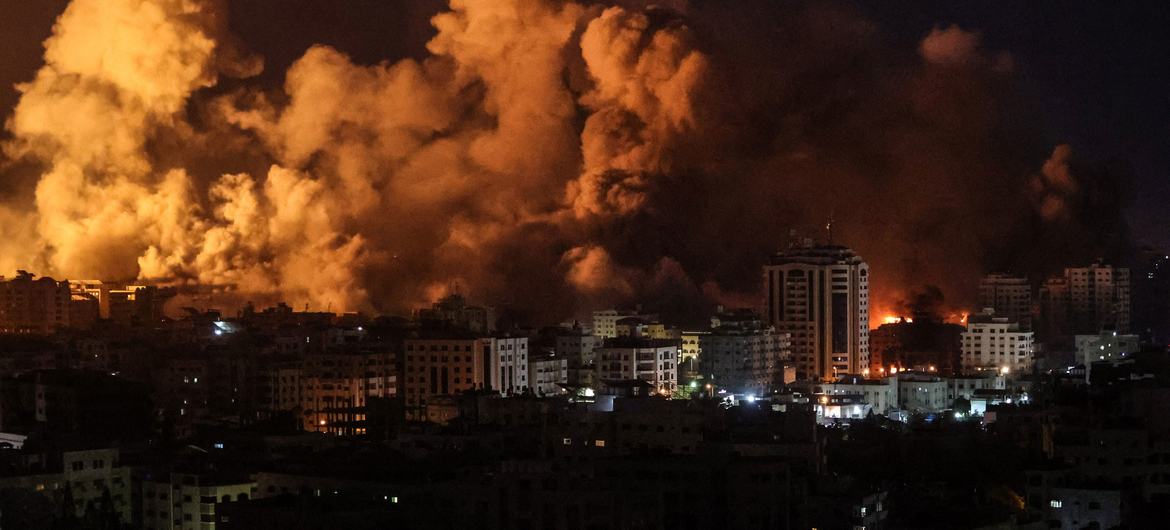
Air strikes on Gaza (file photo). WHO/Ahmed Zakot
Nine UNRWA employees suspected of taking part in the pogrom have been dismissed
As well as being the face of an agency that is constantly vilified and accused online of collaborating with Hamas fighters in Gaza, he has witnessed the devastating impact of Israel’s war on the population of the Palestinian enclave and on UNRWA — a conflict triggered by Hamas’s bloody attacks in Israel in October 2023.
A high-level UN investigation into the accusations levelled against UNRWA concluded that, of the 19 staff members accused of taking part in the attacks, one case was not supported by any evidence, while in nine others the evidence was insufficient to support any involvement.
In the remaining nine cases, the evidence suggested that these UNRWA staff members may have been involved in the 7 October attacks. The agency then announced that they had been dismissed.
Today, suffering and death continue to stalk the entire Gaza Strip. One encounter with a Gaza resident, at the very start of the conflict, remains particularly unforgettable for Mr Lazzarini — despite his many years of experience in conflict zones around the world, from Angola to Iraq, and from Somalia to South Sudan.
Haunted by hunger in human eyes
“It was a young girl I met in Rafah, four weeks after the war began. I saw her, with an empty gaze, actually begging for a sip of water or a piece of bread in the very school where she had once been a pupil. So this school, which should have been a place of joy and learning, became a place of misery and a shelter for these young girls. And I have to say that this image haunts me, because I have children of the same age myself.”
“This is nothing other than pure suffering,” he continues. “We may have managed to halt the spiral of worsening hunger in Gaza, but that is all. People are still living amid the rubble and still waiting hours for drinking water. They are struggling and battling disease.
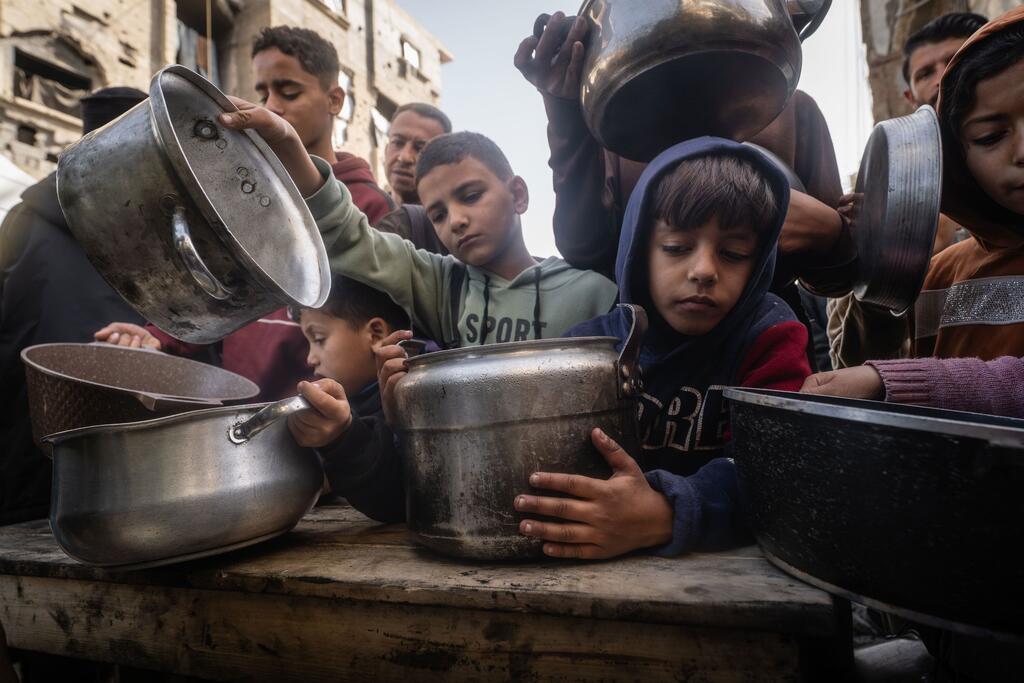
Children wait to be served a hot meal at a community kitchen in Gaza (file photo). WFP/Maxime Le Lijour
No real alternative to UNRWA in Gaza
Faced with such suffering, Mr Lazzarini dismisses suggestions that another body could take UNRWA’s place. “There is no operational alternative in Gaza,” he insists. “UNRWA is the only organisation with the staff, the expertise and the trust of the community when it comes to public health and education services. There are no other NGOs or other United Nations agencies. But we also know that the Palestinian Authority is not ready to take over the running of these services.”
Beyond the attacks on UNRWA staff and on hundreds of the agency’s buildings in Gaza, its ability to provide essential services – both in Gaza and beyond – has been severely constrained by a lack of financial support from the international community, support that should have matched the three-year extension of its mandate voted by the United Nations General Assembly last December.
A UN agency running out of breath
Despite austerity measures — including cuts to services and a 20% pay cut for most local staff — the warning Mr Lazzarini gave the President of the General Assembly, that UNRWA “could soon cease to be viable” without concrete financial contributions, still stands. Yet political support is also invaluable, and not only for the survival of his agency, he explains.
“The attacks against UNRWA are not an exception; they cannot be treated in isolation. If we tolerate such attacks against an agency like ours, others will follow. And that is exactly what happened in Gaza: UN agencies were singled out and accused of being infiltrated by Hamas, in order to justify action taken against them… And today we are hearing exactly the same rhetoric; we are seeing the same pattern repeat itself in Lebanon.”
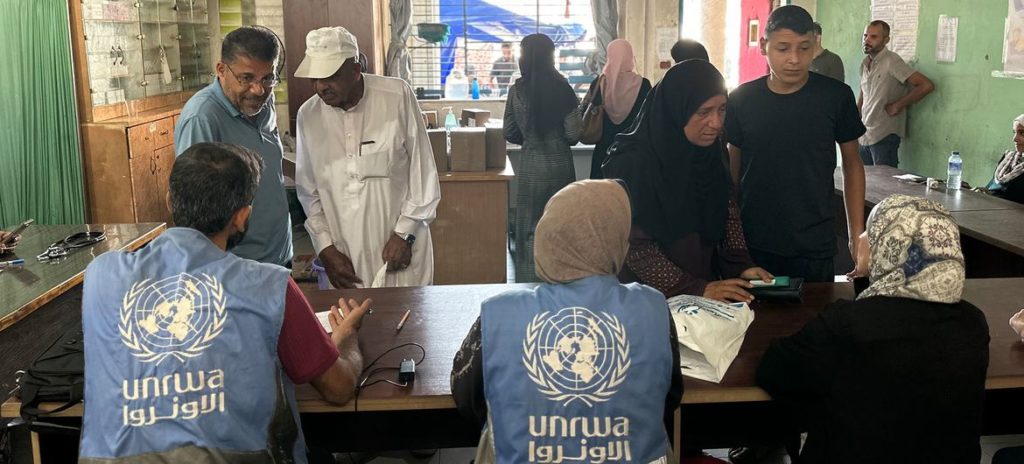
UNRWA teams in Gaza City continue to provide medical services. UNRWA
Israel’s “silent war” in the West Bank
Far from Gaza, the dire situation of Palestinians in the occupied West Bank, who face mounting attacks by Israeli settlers, has also brought to light the “silent war” being waged there “with total impunity”, Mr Lazzarini continues.
In January, Israeli bulldozers entered the UNRWA headquarters in East Jerusalem and demolished buildings on site, while an Israeli flag was raised atop the UN compound — an act firmly condemned by the United Nations as a violation of international law.
“When we talk about, you know, respect for international law, we see that this blatant contempt and disdain — the fact that everything has been conducted without the slightest regard for the rules of war — has now allowed the conflict to spread as far as Iran, without there being any justification for unleashing a war of such magnitude, one that affects the entire region,” the head of UNRWA argues.
© UNRWA
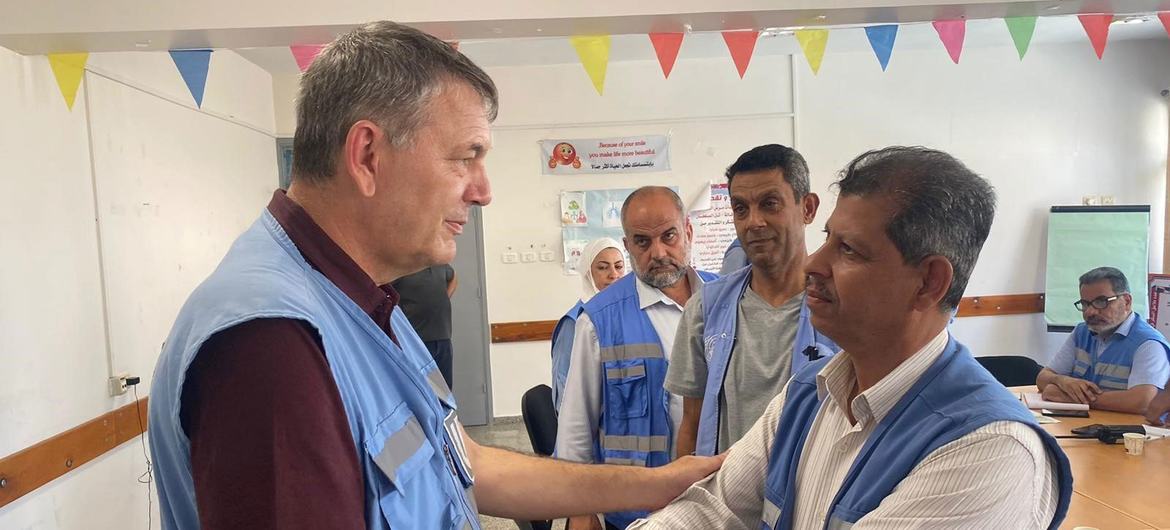
UNRWA Commissioner-General Philippe Lazzarini visits colleagues in Gaza (file photo).
BREAKING NEWS. The UN human rights chief, Volker Türk, on Tuesday urged Israel to repeal a law passed by its parliament on 30 March reinstating the death penalty under terms that apply almost exclusively to Palestinians. “It is deeply disappointing that this bill was approved by the Knesset,” Volker Türk, the United Nations High Commissioner for Human Rights, said in a press release. “It is clearly incompatible with Israel’s obligations under international law, including with regard to the right to life. It raises serious concerns about violations of due process guarantees, is deeply discriminatory and must be promptly repealed.” Among other problematic provisions, the law makes execution by hanging the default sentence for Palestinians convicted in the occupied West Bank of deadly attacks on Israelis. It also stipulates that death sentences, once handed down, must be carried out within 90 days – which in itself constitutes a violation of international humanitarian law. Furthermore, the law makes no provision for the possibility of a pardon, as required by international human rights law.
Translated from French. The French original prevails.