At its fourth Universal Periodic Review, Tanzania announced that it supports 70% of the recommendations made by states. The authorities highlighted institutional reforms and social progress, while maintaining reservations on several issues relating to individual freedoms. Implementing these commitments and addressing the aftermath of the electoral violence remain major challenges.
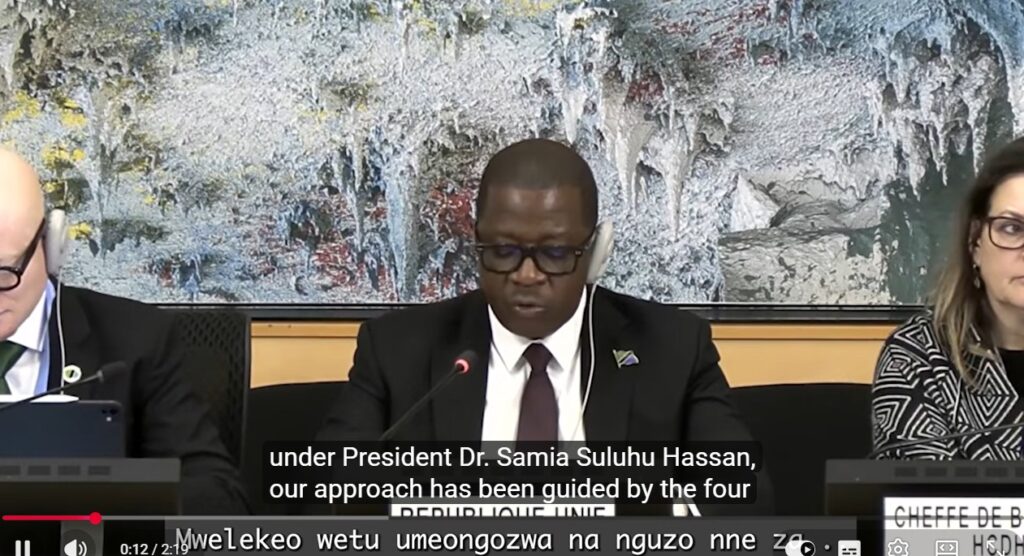
Tanzania has announced that it supports 196 of the 280 recommendations it received during its fourth Universal Periodic Review (UPR), the United Nations mechanism for assessing the human rights situation in every member state. The Minister for Constitutional and Legal Affairs, Abdallah Hamis Ulega, presented these initial positions on 13 November 2026 at the 53rd session of the UPR Working Group, following the country’s review on 5 November.
Of the remaining recommendations, 68 were ‘noted’ – a term meaning that the government does not support them – and 16 are still under consideration. For the latter, the authorities wish to examine their legislative, policy and financial implications in greater depth before communicating a final position. Consultations are planned with the judiciary, Parliament, civil society and the national human rights institution.
The recommendations not supported include, in particular, proposals concerning same-sex relationships. The government cites the country’s traditions and customs, as well as its constitutional, legal and policy frameworks, to justify its position.
Political reforms in the spotlight
Before the delegations gathered in Geneva, the Tanzanian authorities defended the record of reforms undertaken since the previous review in 2021. They framed them within President Samia Suluhu Hassan’s ‘four Rs’ philosophy: reconciliation, resilience, reforms and rebuilding.
The government cited, among other things, the resumption of inter-party dialogue, the lifting of restrictions on political rallies and the end of the suspension of four newspapers. It also highlighted changes to the procedures for selecting certain members of the electoral commission and to the rules governing unopposed candidacies.
On the media, the delegation reported amendments to, and reviews of, several laws on the press, access to information and cybercrime, notably the removal of criminal defamation provisions.
These announcements come with a sensitive issue attached: the aftermath of the violence surrounding the general elections of 29 October 2025. The government described the events as deeply regrettable and acknowledged the loss of life and the suffering of families and communities.
According to information presented by the delegation, a presidential commission of inquiry, established on 18 November 2025, made its main findings public on 23 April 2026. A separate commission responsible for criminal investigations was then set up to examine possible criminal liability. The authorities say they intend to establish the facts and prosecute those responsible in accordance with judicial procedures.
Justice, equality and the protection of vulnerable people
Access to justice featured prominently in the record presented in Geneva. On the mainland, the government reports that the proportion of backlogged cases fell from around 10% to 5%, and that the average time taken to process a case dropped from 95 to 66 days. In Zanzibar, the case backlog rate reportedly fell from 43% to 18%.
The ‘Mama Samia’ legal aid campaign is said to have reached some 7.9 million people, more than four million of them women. The translation of 446 pieces of legislation into Kiswahili is also intended to make the law more accessible.
On equality, the authorities state that women made up 39.3% of members of Parliament in 2025 and 36.5% of the judiciary. The proportion of women holding land rights reportedly rose from 28.5% in 2020 to 35% in 2025.
The delegation also presented measures to combat violence against women and children, expand inclusive education and strengthen the protection of persons with albinism. The supported recommendations cover these areas, as well as efforts to combat harmful traditional practices.
Social rights at the heart of the government’s record
Tanzania devoted a large part of its presentation to essential services. According to government figures, the education budget rose from around 5.6 trillion Tanzanian shillings in 2022–23 to 6.3 trillion in 2025–26. The authorities reaffirmed their commitment to free basic education and to enabling pupils who have dropped out of school to return, in particular adolescent girls after pregnancy.
In health, they report more than 10,000 facilities on the mainland in 2026, compared with 8,458 in 2022. They also report a fall in maternal mortality from 197 to 104 deaths per 100,000 live births on the mainland, and from 166 to 119 in Zanzibar.
The government also reports a decline in the basic needs poverty rate, from 26.4% in 2020 to 24.9% in 2025, as well as wider access to safe drinking water and electricity.
From diplomatic support to practical implementation
The 196 supported recommendations cover, among other areas, constitutional and electoral reform, the administration of justice, institutional accountability and the protection of fundamental freedoms. They also address gender equality, child protection, the inclusion of persons with disabilities and equitable access to public services.
Tanzania intends to mobilise its international partners to support their implementation, within the framework of its Development Vision 2050. Human rights education, the dissemination of laws in Kiswahili and the responsible use of technology in public services are among the proposed areas of cooperation.
In Geneva, the authorities thus set out a broad programme of commitments. Their scope will now be measured by how they translate into public policy, by the effective protection of freedoms and by the judicial follow-up to the electoral violence.
(This article was written with the help of AI on the basis of a press release.)
Translated from French. The French original prevails.