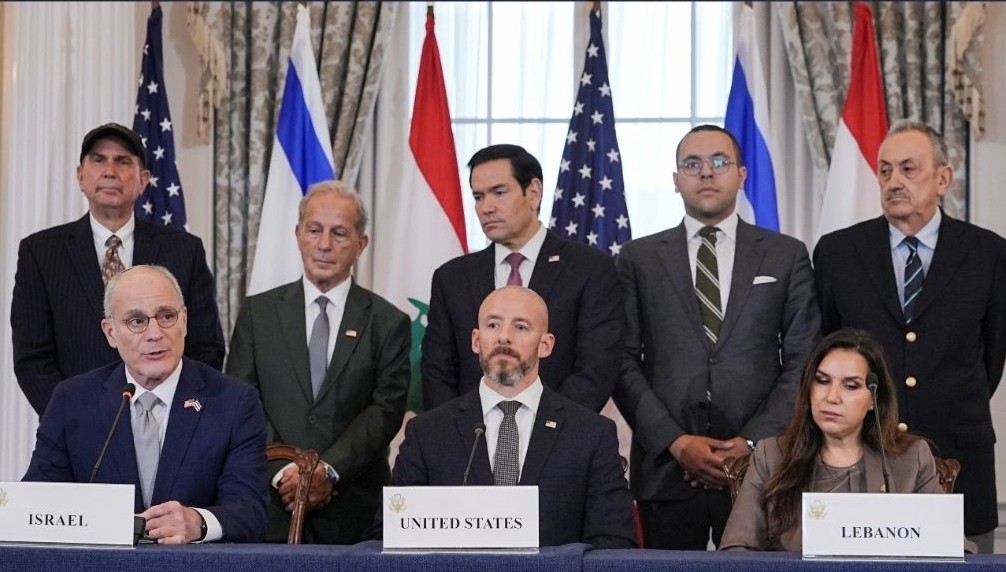
The “Framework Agreement” signed between Lebanon and Israel under the auspices of the United States, with the support of Arab countries and the international community, is not merely a bilateral arrangement intended to settle border and security issues. It forms part of a far broader regional transformation, marked by the redefinition of relations between Washington and Tehran and by the American determination to move from a logic of managing wars to a strategy of managing balances of power. Seen in this light, the agreement extends well beyond Lebanon: it is one of the pillars of a regional project aimed at consolidating stability and preventing a fresh confrontation that could threaten energy security and the global economy.
The agreement in the context of US-Iranian dynamics
The central question is now this: will the United States, the Arab countries and the states called upon to take part in the security guarantees – notably Saudi Arabia, Qatar, Egypt and Pakistan – be able to compel Iran to give up a network of influence built up over several decades in the Middle East, of which Lebanon’s Hezbollah is one of the main instruments?
The statements made by US Secretary of State Marco Rubio after the signing of the agreement, announcing $30 million in aid to the Lebanese army as well as direct oversight by Washington of the tripartite military coordination mechanism between Lebanon, Israel and the United States, reflect American determination to implement the agreement. By contrast, the signals remain uncertain as to Tehran’s willingness to accept this new trajectory.
The implementation of the agreement will therefore depend as much on broader regional compromises as on the will of the Lebanese authorities alone. In this context, a distinction should be drawn between what Iran wishes to preserve and what it will actually be able to retain if, in its political confrontation with Washington, it finds itself forced to choose between maintaining its armed wing in Lebanon and securing agreements with the United States on issues it considers priorities, foremost among them its nuclear programme, international sanctions and freedom of navigation in the Strait of Hormuz.
The Lebanese-Israeli agreement therefore cannot be analysed independently of the new US strategy in the Middle East. That strategy no longer seeks to bring about regime change in Iran or to engage in open confrontation, but rather to integrate Tehran into a system of deterrence and tension management, in order to preserve regional stability and avoid any escalation liable to threaten the global economy and energy markets.
Regional security and international stability
Marco Rubio’s recent tour of the Gulf states confirms this direction. Its aim was to reassure America’s Arab allies by stating that any rapprochement with Iran would come neither at the expense of Gulf security nor of the regional balance. US policy now appears to rest more on managing the balance of power between adversaries than on seeking a decisive military victory.
This approach was also confirmed in the communiqué issued after the meeting between the foreign ministers of the Gulf Cooperation Council and Marco Rubio. The text stresses the need to separate the Lebanese issue from other regional conflicts and welcomes “a pragmatic approach that will make it possible to restore security, extend the authority of the Lebanese state and proceed with a permanent demarcation of the borders”. It also underlines that “Lebanon’s full sovereignty cannot be achieved as long as non-state armed groups retain military capabilities outside the authority of the state”, calling for the complete disarmament of these groups and the restoration of the monopoly on the use of force by Lebanese institutions, with stronger support for the Lebanese Armed Forces.
In this new configuration, Lebanon is becoming one of the main testing grounds for this regional strategy, since it is where Iranian, American, Israeli, Arab and European interests converge. The agreement is therefore not an end in itself, but the first step in a process intended to stabilise the borders on a lasting basis and pave the way for broader political and economic arrangements.
The challenges of Lebanon’s domestic scene
In light of these developments, the “Framework Agreement” is of exceptional importance for Lebanon. It marks a major turning point in the country’s foreign policy, opening a new phase in the organisation of security relations with Israel. It also enshrines the shift from a logic of permanent conflict management to one of organising the post-conflict period, under American supervision and with the support of Arab and international partners.
The agreement also reflects a shift in Lebanon’s traditional approach to the conflict, prioritising the restoration of national sovereignty and the recovery of territory south of the Blue Line through direct understandings between the two states. The centre of gravity is thus moving away from international negotiations towards Lebanon’s ability to implement its commitments on its own territory.
The agreement provides for an Israeli withdrawal from the territories still occupied, but this remains conditional on the Lebanese state honouring its security commitments, notably the state’s exclusive monopoly on weapons and the elimination of any military presence outside the legitimate institutions, including Hezbollah’s military infrastructure and Iranian military influence.
It is precisely here that the most difficult test begins. Hezbollah and its allies have rejected the agreement, arguing that it calls into question their status and their political and military role. Protests broke out as soon as it was announced.
The challenge, however, goes beyond security alone. It also concerns redefining the role of the state and its exclusive authority over the whole of the national territory, at a time when economic reconstruction will be largely conditional on these commitments being honoured. The main issue is therefore no longer negotiating with external actors but managing deep internal divisions, with the risk of heightened political polarisation, demonstrations, sit-ins and fresh security tensions if no national compromise is found.
Israel, for its part, considers that the strategic objectives of the last war will not be achieved as long as Hezbollah retains an organised military capability. The Jewish state is therefore likely to keep up diplomatic, political and, where necessary, military pressure whenever it judges that the movement is rebuilding its arsenal or acquiring new capabilities.
Hezbollah, for its part, is aware that keeping its arsenal under the conditions that prevailed before the war has become far more costly, both domestically and regionally. It nevertheless believes that disarming without a comprehensive agreement or political and security guarantees would amount to giving up its role in Lebanon and in the region.
The “Framework Agreement” on Lebanon is now a major test for both Washington and Tehran in their political confrontation, which could take on a military dimension again at any moment. Within Lebanon, the agreement does not mark the end of the conflict but the start of a new phase, one that will test the state’s ability to fully restore its sovereignty in a regional environment that remains extremely complex.
Its success will be measured not only by the Israeli withdrawal or the country’s reconstruction, but above all by the ability of Lebanon’s institutions to restore their authority over the whole of the national territory and to manage deep internal divisions without sliding into a fresh large-scale political or security confrontation.
Translated from French. The French original prevails.