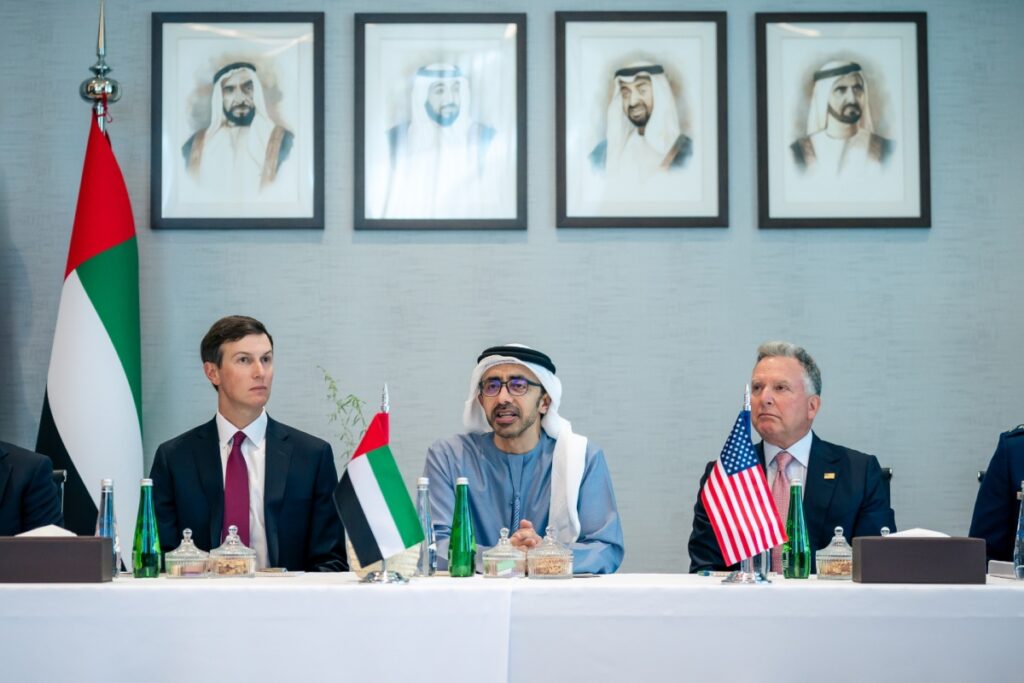
The Prime Minister and Minister of Foreign Affairs of the United Arab Emirates, flanked by US envoys Jared Kushner and Steve Witkoff in Abu Dhabi. Photo: UAE Ministry of Foreign Affairs.
The Abu Dhabi meeting of 10 and 11 November, attended by Ukraine, the United States and Russia, did not bring the parties any closer to a political settlement. The agreement on a large-scale exchange of prisoners of war is nonetheless an important humanitarian outcome. But a prisoner exchange is not a peace negotiation, and the mere fact that a meeting took place is no evidence of the parties’ willingness to seek a common solution.
Moscow continues to demand that Ukraine withdraw its troops from the part of Donbas it has failed to conquer. Kyiv refuses to legitimise the occupation. Washington is looking for a formula that could be presented as a diplomatic success. In these circumstances, to speak of a breakthrough in the negotiations is to mistake form for substance.
Abu Dhabi showed, rather, how a diplomatic process can be turned into political stage scenery. Contacts continue and statements about progress multiply, but the fundamental contradiction remains: Russia wants to reap the political rewards of its aggression, while Ukraine cannot accept that those gains should serve as the basis for peace.
It is telling that the European representatives who travelled to Abu Dhabi held separate consultations with the American and Ukrainian sides, without taking part in the direct negotiations with Russia. Europe, whose security depends directly on the outcome of the war, once again found itself beside the negotiating table rather than at it.
Washington: peace as a political result
For Donald Trump, ending the war in Ukraine is not only a matter of foreign policy. It is also an opportunity to demonstrate his own ability to strike a deal where his predecessors achieved no result. Hence his desire to reach an agreement quickly that he could present as a personal diplomatic achievement.
But a political result and a lasting peace are not the same thing. An agreement can end the fighting while leaving unanswered the questions that led Russia to start the war. If speed becomes the main criterion, the risk of making Ukraine bear the cost of the deal will only grow.
That risk became clear in Volodymyr Zelensky’s statement of 14 November. According to him, American negotiators raised the possibility of a withdrawal of Ukrainian forces from the part of Donbas still controlled by Ukraine in exchange for its membership of NATO. This is neither a concluded agreement nor a position officially confirmed by the American president. But the very appearance of such a formula is revealing.
In this formula, a territorial concession by Ukraine is envisaged as a possible instrument of a deal with Russia. NATO membership, by contrast, does not depend on Washington alone, but also on the agreement of all the Allies. The result is an unbalanced exchange: Ukraine is expected to take a concrete decision about its territory, while the security it would receive in return still requires political agreement.
Zelensky said that Ukraine was not prepared simply to give up its territory, but that, given comprehensive security guarantees, a strong army and funding for reconstruction, such a proposal could be put to a referendum. And the essential question is not whether Kyiv is willing to consider difficult decisions. It is whether Ukraine is being asked first to give up what it is defending, in exchange for guarantees whose reliability has yet to be demonstrated.
Moscow: a return to the top table
For the Kremlin, the war against Ukraine has always been about far more than an attempt to change borders. Moscow seeks to call into question the entire European security order – the very order it tried to challenge through the ultimatum-style demands it made of the United States and NATO as early as December 2021.
Those demands are now back on the negotiating agenda. The Russian side is calling in particular for NATO’s military presence in Europe to return to its 1997 level. That would in effect limit the sovereignty of the states that joined the Alliance after that date when it comes to choosing their own security guarantees. Moscow seeks to discuss not only Ukraine’s future, but also the right of other European countries to decide their own security.
This is one of the main aims of Russian diplomacy: to shift the debate from responsibility for the aggression to the negotiation of a new balance of power. It is no longer for Russia to explain why it attacked Ukraine, but for other states to work out how to accommodate its demands.
For the Kremlin, negotiations with the United States have another advantage: they bring Russia back into the game of great-power geopolitics. Instead of the withdrawal of troops and an end to the aggression, the debate widens to European security, in a format in which Moscow intends to present itself as Washington’s equal, with the right to set the rules for others.
The meeting between Donald Trump, Vladimir Putin and Xi Jinping scheduled for 19 November in Shenzhen adds another dimension to this context. For the time being, the precise agenda has not been made public; the American side has mentioned nuclear disarmament among the topics under consideration. But the very format of this meeting between the three leaders carries symbolic importance for the Kremlin: Russia is seeking to show that it remains a player in world politics, despite the war and its international isolation.
Europe: responsibility without a decisive voice
European security depends directly on the outcome of the war, and Europe provides Ukraine with considerable financial and military aid. Yet its influence over the key diplomatic decisions remains limited.
European states differ in their assessment of the Russian threat, have unequal defence capabilities and depend to varying degrees on American guarantees. Added to this are disagreements over the pace and scale of support for Ukraine. A common position is taking shape slowly, whereas in wartime, time itself becomes a political resource.
Europe has economic weight, sanctions instruments and significant defence production potential. But these resources do not always translate into a common political will. Its dependence on American military capabilities further limits its room for manoeuvre.
At the European Political Community summit in Dublin on 12 November, an important signal was sent: European leaders agreed that representatives of the United Kingdom, France, Germany, Italy, Poland and the institutions of the European Union would take part in the next negotiations. This is a step towards a stronger European presence at the negotiating table. But the very fact that this representation had to be secured separately shows how limited Europe’s influence had been until then.
For Ukraine, this question is of direct importance. Europe will bear a large share of the consequences of any settlement, but its political weight will depend on its ability to turn its economic resources and security interests into a common position. Otherwise, its participation risks being reduced to financing decisions taken by others.
Ukraine: not an object of negotiation
In diplomatic discussions on Ukraine, the words ‘compromise’, ‘concessions’ and ‘guarantees’ recur more and more often. But this language risks obscuring an essential reality: Ukraine is not the party that caused this conflict and should not bear the bulk of the political cost of ending it.
Dependence on the military and financial support of its partners is a reality that Kyiv cannot ignore. But it does not call into question Ukraine’s right to decide its own future. Nor does it turn its territory into a resource that its allies could dispose of in order to reach a deal with Moscow.
The Ukrainian position must take into account not only the front line, but also what will happen after a ceasefire. If Russia retains its military potential, its political ambitions and the capacity to launch a new attack, the ceasefire risks becoming a pause for it rather than the end of the war. That is why security guarantees, defence capabilities and long-term support for Ukraine are not a mere supplement to a territorial agreement, but decisive conditions of it.
The question is not whether Ukraine must be ready to take difficult decisions. It is already paying a price for this war that bears no comparison with the political risks run by its partners. The question lies elsewhere: is there not an attempt, in the name of realism, to make the willingness of the victim of aggression to give ground the main condition for peace?
In this diplomatic game, international law increasingly appears not as the foundation of agreements, but as an inconvenient constraint for those seeking a quick political result. Yet a ceasefire does not, in itself, mean peace. And an agreement reached at the price of legitimising territories conquered by force does not remove the causes of the war. It merely postpones the conflict.
The question is not whether negotiations are necessary. It is whether they risk becoming a mechanism by which the law of force is presented as the force of law. And whether, under the guise of peace, Ukraine is being asked to accept that aggression can become the foundation of a new order.
Translated from French. The French original prevails.