On the sidelines of the 62nd session of the Human Rights Council, researchers, international experts and senior officials argued for an approach that goes far beyond climate issues. Behind the debates on energy, a new architecture of global governance is taking shape, in which human rights, artificial intelligence, technological sovereignty and development are becoming inseparable.
For a long time, international negotiations dealt separately with climate issues, energy policy, human rights and economic development. The conference held on 25 June at the Geneva Press Club demonstrated that this fragmentation is now a thing of the past.
Meeting on the sidelines of the 62nd session of the United Nations Human Rights Council, academics, energy specialists, researchers and civil society representatives outlined a far more systemic reading of today’s transformations. The energy transition no longer appears as a mere response to climate change; it is becoming one of the main determinants of the geopolitical balance of the 21st century.
This shift is not merely conceptual. It reflects a strategic reality. Electricity infrastructure, digital networks, data centres, artificial intelligence, critical mineral supply chains and research capabilities are now as much instruments of power as oil and gas resources were in the previous century.
It is precisely this analytical framework that the organisers – the International Observatory for Peace, Democracy and Human Rights (IOPDHR-Geneva), the Alliance Suisse-Maroc and the international NGO P.D.E.S. – sought to bring before the international community. By placing the right to development at the heart of the debate, they proposed an approach that goes beyond traditional environmental policies to examine the conditions for a truly just transition.
The choice of Geneva carried particular significance. At a time when the multilateral system is facing successive crises, the city on Lake Geneva remains one of the few places where researchers, diplomats, international organisations and civil society representatives can still compare their analyses within an institutional setting. More than simply a host city, Geneva continues to serve as a laboratory for new forms of global governance.
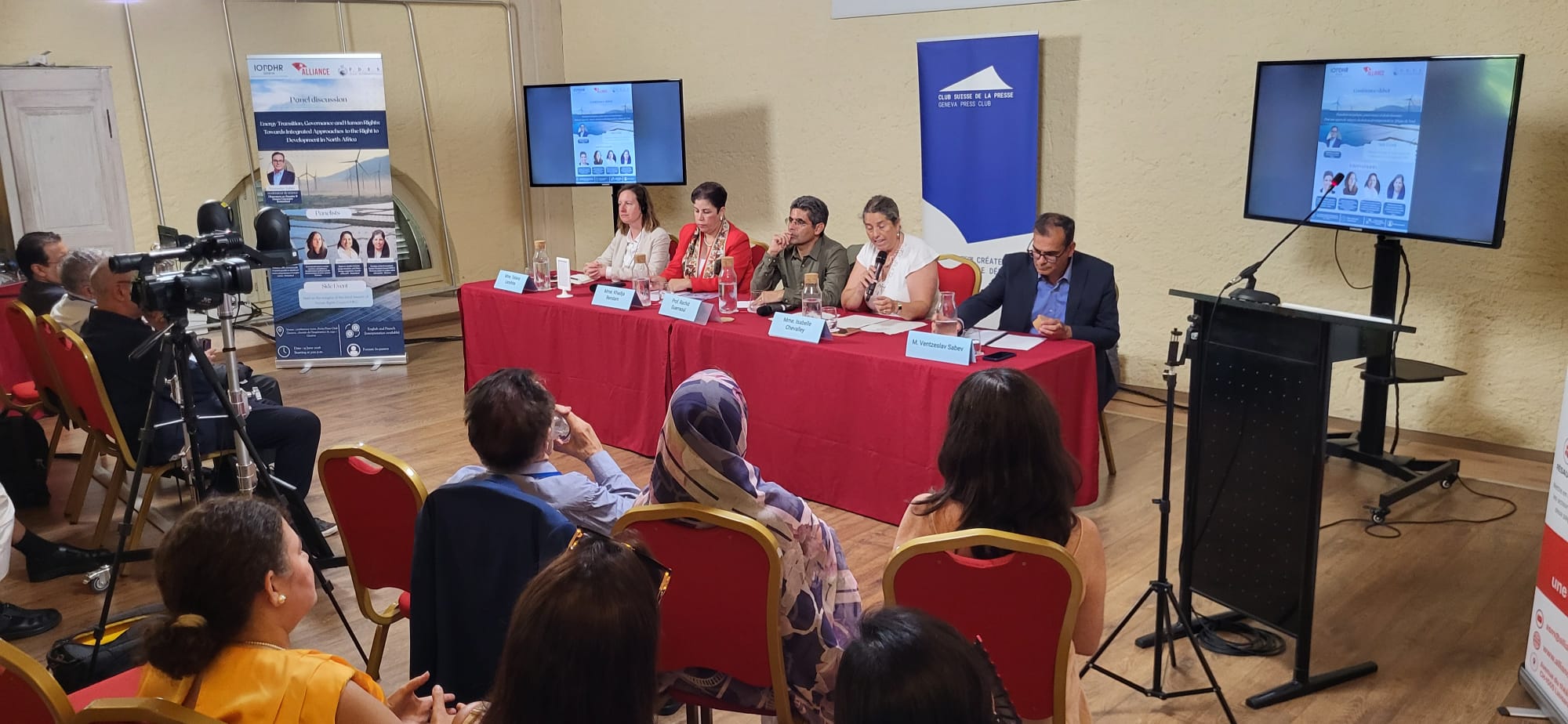
The contributions illustrated this determination to break down silos between approaches. Isabelle Chevalley placed access to energy within a broader reflection on economic development. For the former Swiss parliamentarian, the difficulties faced by many African projects stem not from a lack of capital but from a lack of trust. The energy transition cannot advance without international mechanisms capable of securing investment and reducing the risk perceived by private actors. Her plea for the circular economy and digital connectivity also served as a reminder that access to digital infrastructure is now becoming as strategic as access to electricity.
Khadija Bendam, for her part, called for moving beyond the ideological divisions that still all too often shape energy debates. Drawing on her experience in the field of nuclear safety, she argued for a pragmatic vision based on the complementarity of different energy sources, while stressing that the success of any energy policy depends first and foremost on investment in skills, scientific research and the training of new generations.
Tatiana Lanshina set these issues in an international economic perspective. In her view, hydrocarbon-dependent states will have no choice but to diversify their economies, develop new industrial value chains and strengthen regional cooperation so that the energy transition does not reproduce the imbalances of globalisation. North Africa, thanks to its solar potential and its geographical position, could become one of the major hubs of this new low-carbon economy, provided it invests simultaneously in innovation and international partnerships.
Rachid Guerraoui’s address was arguably one of the most forward-looking moments of the conference. Drawing a parallel between the rise of artificial intelligence and the surge in energy demand it is driving, the EPFL professor highlighted the emergence of a new paradox: the digital revolution that was supposed to accelerate the ecological transition is itself becoming a massive consumer of energy. His analysis placed technological sovereignty, open artificial intelligence models and the development of critical thinking at the heart of tomorrow’s public policies.
As the discussions unfolded, a consensus gradually emerged: no energy transition can be sustainable unless it is grounded in a robust governance framework that guarantees transparency, citizen participation, social inclusion and genuine respect for human rights. The organisers’ final recommendations build on this reflection, calling on states to integrate human rights more fully into their energy strategies, to invest in infrastructure and skills, and to strengthen international cooperation on the right to development.
Beyond the technical questions, the conference above all confirmed a profound shift in the international debate. Energy is no longer solely a matter of production or decarbonisation. It is becoming a factor of sovereignty, an instrument of economic competitiveness, an issue of social justice and a defining element of the new balance of power.
In Geneva, the speakers ultimately restated a truth that contemporary crises make more apparent by the day: the energy transition will not simply be a technological revolution. It will, above all, be a political, institutional and human transformation. It is in this interplay between innovation, governance and fundamental rights that a crucial part of the geopolitical balance of the coming decades will be decided.
Translated from French. The French original prevails.