By Lessia Bidotchko in partnership with Desk Russie
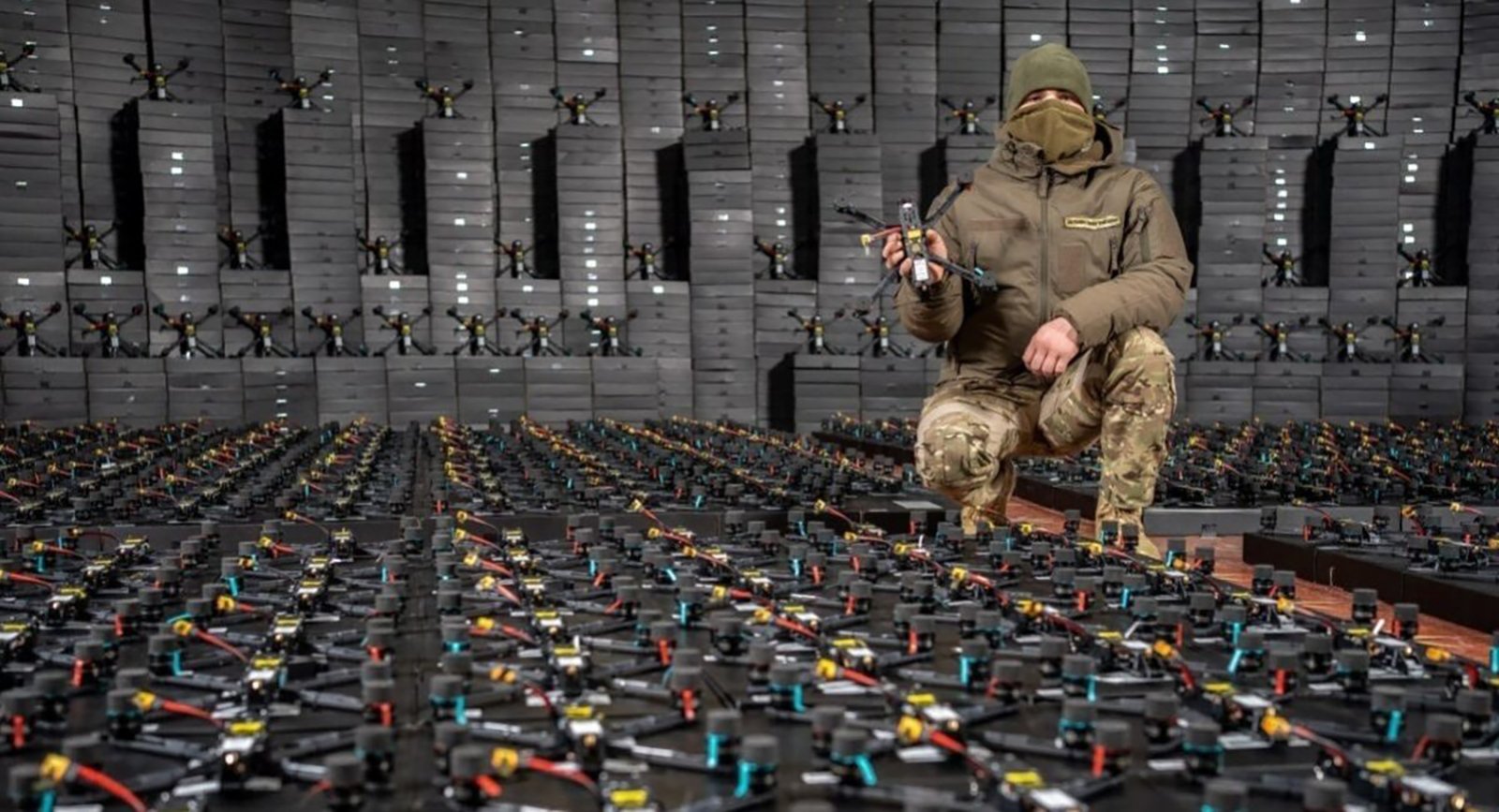
Between 2022 and 2025, drone production in Ukraine increased roughly a thousandfold. The Ukrainian researcher calls for Ukraine’s drone capabilities to be gradually integrated into the European air defence system, which would allow NATO and EU member states to draw on Ukraine’s experience. This is of paramount importance for transforming armament and defence across Europe, in order to adapt them to the coming war.
In nominal terms, Ukraine’s economy is far smaller than Russia’s. In 2025, Ukraine’s gross domestic product (GDP) stood at around $209 billion, while Russia’s reached $2,540 billion. For four years, Ukraine has been engaged in intense fighting against a far more powerful adversary. It has sustained its defence thanks to Western military support and a rapid transition to a war economy. Since 2024, new military technologies, in particular unmanned systems, have become a key component of Ukraine’s economic mobilisation and combat power.
FPV drones1 have been ubiquitous on the battlefield since 2023. Their mass use was triggered by Ukraine’s severe shortage of artillery ammunition. What began as a stopgap quickly became a major combat tool. Ukrainian production of FPV drones rose from around 3,000 to 5,000 units in 2022 to around 300,000 units in 2023. In 2024 it reached around 1.7 million units, and it continued to climb in 2025 to around 3 million drones. In 2026, Ukraine’s arms industry will be able to produce more than 8 million FPV drones a year. Such growth is unmatched in Europe. Ukraine’s edge in drones rests on its decentralised production model: more than 500 companies currently manufacture drones, with the private sector accounting for almost 90 % of FPV drone production.
In 2026, Ukraine began to shift from being a recipient of humanitarian aid to being a security actor. Since some of the export restrictions imposed under martial law were lifted, Kyiv has set up a system of “controlled exports” of Ukrainian weapons. Revenue from these exports is used, among other things, to replenish stocks at the front. Ukraine has opened drone production sites in Germany and set up arms export centres across Europe.
Europeans can draw four lessons from the Ukrainian experience. First, decentralised ecosystems outperform platform-centred models of the arms economy. Second, speed of adaptation matters more than technical perfection. Third, strategic autonomy requires a degree of sovereignty over supply. Fourth, pan-European drone defence will achieve sufficient performance and adaptability only if Ukraine is its central operational pillar rather than a peripheral partner.
How economies adapt to war: Ukraine’s hybrid mobilisation model
Faced with limited financial resources and the decline of industrial capacity inherited from the Soviet era, Kyiv could not rely solely on traditional centralised mobilisation. In 2025, Russia’s defence spending stood at around $160 billion, compared with $44 billion for Ukraine. This structural imbalance in resources forced Kyiv to adopt more decentralised and more cost-effective forms of military production. Ukraine has put in place a hybrid model of military-industrial mobilisation – a mix of state-funded procurement and subsidies involving a range of private-sector actors, vast volunteer networks and fast, informal feedback channels between the battlefield, companies and NGOs.
This form of mobilisation was necessary because the nature of warfare has evolved into what is now known as drone and robot warfare. As a result, drone production has become a key element in the structure of Ukraine’s economic demand, division of labour and procurement logic, representing not only a military-industrial capability but also a new economic sector. The state certainly continues to play an important role in stimulating demand through purchases, subsidies and the awarding of contracts. However, it does not fully regulate production. Ukraine has succeeded in increasing its drone output not thanks to a single national champion, but by creating parallel production sites specialising in components, assembly, software and the integration of weapons on the battlefield.
Feedback loops connect frontline troops and unit commanders with engineers in the rear, and drive innovation forward faster than traditional production planning in the defence sector allows.
Ukraine’s war economy is not, however, decentralised from end to end. Traditional sectors such as construction, fuel supply and certain areas of conventional arms procurement continue to display monopolistic tendencies and rent-seeking behaviour, as recent Ukrainian anti-corruption investigations have shown. The drone sector stands out, however, not because it is free from corruption risks, but because its structure penalises inefficiency and rewards rapid adaptation as well as results.
Ukraine’s hybrid model is also characterised by its integration with a number of Western partners, the adoption of NATO interoperability standards, the use of EU funds, direct technology transfers and access to global commercial supply chains. Western tools such as Starlink, commercial AI models and open-source software have enabled rapid adaptation at the tactical level and have created a competitive environment among small and medium-sized enterprises, NGOs and emerging defence technology start-ups.
From industrial scale-up to battlefield impact
Since 2022, Ukraine has gone from importing and using drones on the battlefield to becoming one of the world’s largest and most innovative manufacturers and operators of unmanned systems. At the tactical level, drones have radically transformed fighting at the front. FPV systems, sold for between $300 and $400 apiece, now offer an alternative to artillery shells, which cost between $800 and $9,000 each, allowing Ukraine to make up for its shortage of conventional weapons and to inflict disproportionate losses on the enemy. Some Ukrainian estimates attribute up to 90% of the Russian armed forces’ losses to drone attacks. Engagement cycles have shrunk from several hours to a few minutes, and continuous aerial reconnaissance allows targets to be detected and acquired in near real time.
Operations such as the “Spiderweb” attack of June 2025 illustrate this strategic asymmetry: 117 FPV drones, each costing less than $1,000, reportedly damaged or destroyed more than 40 Russian aircraft, causing losses running into several billion dollars. A similar logic of use and cost applies to air defence. By 2025, Ukraine had developed the capacity to produce up to 1,000 interceptor drones a day – effective against low-flying targets that evade conventional air defence systems.
Beyond the tactical level, long-range drone strikes target oil infrastructure, refineries and fuel storage facilities located hundreds of kilometres from the front line. This makes it possible to exert systematic economic pressure and to force a reallocation of resources. Locally manufactured unmanned systems enable Ukraine to strike targets deep in the hinterland while sidestepping the diplomatic and financial difficulties associated with the use of long-range weapons: Ukrainian drones cost between 500 and 20,000 dollars, compared with more than one million US dollars per unit for Western-supplied missiles such as ATACMS or Storm Shadow, the use of which may moreover be subject to political restrictions.
Ukraine’s experience shows that a large-scale arms industry does not necessarily translate into an advantage on the battlefield. While drones have delivered tactical successes, maintaining a strategic advantage requires skilled personnel and the integration of production across different sectors of the economy. The value of Ukraine’s drone industry lies not only in its production volume, but also in its ability to respond faster than Russia in the ongoing race in unmanned and electronic warfare.
Structural limits and risks for Ukraine’s drone economy
Under extreme pressure, Ukraine’s drone ecosystem has delivered impressive results in innovation and production. Its effectiveness, however, rests on fragile economic and institutional foundations. Without predictable demand volumes over several years, companies struggle to plan production, retain skilled workers and invest in innovation. Manufacturers sometimes expand capacity during periods of high demand without knowing how many of their products will ultimately be purchased.
The chief weakness of Ukrainian drone production lies in its reliance on long supply chains stretching abroad. Almost 89 % of Ukrainian drone manufacturers cite China as their main source of imported components, and since 2023 Beijing has tightened its controls on drone technology and rare metals, causing shortages and price fluctuations. Paradoxically, a further constraint is that Ukraine’s current production capacity far exceeds what the state is able to procure reliably and deliver to the front. Yet units may have to wait weeks, or even months, to receive the weapons they have ordered, and cutting-edge drones may already be obsolete by the time they reach end users.
Ukraine’s arms industry employs hundreds of thousands of people, more than 60,000 of them directly involved in drone production. Yet the drone ecosystem is facing a labour shortage. Since 2022, more than 120,000 IT and engineering professionals have emigrated. At the end of 2025, private drone manufacturers reported a critical shortage of young professionals capable of designing and implementing cutting-edge solutions. Manufacturers are increasingly relying on engineering students to fill these gaps.
Why Ukraine’s drone war matters for Europe
Ukraine’s wartime experience cannot be transferred wholesale to other countries. Future military conflicts in Europe or elsewhere would, if they occurred, reproduce Ukraine’s current conditions only in part. Nevertheless, Ukraine’s drone-based war economy offers several valuable lessons for European arms and defence policy with regard to institutional structures, procurement practices and the organisation of military-industrial capabilities.
Lesson No. 1: Decentralised industrial ecosystems are more resilient than platform-centred mobilisation
Unlike traditional models of mobilisation, Ukraine does not rely on a handful of large state-backed arms manufacturers. Instead, it has built a decentralised production ecosystem made up of private companies, volunteer engineering groups, university laboratories and workshops located on the front line.
By contrast, European defence procurement remains concentrated on a limited number of dominant national and transnational contractors such as Airbus, Rheinmetall, Thales, Leonardo and BAE Systems. These operate with long-term contracts, fixed technical specifications and multi-year development cycles. In peacetime, this approach prioritises efficiency, predictability and compliance.
Some striking remarks by Armin Papperger, chairman of the executive board of Rheinmetall, highlighted this orientation. They drew sharp criticism in Ukraine, not least because they gave the impression that traditional procurement logic took precedence over urgent wartime needs.
Lesson No. 2: speed of adaptation trumps technical perfection
Ukrainian drone systems are rapidly deployed, tested in combat, modified on the basis of feedback from the front, and then put back into use within a matter of weeks. Initial, or even persistent, failures are regarded as a normal stage in the process of improvement and learning. A decentralised industrial structure can foster different procurement cultures.
In the EU, defence procurement comes with cumbersome certification and qualification procedures, designed to reduce technical, financial and political risks. Major projects funded by the European Defence Fund (EDF) often take five to ten years to become operational, even when the technologies are already mature.
Combined with development phases stretching over several years, this results in very slow implementation of EU defence projects compared with Ukraine’s combat-proven procurement models.
Moreover, Ukrainian engineers and programmers, whether they come from the military-industrial complex or from outside it, work directly with combat units, receive real-time feedback and keep this cycle going continuously, allowing rapid adaptation. Within the EU, such direct and constant interaction between civilian developers and users in the field is unusual and has so far been limited by various legal and security-related obstacles.
Lesson No. 3: strategic autonomy requires a degree of supply sovereignty
Despite an increase in European production capacity, many key components such as motors, batteries, electronic speed controllers, basic frames and entry-level chips are still imported from China. Geopolitical tensions or a change of course in Beijing’s external trade policy could lead to serious supply problems.
Moreover, Russia depends on the same global supply chains, which leads to a bizarre competition between the belligerents for the same components.
Crises must be prevented by establishing selective sovereignty over essential, hard-to-replace components before a new crisis even breaks out.
Lesson 4. Without Ukraine, a European counter-drone defence system remains idle
For the Baltic states and the other countries on the eastern flank, effective defence against drones is not a challenge for the future but an urgent necessity today. The EU’s recent defence initiatives on the eastern flank will certainly create important new capabilities. However, they will become effective only after a certain delay and will be only partially suited to the latest technical and tactical developments unless Ukraine’s operational expertise is built into them.
Frequent incursions by Russian drones into EU and NATO airspace show that Europe is already exposed to a persistent aerial threat and lacks sufficiently effective countermeasures. Ukraine is currently the only European actor that systematically detects, intercepts and destroys Russian drones on a large scale and at low cost. Ukraine’s long-range drones also strike launch sites, logistics hubs and production facilities in Russia – measures that EU and NATO member states cannot carry out directly themselves without risking a serious escalation. Moreover, Ukraine is now Europe’s main training, testing and learning ground for drone warfare. Ukraine’s armed forces face every possible variant of Russian air warfare – from waves of decoys and saturation attacks to changes in altitude, navigation without a GPS signal, electronic warfare and combined drone and missile attacks – in combat conditions that no NATO member has yet experienced.
The resulting gap became apparent during the “Hedgehog 2025” exercise in Estonia. Ten Ukrainian soldiers, playing the opposing force, defeated two full NATO battalions. They simulated the destruction of 17 armoured vehicles and carried out 30 attacks in the space of half a day. According to some reports, a NATO commander present as an observer summed up the result in three words: “We are finished.“ This realisation is gradually taking hold at political level too. Federal Chancellor Friedrich Merz has demanded that Germany learn from Ukraine’s military experience.
Ukraine’s drone economy shows that small and medium-sized states do not need to build a complete defence industry with autonomous supply chains in order to strengthen their deterrence capability. Modern drone and counter-drone systems are complex and require coordination between air defence, electronic warfare and command structures.
The EU could soon face the post-war challenge of a potential drone shortage alongside a surplus of Ukrainian drones. When the Russo-Ukrainian war ends, Ukraine will still have the largest ecosystem for developing and manufacturing operational drones outside the United States and China. The EU should integrate these capabilities through co-production and joint certification. The war in Ukraine has highlighted the speed at which the arms industry can transform and develop as the new benchmark for defence and deterrence. In wartime, what matters is how quickly a society can train civil engineers and programmers to turn them into weapons specialists. In Ukraine, the drone economy need not lead to a lasting militarisation of Ukrainian industry. Targeted public procurement and investment programmes should, on a decentralised basis, enable small and medium-sized enterprises to preserve jobs after the war ends, as well as foster innovation in dual-use technologies and develop export-relevant skills, so that the major Ukrainian economic sectors that are currently “droned” do not remain tied to permanent defence spending. In this sense, “dronisation” refers to a society’s resilience and flexibility, not to a permanent militarisation of the economy.
Bibliography
· Betliy, O. (2024). Ukraine: Balancing aid, reforms, and resilience. LibMod – Zentrum Liberale Moderne. https://ukraineverstehen.de/wp-content/uploads/Ukraine_BalancingAid.pdf
· Amoah, M., Bazilian, M., Matisek, J., & Schweiker, K. (9 December 2025). The drone supply chain war: Identifying the chokepoints to making a drone. Center for Strategic and International Studies (CSIS). https://www.csis.org/analysis/drone-supply-chain-war-identifying-chokepoints-making-drone
· Danylyuk, O. V., & Watling, J. (3 April 2025). Winning the Industrial War: Comparing Russia, Europe and Ukraine, 2022–24. Royal United Services Institute (RUSI). https://static.rusi.org/winning-the-industrial-war-comparing-russia-europe-ukraine-2022-24.pdf
· KSE Institute. (9 April 2026). Impact of Ukrainian strikes on Russia’s oil infrastructure. Kyiv School of Economics. https://kse.ua/about-the-school/news/impact-of-ukrainian-strikes-on-russia-s-oil-infrastructure-kse-institute-assessment/
· Bondar, K. (13 April 2026). How Russia is building a sovereign drone ecosystem for AI-driven autonomy. Center for Strategic and International Studies (CSIS). https://www.csis.org/analysis/how-russia-building-sovereign-drone-ecosystem-ai-driven-autonomy
· Drake, R. (6 March 2026). One Operator, Many Platforms: Unlocking the Full Potential of Attritable Mass. Royal United Services Institute. https://www.rusi.org/explore-our-research/publications/commentary/one-operator-many-platforms-unlocking-full-potential-attritable-mass
Translated from French. The French original prevails.