In Antalya, António Guterres called for a global pact for climate justice. At the heart of his address was the demand that oil and gas companies contribute, as their windfall profits stand in stark contrast to the meagre funding available to countries suffering the effects of climate change. The demand raises the question of the responsibility of the major polluters and of the redistribution of the wealth generated by fossil fuels.
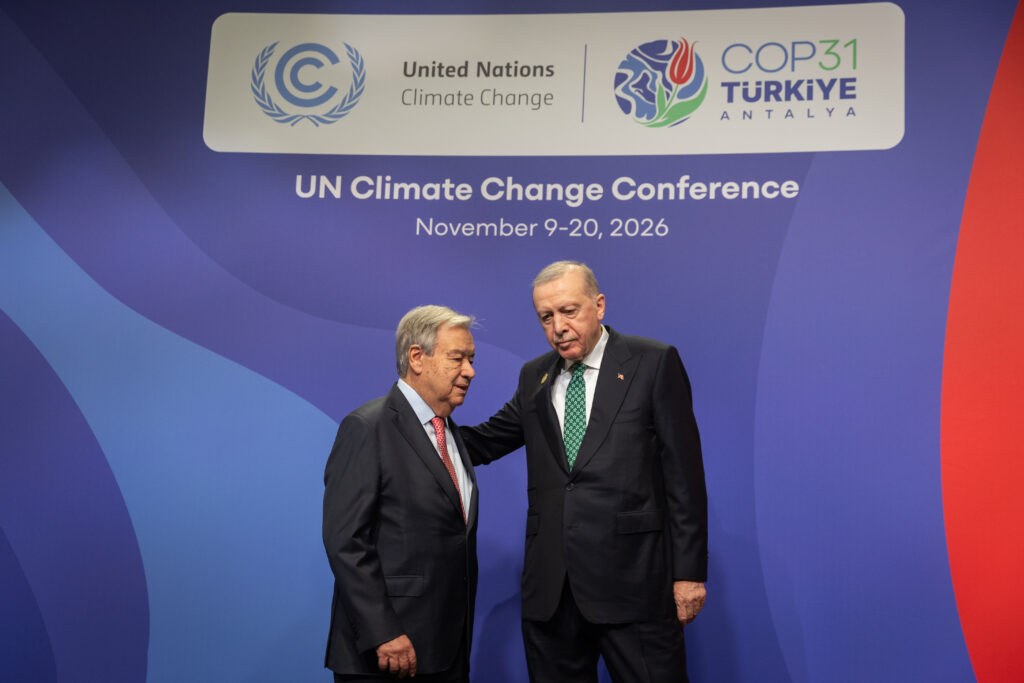
“Our planet is heating up. Time is running out. This is the moment of truth.” Opening the COP31 leaders’ summit in Antalya, Turkey, on Wednesday 11 November, António Guterres issued an unambiguous warning. In the face of the accelerating climate disruption documented by the Geneva-based Intergovernmental Panel on Climate Change (IPCC) and inadequate international commitments, the Secretary-General of the United Nations is calling for a change of course: making climate justice the guiding principle of the energy transition.
His statement comes against a particularly worrying backdrop. Even if the climate policies currently announced by states were fully implemented, global warming could exceed 2.5°C by the end of the century – a scenario fraught with consequences for the most vulnerable populations, ecosystems and economies. For Guterres, however, overshooting the 1.5°C threshold must not serve as an excuse for resignation. Every fraction of a degree avoided will help to limit the damage. But that ambition means moving beyond declarations of principle to tackle the economic and financial power relations that are holding back the transition.
Make oil companies pay on windfall profits
It was on the financial responsibility of the fossil fuel industries that the UN Secretary-General placed one of the most political points of his speech. His observation is striking: the world’s nine largest oil companies raked in $95 billion in profits in a single quarter, while the fund intended to compensate countries suffering climate loss and damage has received only around $600 million.
By António Guterres’s reckoning, that sum amounts to barely fourteen hours of profits for these companies. The gap reflects a profound imbalance: those who contribute heavily to climate change continue to generate considerable profits, while the most exposed populations struggle to obtain the resources needed to repair the damage they suffer.
“Polluters must pay,” the Secretary-General insisted, calling on governments to introduce a tax on the windfall profits of oil and gas companies. The stakes go beyond tax alone. The aim is to make the sectors that derive their wealth from exploiting fossil fuels contribute more to financing the energy transition and international solidarity.
Such a tax could, in particular, feed mechanisms to support developing countries, back investment in renewable energy, strengthen adaptation policies and help compensate populations facing the irreversible consequences of climate change.
The proposal nevertheless raises a central question: how can this contribution be organised at international level, tax avoidance strategies be prevented and the sums collected be guaranteed to actually benefit the populations concerned?
Climate justice: a precondition for an acceptable transition
Behind the tax demand lies a broader conception of climate justice. It rests on one principle: historical responsibility for greenhouse gas emissions is not evenly distributed, any more than the financial capacity to deal with their consequences.
Industrialised countries built their development largely on fossil fuels. Yet many developing countries, which have contributed less to cumulative emissions, are bearing the full brunt of droughts, floods, cyclones, rising sea levels and agricultural losses.
They must now embark on their own energy transition while devoting considerable resources to repairing climate damage. “We cannot demand that countries transform their economies while denying them the means to do so,” António Guterres said.
His pact for climate justice rests on four priorities: accelerating the phase-out of fossil fuels while protecting workers and communities, strengthening adaptation and early warning systems, guaranteeing accessible and affordable climate finance, and expanding international cooperation on technology and investment.
This last dimension is essential. A transition imposed without social support risks deepening inequalities, weakening economies dependent on oil, gas and coal, and sparking fresh social tensions.
Climate justice therefore also means protecting employees in the sectors concerned, supporting regions dependent on fossil fuel activities and guaranteeing people access to affordable energy.
Fossil fuel industries in the firing line
António Guterres also denounced the political influence of the oil and gas industries, which he accuses of contributing to scientific disinformation and of holding back climate policy. “Fossil fuels must go the way of the dinosaurs,” he declared, before adding, not without irony: “The dinosaurs didn’t have a lobby. Fossil fuels do.” The remark sums up one of the main obstacles to the transition: the ability of economic interests tied to fossil fuels to sway public decision-making, even as scientific warnings multiply.
Taxing windfall profits thus takes on a political dimension. It is aimed not only at raising new financial resources, but also at challenging an economic model in which the profits from exploiting fossil resources are largely privatised, while a growing share of their environmental and human costs is borne by society as a whole.
Methane, the oil sector’s other emergency
The fossil fuel industry’s responsibility is not limited to the carbon dioxide emissions produced by burning oil and gas. Methane leaks are also a major issue. This greenhouse gas has a warming potential more than 80 times that of CO₂ over a twenty-year period and accounts for nearly a third of the warming observed to date.
The UN Secretary-General has asked the United Nations Environment Programme to work towards a global standard aimed at bringing methane emissions from the oil and gas sector down to near zero. The technology already exists. UNEP’s International Methane Emissions Observatory, for instance, uses satellites and artificial intelligence to detect leaks and alert governments and companies.
Since its launch, the system has led to action in 45 cases across 13 countries. But the record remains inadequate: of more than 5,000 alerts issued since 2023, only one in eight has resulted in action. This highlights the persistent gap between the technical capabilities available and the genuine willingness of economic and political actors to act.
Multilateralism tested by national interests
The speeches by the other leaders present in Antalya also highlighted the limits of international cooperation. Turkish President Recep Tayyip Erdoğan acknowledged that progress in climate negotiations had not translated into comparable results on the ground. He called for greater support for developing countries.
Brazilian President Luiz Inácio Lula da Silva, for his part, lamented that armed conflicts and trade tensions are gradually pushing the climate crisis down the agenda. He announced that national roadmaps were being drawn up to reduce Brazil’s dependence on fossil fuels and to end deforestation.
But the leaders’ speeches still stand in contrast to the difficulties facing negotiators. Adaptation finance, compensation for loss and damage and the terms of a just transition remain points of disagreement.
The most vulnerable countries are calling for funding that is predictable, accessible and large enough to match the scale of their needs. In particular, they criticise the slowness of international mechanisms and the inadequacy of the resources available.
COP31 must turn words into action
In Antalya, António Guterres presented governments with a choice: pursue a climate transition whose costs are borne largely by the most vulnerable populations, or embark on a fairer redistribution of responsibilities and resources. From this perspective, taxing oil companies’ windfall profits is a concrete instrument of climate justice. It would make companies that derive their revenue from fossil fuels contribute more, while giving the most vulnerable countries additional means to adapt and rebuild.
But this proposal must first move beyond the stage of a political appeal. Its effectiveness will depend on the ability of states to agree on a tax base, collection arrangements and transparent redistribution mechanisms.
Ultimately, the question raised by the UN Secretary-General is one of coherence in global climate action: can poor countries be asked to give up fossil fuels, protect their populations and repair the damage caused by global warming without mobilising the necessary financial resources?
For Guterres, the answer is clear. The energy transition will only be credible if it goes hand in hand with genuine economic and social justice. And that justice starts with a simple principle: those who pollute and profit from the exploitation of fossil fuels must contribute more to funding the solutions
Translated from French. The French original prevails.