With Task Force Iron Gate, Washington is extending its pressure to Iran’s land borders and the Caspian Sea. Suspicions centre on a channel exporting Iranian oil under Kazakh documentation. Though still insufficiently substantiated, this hypothesis raises the question of what means Tehran has at its disposal to keep exporting its oil, finance its supplies and rebuild its arsenal.
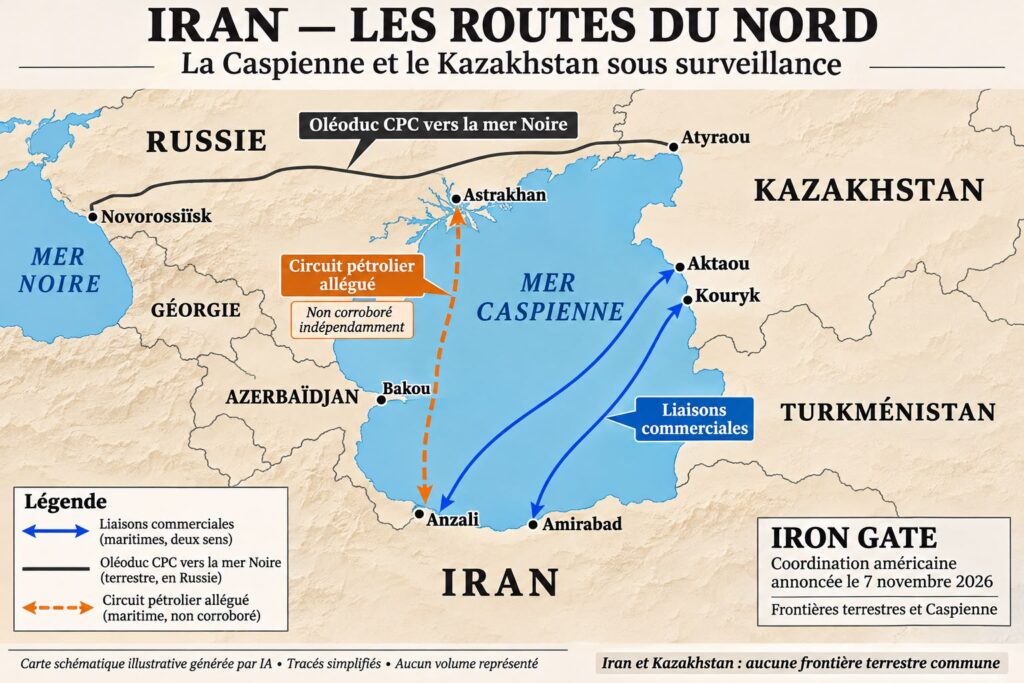
The tightening of the US net is aimed in particular at Iran’s northern outlets. The Caspian links Iranian ports with those of Russia and several countries in Central Asia and the Caucasus. Cargo can move across it without passing through the Strait of Hormuz. These routes also allow goods to be shipped to Tehran that the blockade of the southern ports cannot stop.
An oil producer, a neighbour of Russia and a trading partner of Iran, Kazakhstan has ports and rail links that serve Eurasian trade. This position draws attention to flows that could circumvent the sanctions targeting Iran. The allegations concerning oil must nonetheless be distinguished from the military supply channels that have already been documented.
Iron Gate also targets the routes that allow Iran to rearm
On 7 November, US Central Command, or CENTCOM, announced the creation of Task Force Iron Gate. The unit of around twenty military and civilian personnel, based in Tampa, in the United States, is to coordinate the action of US agencies against transfers of weapons, dual-use technologies and sanctioned equipment, as well as against the financial networks that support them.
The aim is to reduce Iran’s capacity to rebuild its arms factories and renew its equipment. In the same statement, CENTCOM asserts that the blockade has prevented more than $25 billion of Iranian crude exports.
Inbound flows explain the interest in the northern routes. A Reuters investigation documented a network that has imported at least $2 billion worth of equipment, explosives and heavy lorries since January 2025. The goods were shipped by cargo vessel from Russia across the Caspian, by lorry from Central Asia and by freight aircraft from China. The figure covers the network as a whole, not the Caspian route alone.
The announced mission rests on inter-agency coordination. CENTCOM does not specify how cargoes might be intercepted in the Caspian, nor which transit countries would cooperate. Identifying shell companies and their payments is therefore a key means of disrupting these supplies.
Pressure on Iraq’s borders shows the reach of the operation
The land dimension extends beyond Central Asia. On 8 November, Reuters reported remarks by Iraq’s Foreign Minister, Fuad Hussein, who said that the US Treasury had asked Baghdad to close all border crossings with Iran except two, one of them in Iraqi Kurdistan. The minister stressed the difficulties and economic cost of such a measure, which is still under discussion with Washington.
The request illustrates the pressure being brought to bear on transit countries. For Washington, controlling Iran’s routes means persuading neighbours whose commercial interests may hold back cooperation.
Kazakh ports expand trade with Iran
Port cooperation is a matter of public record. The port of Kuryk announced, among other things, that on 10 June it had received an Iranian delegation led by Iran’s consul general in Aktau. The talks covered the port’s capacity and the development of trade and logistics ties. Kuryk presents its complex as a transshipment hub for grain, petroleum products, fertilisers, chemicals and other goods. These facilities serve legitimate trade, but may also appeal to operators seeking to conceal certain transactions. Any analysis must focus on the cargo, its owner, its destination and how it is financed.
The ports of Aktau and Kuryk give Kazakhstan maritime access to Iran. By rail, the link between the two countries runs through Turkmenistan. This combination offers several transport options, at the cost of successive transshipments and inspections.
OilPrice describes an oil circuit whose links have yet to be verified
The most sensitive allegation concerns oil. In an article dated 12 October, the energy news website OilPrice reports, citing an anonymous European official, that Iranian crude is allegedly being sold to Russia at discounts of 35 to 42%. After being shipped across the Caspian and blended, it would reportedly join flows exported under Kazakh documentation, notably CPC Blend.
The public evidence examined does not make it possible to reconstruct a complete chain of cargoes, transfers and certificates of origin. The reported discounts remain attributed to this source. The repetition of these claims in several publications does not amount to independent confirmation.
The Caspian Pipeline Consortium, or CPC, network is a pipeline system terminating on the Black Sea, near Novorossiysk. To establish the alleged circuit, it would be necessary to identify where the Iranian crude was landed, how it was carried to the network and which operators allegedly fed it in.
Blending of crudes means their origin must be traced
The consortium states that several crudes are combined in CPC Blend. It describes a compensation mechanism between shippers based on the quality of the oil delivered, as well as accounting for incoming and outgoing volumes. Blending is therefore a normal feature of how the network operates.
Proof of fraud would have to show how Iranian crude was allegedly declared under another origin. A gap between production and exports is not enough: the same periods and scopes must be compared, and account taken of stocks, other crudes passing through the system and changes in capacity. Without this exhaustive work, a “phantom volume” remains an interpretation.
Verifying such a circuit falls within the remit of the mission entrusted to Iron Gate. The information gathered on carriers, beneficial owners and payments could make it possible to confirm its links or to dispel the suspicions.
Sanctions seek to deprive these routes of their intermediaries
Iron Gate is part of a broader campaign of economic pressure. On 8 October, the US Treasury announced new measures under Operation Economic Outcast against vessels in Iran’s shadow fleet and their support networks. The statement makes no mention of the alleged Kazakh oil circuit.
The aim is to make transactions harder to arrange. A shipper, a bank or a buyer may pull out once it judges that the payment on offer no longer outweighs the risk of sanctions. Identifying the beneficial owners and tracking payments therefore matter as much as locating the vessels.
The Caspian remains useful even if it cannot replace southern outlets
For Tehran, an alternative route remains valuable even if it makes up for only a fraction of the exports shipped through its southern ports. Cargoes containing hard-to-obtain equipment can carry a strategic importance greater than their commercial value. A distinction must therefore be drawn between bulk oil shipments and the more limited supplies needed by industry or military programmes.
Transshipments, that is, transfers from a ship to a train or a lorry, lengthen lead times and drive up transport costs. Port and vessel capacity also limits volumes. These constraints reduce the scope for replacing southern exports without rendering the northern routes unusable. Closing them would depend on effective controls and on the cooperation of transit countries, the terms of which have yet to be set out.
For Kazakhstan, the challenge is to preserve its trade while preventing intermediaries from using its infrastructure to disguise the origin of Iranian oil. On the American side, the effectiveness of Iron Gate will be measured by the financial channels disrupted and the equipment deliveries actually slowed. Tracking cargoes and payments will make it possible to assess the results.
Seals Consulting: Follow the author of this article on Seals Consulting’s X page
Translated from French. The French original prevails.