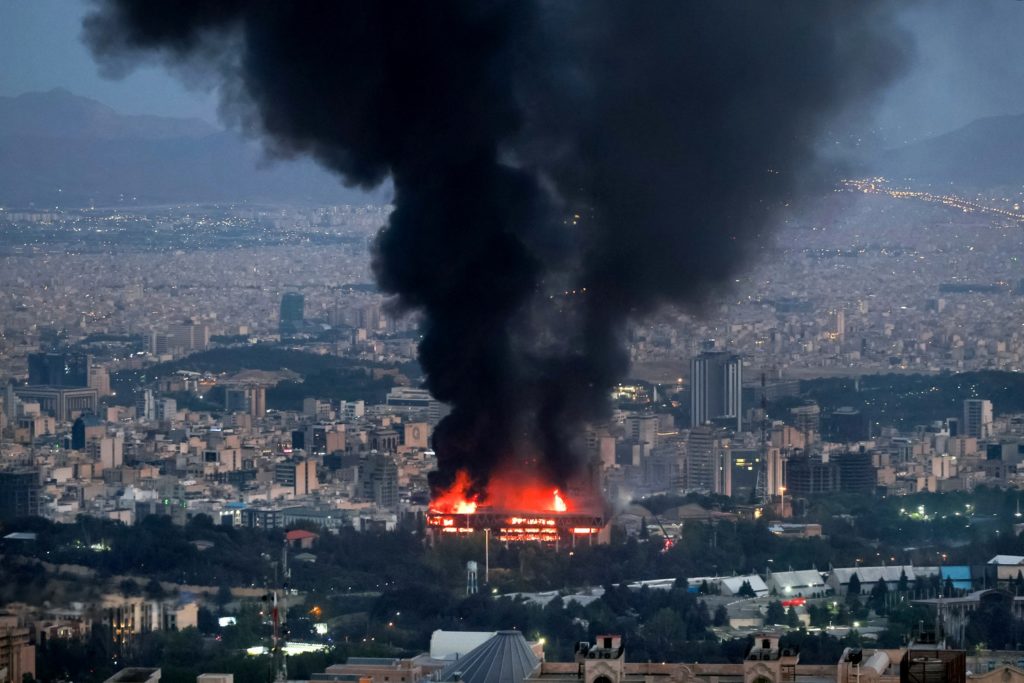
The bombing of the Iranian state television building in Tehran.
A sequence of events set in motion by the war in Ukraine marks a geopolitical upheaval whose scale is still poorly understood today. It is arguably as significant as the Iranian Islamic Revolution of 1979 and the taking of American hostages at the embassy in Tehran, the war in Afghanistan and global Salafist terrorism (11 September 2001), or the collapse of the Soviet Union and its satellites and the reunification of Germany from 1989 onwards.
The right to invade a neighbouring country
The war in Ukraine, first of all, is the most serious challenge to the international order and to the rules put in place at the end of the Second World War. One country, Russia, invaded its neighbour, Ukraine, on false pretexts and has committed war crimes on a massive scale with genocidal intent, as confirmed by the statements of the Russian president, for whom Ukraine does not exist, and by the abduction of children in order to Russify them. This resurgence of Putin’s imperial ambitions in Europe has not only brought international law crashing down but has also pushed European countries to embark on rearmament after 80 years of peace.
Hamas’s attack on 7 October 2022, in which civilians were killed and abducted, some of them tortured or executed, also made Israel realise that its survival was at stake. The offensive in Gaza and against Hezbollah in response to the terrorist attack led the Israeli government to turn on the Shia arc, since it is chiefly Iranian power that lies behind the drive to destroy Israel.
The right to assassinate a head of state
The war now being waged by Israel and the United States began with a dangerous precedent: the assassination of a head of state, in this case Ali Khamenei, the Supreme Leader of the Islamic Republic. What head of state in the world can now fail to imagine that a global power might make an attempt on his life? In these circumstances, the room left for diplomacy appears very limited indeed. The drive to annihilate Iran’s bid to acquire nuclear weapons and its ballistic capability will, if it is carried through, as seems likely, reduce Iran’s influence in the Middle East and beyond.
After the weakening of Hamas and Lebanon’s Hezbollah, the fall in Syria of Bashar al-Assad, an Alawite (close to the Shias), brought about by Sunni Islamist militias, and the war in Yemen, where the Shia Houthis are allies of Tehran, Iran finds itself very much alone. That does not mean its capacity to do harm has been diminished, for since 1979 global terrorism has been one of the weapons of the mullahs’ regime. Moreover, the Shia culture of martyrdom could drive members of minorities in the countries of the region and elsewhere to take action. Indeed, a first attack has already taken place in Texas, leaving two people dead.
The right to betray one’s alliances
For the Gulf states now targeted by Iran’s retaliation, it marks the end of the carefree lifestyle embodied by their influencers, suddenly plunged into the reality of armed conflict. For the Emirates, where nine-tenths of the population are foreigners, it is a severe blow which, if it drags on, could empty the country. For all these countries, it is also an opportunity to test the commitments of their alliances, from the American umbrella (barely in evidence) to France’s commitment under its defence treaties.
Finally, Trump’s second term is a major upheaval in its own right. His mercantile approach to international relations, his betrayal of long-standing alliances, notably with European countries, and operations such as those carried out in Nigeria, Venezuela (with the abduction of President Madura, another precedent!) and Iran – which, one may suspect, are also intended to cut off oil supplies to his great rival, China, since these countries are its suppliers, fuelling a low-cost economy that is itself upending Western economies – have put force back at the heart of international relations. For the other global power, China, this is also a signal. The rules have changed, and the People’s Republic could in turn play this dangerous game.
Translated from French. The French original prevails.