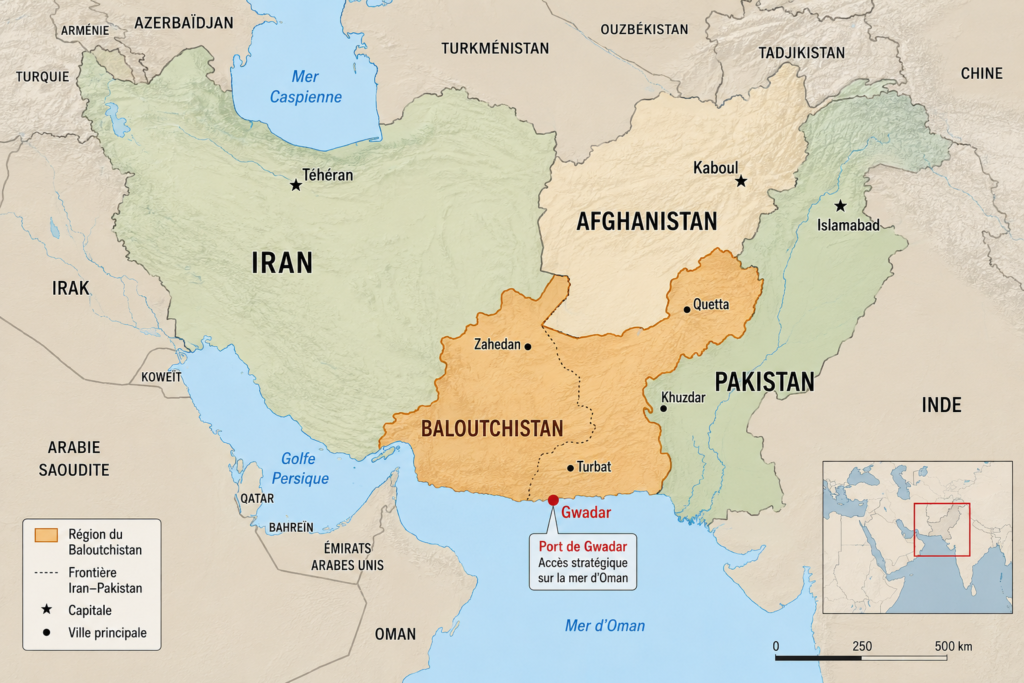
Long relegated to the margins of international news, Balochistan now lies at the heart of a strategic contest that extends far beyond Pakistan’s borders. An energy crossroads, a gateway to the Indian Ocean, a territory rich in mineral resources and the theatre of a persistent insurgency, this vast province is a focal point for the interests of China, Pakistan, India, Iran, the United States, Russia and the Gulf monarchies. Behind the attacks on Chinese interests and the regional rivalries, a geopolitical realignment is taking shape whose consequences could weigh on the balance of the trade routes linking the Middle East, Africa and Asia.
A province that has become a global stake
For decades, Balochistan was of interest to scarcely anyone beyond South Asia specialists. In the eyes of many observers, this arid, sparsely populated province, far from the main centres of power, appeared to be an unstable periphery of Pakistan, regularly shaken by tribal rebellions and clashes with the security forces. That perception now belongs to the past.
Within the space of a few years, Balochistan has become one of the most sensitive territories in contemporary geopolitics. Its importance stems not only from the insurgency that has pitted Baloch nationalist movements against the Pakistani government for several decades. Above all, it results from an exceptional convergence of strategic factors: its geographical position, its natural resources, the presence of the port of Gwadar, China’s massive investment and its proximity to Iran, Afghanistan and the Strait of Hormuz.
This accumulation of stakes now makes Balochistan a veritable laboratory for the new international rivalries. The province lies at the crossroads of Sino-American competition, Indo-Pakistani tensions, Iranian security concerns, Chinese maritime ambitions in the Indian Ocean and the efforts of the Gulf monarchies to secure the major energy routes.
Far from being a mere local conflict, the Baloch question is now part of what several analysts describe as Asia’s “new Great Game”: a multidimensional competition combining economic power, control of infrastructure, access to strategic resources, diplomatic influence, intelligence and maritime security.
The Baloch, a people divided between three states
To understand what is at stake in Balochistan, one must first look at the people who gave the region its name. The Baloch are a people of some 10 to 15 million, spread mainly across Pakistan, Iran and Afghanistan. Pakistan is home to the majority of this population, while a large community lives in the Iranian province of Sistan and Baluchestan. There are also diaspora communities in the Gulf monarchies, where many Baloch have settled over the decades.
They speak Balochi, an Iranian language belonging to the Indo-European family and closely related to Persian and Kurdish. The vast majority are Sunni Muslims of the Hanafi school, a characteristic that sets the Baloch of Iran apart from a predominantly Shia population. Baloch society remains strongly shaped by its tribal structure. The sardars, the traditional chiefs, still wield considerable influence, even if their authority is sometimes challenged by younger generations or by certain nationalist movements.
The historical territory of Balochistan is today divided between three states, a consequence of borders drawn during the British colonial period. This fragmentation partly explains why the Baloch question extends well beyond Pakistan’s domestic affairs and also concerns Iran and, to a lesser extent, Afghanistan.
A rebellion rooted in history
Tensions between Baloch nationalists and the central government date back to the first months of Pakistan’s independence. In 1948, the former princely state of Kalat was incorporated into Pakistan, a decision disputed by part of the Baloch elite. This incorporation marked the starting point of a series of insurgencies that would follow one another over the ensuing decades.
Since then, several rebellions have broken out, each reflecting the same frustrations: a sense of political marginalisation, weak public investment, the central government’s control of natural resources and condemnation of human rights violations, notably enforced disappearances that several international organisations attribute to Pakistan’s security forces.
Baloch movements, however, do not form a homogeneous bloc. Some call for greater autonomy within the Pakistani state, while others pursue an openly separatist goal. Among them, the Baloch Liberation Army (BLA) has emerged as the most active armed organisation. Its operations target Pakistan’s security forces, but also infrastructure and Chinese nationals linked to Beijing’s major investment projects.
This development marks a major turning point. A rebellion long regarded as essentially domestic is now part of a far broader geopolitical context, in which the economic, energy and strategic interests of the major powers are directly at stake.
Balochistan’s riches, Gwadar and China’s ambitions
If Balochistan is attracting so much attention today, it is also because of its considerable natural resources and its central role in China’s infrastructure projects. The province holds substantial deposits of natural gas, copper, gold and coal. The Reko Diq site, for example, is considered one of the world’s largest untapped copper and gold deposits. Yet despite this potential wealth, the local population remains among the poorest in Pakistan, fuelling a sense of injustice and dispossession.
But it is above all the port of Gwadar that has changed the strategic equation. Located on the Arabian Sea, close to the Strait of Hormuz — through which a vital share of the world’s oil passes — Gwadar has become a key component of the China-Pakistan Economic Corridor (CPEC), itself a pillar of the New Silk Roads (Belt and Road Initiative).
For Beijing, Gwadar offers a strategic alternative to the traditional sea routes through the Strait of Malacca, which would be vulnerable in the event of tensions with the United States. By linking Gwadar to China’s Xinjiang region through a network of roads, railways and pipelines, China is seeking to secure its energy supplies while strengthening its influence in South Asia.
These projects, however, are meeting strong local resistance. Many Baloch accuse the central state and foreign investors of exploiting the region’s resources for their own benefit, with no significant gains for the population. Attacks on Chinese interests, notably on workers and infrastructure, illustrate this growing opposition.
Balochistan thus finds itself at the heart of a paradox: rich in resources and of global strategic importance, yet marked by persistent instability that threatens the very projects meant to secure its development.
Regional rivalries: India, Iran and the United States in the background
Beyond China and Pakistan, Balochistan is part of a much wider contest for influence, in which several regional and international powers are seeking to defend their interests. India, Pakistan’s historic rival, is closely watching developments in the province. Islamabad regularly accuses New Delhi of backing certain Baloch separatist groups in order to destabilise Pakistan and counter Chinese influence in the region. While these accusations are difficult to verify independently, they nonetheless reflect the degree of mistrust that characterises relations between India and Pakistan.
For its part, Iran shares a border with Pakistani Balochistan and faces its own security challenges in its province of Sistan and Baluchestan. Tehran fears that instability could spread across the border and is keeping a close eye on Baloch armed movements, some of which are active on both sides. This situation creates a convergence of security interests between Iran and Pakistan, despite their political differences.
The United States, meanwhile, is also following developments in the region closely. Although Washington is not directly involved in the Baloch conflict, China’s growing power through CPEC and the port of Gwadar is raising strategic concerns. In the context of Sino-American rivalry, any expansion of Chinese influence in the Indian Ocean is seen as a major issue.
A key zone for global energy routes
Balochistan occupies an exceptional geographical position, in the immediate vicinity of the Strait of Hormuz, through which around a third of the world’s seaborne oil passes.
This proximity gives the region considerable strategic importance. Any prolonged instability could have repercussions for the security of the energy routes linking the Middle East with Asian and European markets. Conversely, lasting stabilisation would strengthen Balochistan’s role as a major logistics and energy hub.
The Gulf monarchies, notably the United Arab Emirates and Saudi Arabia, are also taking an interest in the region. They see Gwadar and its associated infrastructure as an opportunity to diversify their trade routes and to invest in strategic port and energy projects.
Between development and instability: a fragile balance
The paradox of Balochistan lies in the coexistence of two opposing dynamics. On the one hand, the province is at the heart of ambitious infrastructure projects that could profoundly transform its economy and integrate it further into international trade networks. Chinese investment, in particular, could eventually improve infrastructure, create jobs and stimulate growth.
On the other hand, persistent insecurity, political tensions and the local population’s sense of exclusion are major obstacles to this transformation. As long as the demands of the Baloch are not addressed credibly, development projects risk remaining fragile and contested.
A territory at the heart of future balances of power
Balochistan is no longer a forgotten periphery. It has become a strategic space where the ambitions of the great powers, regional rivalries and the aspirations of a people seeking recognition intersect.
Its future will depend on the ability of those involved to reconcile economic development, security and political inclusion. Failing that, the province could remain a lasting hotbed of tension, with repercussions far beyond its borders.
In a world where trade routes, energy resources and strategic infrastructure are central to the balance of power, Balochistan now appears to be one of the nerve centres of 21st-century geopolitics.
Translated from French. The French original prevails.