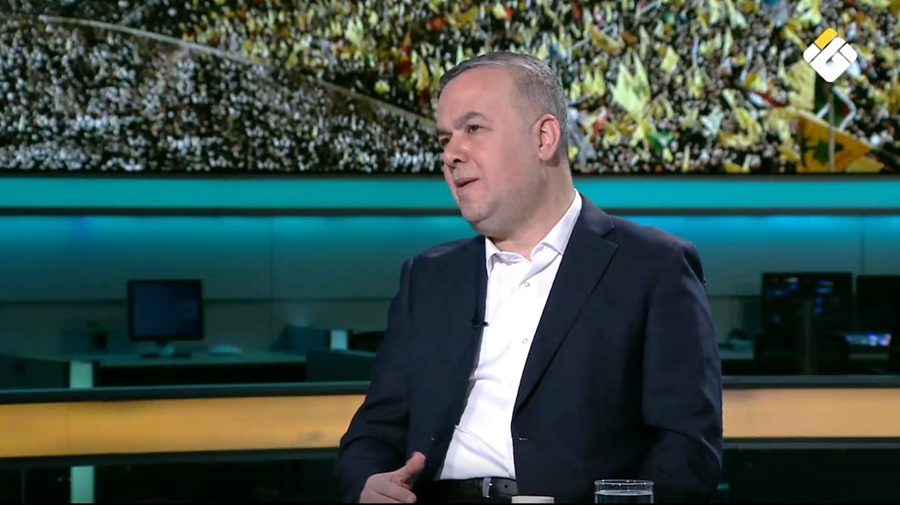
Hassan Fadlallah, MP for the Loyalty to the Resistance Bloc (Hezbollah), on Al Manar television, where he heads political news.
The statements by MP Hassan Fadlallah, a member of Hezbollah’s parliamentary bloc, mark a new stage in the political confrontation triggered by the framework agreement concluded between Lebanon and Israel under the auspices of Washington. “The Lebanese authorities will only be able to implement the Washington agreement at the cost of a civil war backed by the United States,” the Hezbollah official said, before adding: “What has happened is an attempt to obstruct the process under way in Islamabad” and “without the resistance, nothing will get through.”
Beyond their virulence, these remarks raise a fundamental question: if the Lebanese government really did decide to launch a process to disarm Hezbollah, who would be prepared to help it militarily?
A red line, openly declared
Hassan Fadlallah’s statements reflect Hezbollah’s conviction that the agreement with Israel is not merely a diplomatic text. The movement sees it as the starting point of a process that could call into question its military role, its political influence and, more broadly, the strategic balance that has prevailed in Lebanon for several decades.
By declaring that “without the resistance, nothing will get through”, Hezbollah is making clear that it regards its military capabilities as an essential component of national defence and refuses to allow decisions on war, peace or security to be taken without its consent. The use of the term “civil war” harks back directly to the trauma of 1975-1990. More than a prediction, the reference serves as a warning intended to deter any attempt to abruptly alter the internal balance of power.
Behind the agreement, the question of disarmament
For several years, Western partners and a number of Arab states have pursued the same goal: strengthening Lebanon’s institutions and enabling the state to exercise a full monopoly on the use of force. The framework agreement with Israel is part of that approach. It provides for a greater role for the Lebanese Armed Forces in the areas concerned and opens the debate on the future place of Hezbollah’s weapons. For the Shia movement, this development represents a red line.
The threat voiced by Hassan Fadlallah raises a crucial question: if Beirut decided to see this process through to the end, which states would genuinely be prepared to back the Lebanese army militarily? At this stage, the answer looks far less obvious than it might seem.
Western partners favour strengthening the state
The United States remains the leading military backer of the Lebanese Armed Forces, supplying equipment, training and technical assistance to improve their capabilities. France maintains close cooperation with the Lebanese army and has for years contributed to international stabilisation efforts. The European Union is also stepping up its assistance, particularly in intelligence, border control and training. However, none of these partners has announced any intention of taking part in a military operation aimed at disarming Hezbollah.
The spectre of a new civil war
This caution is easy to understand. An operation against Hezbollah could quickly degenerate into fighting between Lebanese, with a high risk of sectarian conflagration. Western capitals remember the consequences of the wars in Iraq and Syria, where internal conflicts turned into major regional crises involving multiple actors. No one wants to see Lebanon slide back into a similar spiral.
Saudi Arabia, Qatar and several Gulf monarchies want to see a stronger Lebanese state and reduced Iranian influence. But their support remains essentially political, financial and diplomatic. There is no indication today that they would be prepared to commit their armed forces to an operation inside Lebanon.
Israel’s dilemma
Israel would look favourably on a reduction in Hezbollah’s military capabilities. Open military cooperation between the IDF and the Lebanese army, however, would be politically explosive. It would risk undermining the legitimacy of the Lebanese Armed Forces and bolstering Hezbollah’s narrative denouncing foreign intervention.
Tehran, by contrast, continues to regard Hezbollah as an essential component of its regional strategy. Any attempt to impose disarmament by force would probably be interpreted as a direct attack on Iranian interests, with the risk of the conflict spreading across the entire Middle East.
Hassan Fadlallah’s reference to the “process under way in Islamabad” shows that Hezbollah does not separate the Lebanese issue from wider regional negotiations. In its strategic reading, the future of its weapons depends as much on Lebanon’s internal balance of power as on talks between the major regional and international powers.
A battle now fought on political ground
Ultimately, the question goes far beyond Hezbollah’s disarmament alone. It raises the question of the future of the Lebanese state: will it be able gradually to regain the monopoly on the use of force without triggering a new national rift? At this stage, no state has publicly announced its willingness to take part militarily in an operation to disarm Hezbollah alongside the Lebanese army. The international consensus favours the gradual strengthening of institutions, while seeking to prevent such a development from tipping Lebanon into a new civil war.
Hassan Fadlallah’s statements thus show that the confrontation between Hezbollah and its adversaries has entered a new phase. After the military clashes, it is now Lebanon’s institutional and strategic future that lies at the heart of the power struggle.
Translated from French. The French original prevails.