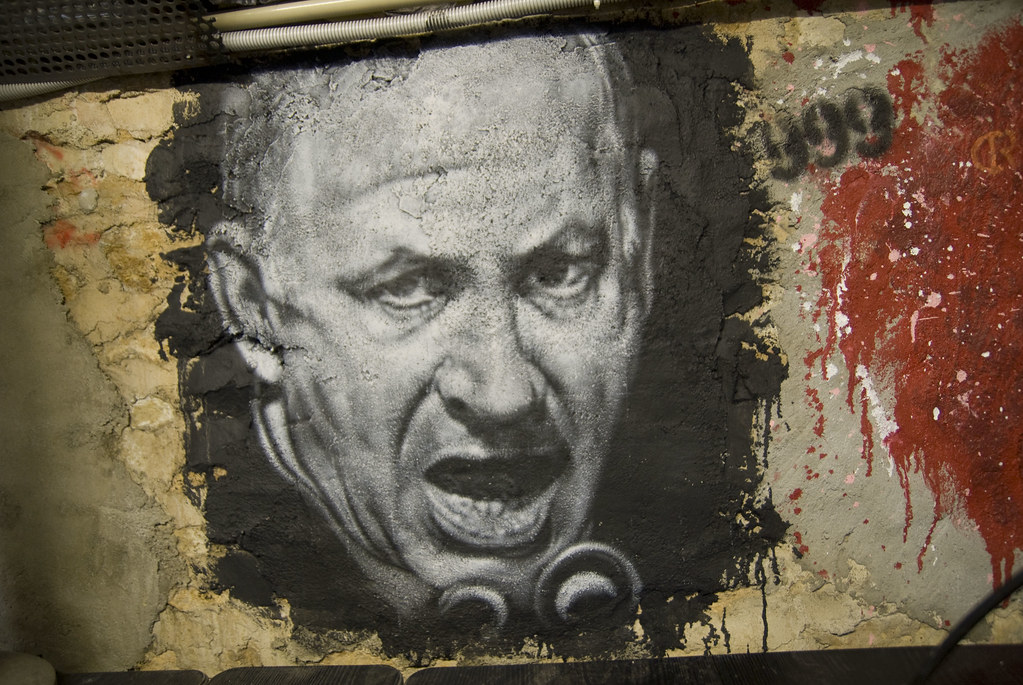
Portrait of Benjamin Netanyahu, painted on a wall. Photo: Thierry Ehrmann.
The revelations that have been rocking Israel in recent days could prove devastating for the seemingly indestructible current Prime Minister, Benjamin Netanyahu, who is nonetheless clinging to his post in the middle of a fresh election campaign in the country. The timing naturally raises questions, since we are in the thick of one of the most decisive election campaigns Israel has seen in recent years, almost three years after the terrible massacres committed by Hamas on 7 October 2023, which left nearly 1,200 people dead in the south of the country.
According to a recent investigation published by the left-leaning liberal daily “Haaretz”, Mohamed bin Zayed, President of the United Arab Emirates, personally warned Benjamin Netanyahu, some ten days before 7 October 2023, that Hamas was preparing a major operation against Israel. An Emirati source has since confirmed to “The Times of Israel” that the warning was given. The Israeli Prime Minister’s office categorically denies it. Even the Israeli intelligence services said at the time that they had warned Bibi!
With the Israeli legislative elections on 27 October only weeks away, the affair is plainly a political bombshell. It comes at the worst possible moment for a Prime Minister who has built much of his career on a single promise: that he alone could guarantee Israel’s security. Yet it is precisely this promise that 7 October shattered.
A disaster that no longer seems to have come out of the blue
The massacre carried out by Hamas on 7 October 2023 remains first and foremost the responsibility of those who planned and executed it. More than 1,200 people were killed and 251 taken hostage. Nothing in Israel’s mistakes can lessen the responsibility of the killers. But this self-evident truth does not rule out another question: how could the state with some of the most effective intelligence services in the world have been caught so completely off guard? Especially when one recalls their feats of arms in Lebanon and Iran since?
For the Emirati revelation does not come out of nowhere. We now know that the warning signs were there. Long before the attack, the Israeli army had been aware of a Hamas plan bearing a striking resemblance to what was about to happen. Female military observers had reported worrying training exercises and, in particular, the movements of pick-up trucks. In the hours before the attack, further indications were detected. And the former head of Shin Bet, Ronen Bar, is even said to have warned Netanyahu a few days earlier of the risk of a coming “earthquake” triggered by Hamas. But Bibi’s hubris seemed to prevail, locking him into total political and strategic blindness.
For years, Netanyahu took the view that Hamas could be contained. Palestinian division even served an obvious political purpose: a Hamas in control of Gaza and a weakened Palestinian Authority in the West Bank made it even less likely that a Palestinian interlocutor strong enough to negotiate a state would emerge. It was in this logic of preserving the status quo that Israel and the United States authorised transfers of Qatari money to Gaza. The problem is that Hamas, for its part, clearly did not regard this status quo as an end in itself, since its ideology does not stop at a hypothetical Palestinian state but continues to advocate the destruction of Israel and… of the Jews!
The government of chaos
This strategic error was compounded by another, which is one of the main causes of everything that has happened since. When Netanyahu returned to power at the end of 2022, he chose to ally himself with the most radical elements of the Israeli right. Itamar Ben-Gvir and Bezalel Smotrich are no ordinary partners. They are time bombs, because they represent a nationalist and religious right for which the Palestinian question should not so much be resolved as removed from the agenda for good.
The West Bank gradually became one of the government’s political and security centres of gravity. Settlement expansion, protection of the settlements, violence between settlers and Palestinians, provocations around the holy sites: tensions mounted while Gaza paradoxically appeared to be under control. Therein lies one of the great tragedies of 7 October.
Israel had so thoroughly internalised the idea that Hamas was deterred that it had simply not prepared its defences for an offensive of this scale. When thousands of attackers crossed the border, stormed the kibbutzim and massacred those attending the Nova festival, the system collapsed. In some places, residents had to defend themselves alone for hours. In Be’eri, the IDF’s investigation established that residents and their local security teams bore the brunt of the fighting for the first seven hours. The army itself has acknowledged that it was not prepared for a scenario of simultaneous mass infiltration.
This makes the new revelation all the more serious. If Netanyahu did indeed personally receive a warning from the Emirati president, and if that warning explicitly mentioned Yahya Sinwar and the preparation of a major operation, it will no longer be possible to present 7 October as an entirely unforeseeable catastrophe.
1973–2023: fifty years of blindness
Israeli history helps to put 7 October into perspective, for there has already been a precedent of the authorities strikingly denying an existential threat to the Jewish state. On 6 October 1973, the day of Yom Kippur, Egypt and Syria attacked Israel. Then too, the information existed. Then too, the leadership and the intelligence services had built an analytical framework so robust that they ended up dismissing whatever no longer fitted their certainties.
Golda Meir was, of course, not accused of having wanted the war. But the trauma was such that a commission of inquiry was set up, and her political responsibility ultimately brought down her government. Fifty years and one day later, Israel suffered the worst massacre in its modern history.
The difference is that Benjamin Netanyahu still refuses to allow an independent national commission to establish the full extent of political responsibility for 7 October. And it is here that the question also becomes an electoral one.
With the vote just weeks away, Netanyahu may be fighting the toughest battle of his seemingly endless career. At 76, having served as prime minister for longer than any other Israeli leader, he has little left to conquer. He does, however, have an enormous amount to lose: power, his immunity, his political legacy and, above all, the historical narrative of his record. The continuing operations in Gaza, the recurring flare-ups in the West Bank and the radicalisation of some of his allies are thus sustaining a situation in which the security emergency has endlessly postponed the day of reckoning. Perhaps not for much longer
Translated from French. The French original prevails.