By Frédéric Roussey*

Transatlantic relations are not in crisis, but their nature is changing. And Europe’s mistake would be to keep analysing them with the reflexes of the past, in a world that has passed. For more than seventy years, Europe has lived under an American strategic guarantee and beneath Washington’s umbrella, an arrangement that suited it very comfortably.
That model is reaching its limits. Not because of a political accident, but because the United States is redefining its global priorities, and its priority today is… itself!
Europe, for its part, has still not redefined its own.
Trump, NATO and the reality of American power. It is essential to bring some precision back to a debate saturated with posturing.
A US president cannot unilaterally withdraw the United States from NATO. Such a decision requires a vote in Congress. This is a genuine institutional safeguard. And with the November elections approaching, a reshaping of Congress is likely. If the opposition takes control, the Trump administration will automatically find itself constrained. It will be able to issue statement after statement, but its capacity for structural action will be severely limited.
This means one simple thing: the threat of a formal withdrawal is low in the short term. But such reasoning would be a major strategic error.
The real shift is the dilution of America’s commitment
The issue is not withdrawal. The issue is the transformation of that commitment. The United States is no longer destined to be the automatic guarantor of European security. Its priorities lie elsewhere: the Indo-Pacific, rivalry with China, the reshaping of the global balance of power. In this context, Europe becomes a secondary theatre. An alliance does not necessarily disappear. It can be hollowed out and become a mere administrative structure with no political will to intervene.
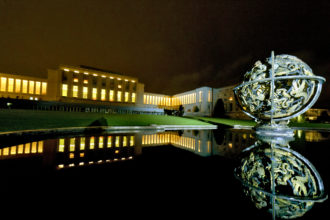
The UN has become a central yet marginal institution. Amid this shift, one actor remains strikingly absent from the European strategic debate: the United Nations. The UN is today weakened by structural inertia and political paralysis. This situation is unsustainable in a world that calls for multilateral regulation, now more necessary than ever. The forthcoming appointment of the Secretary-General will be a pivotal moment. If the UN continues to produce candidates drawn exclusively from its own internal circles, it will prolong its decline. What the international system needs is not a manager, but a reformer capable of shaking up the status quo at the Security Council. Someone capable of restoring the institution’s political credibility, imposing more effective decision-making mechanisms and repositioning the UN as a genuine actor in managing international tensions.
Europe must wake up
Failing that, Europe must speak with a strong voice to prevent the UN from ending up like the League of Nations in its day. And to do so, it has a lever that few players possess: the ability to shape balances of power. Yet it still refuses to use it to the full. Rather than remaining strategically dependent on the United States, it must chart a course towards an intelligent rebalancing of its partnerships. That means moving beyond normative naivety and embracing a diplomacy of interests. It means a deliberate rapprochement with the Gulf monarchies, central players in finance, energy and influence diplomacy, and with the Asian powers, notably Japan, South Korea, India and the emerging economies of South-East Asia. This shift does not mean distancing itself from the United States. It means an end to exclusive dependence. It is the move from Europe as client to Europe as partner. France bears a particular responsibility. It must stop wavering between the rhetoric of autonomy and the practice of alignment.
Three priorities stand out. Unapologetic firmness towards Washington The transatlantic relationship must be rebalanced. From November 2026, if Congress is divided, the Trump administration will be politically constrained. That offers Europe a window of opportunity: to regain the initiative without the risk of an abrupt rupture.
A strategy of broader, pragmatic alliances France must speed up the building of strategic partnerships with the Gulf, technological Asia (Japan/Korea) and India. This network must become a pillar of its international strategy, offering Europe credible alternatives to Sino-American pressure.
A leading role in Europe, without arrogance France must drive forward a hard core of European states – which must include Germany and Poland – that are ready to make genuine progress on military capabilities and the defence industry. This qualitative leap requires the political will to fund our sovereignty, because freedom has a price that Europe can no longer delegate.
The world now emerging is not the product of an abrupt break but rather of a gradual erosion of certainties. The United States will not disappear from NATO, but it will no longer be what it was. The UN will not collapse, but it will keep losing influence unless it undertakes radical reform. Europe will not be sidelined – but it will be if it refuses to assert itself as an autonomous power bloc. The question is no longer whether the international order is changing. It already is. The only question is this: who still decides, and who adapts? Today, Europe adapts. Tomorrow, it will have to decide.
*Journalist, analyst, international relations adviser
Translated from French. The French original prevails.