The new mission by Donald Trump’s envoys on 5 and 6 September does not mean that Moscow and Kyiv are moving closer to a territorial compromise. Russia is demanding not only the regions it occupies but also parts of Ukraine that its army has not taken. Kyiv might consider a military freeze along the front line, but refuses to turn occupation into Russian sovereignty. Between a constitutional obstacle, political legitimacy, European guarantees and American pressure, a peace treaty appears out of reach. A precarious armistice remains more conceivable.
Steve Witkoff and Jared Kushner, the US special envoys, say that “substantial progress” has been made, notably in scheduling new trilateral talks between the United States, Russia and Ukraine. That wording, however, describes progress in organising the negotiations, not a verifiable advance on their substance. No territorial agreement, no shared map and not even a date for a trilateral meeting have been made public. Diplomacy is moving again; the main obstacle remains intact.
A truce far more limited than announced
The American account also calls for clarification. The “three-day ceasefire” mentioned in connection with the Witkoff-Kushner mission was not a general suspension of hostilities. It essentially covered certain air strikes on the capitals, in order to facilitate travel and talks. Vladimir Putin refused to extend this pause to the entire front line. Military operations therefore continued. This ambiguity is telling: Washington is seeking to build political momentum out of limited measures, while both belligerents retain their means of leverage. The words used by the delegations — “substantive”, “useful”, “constructive” — should not be mistaken for any shift in territorial positions.
What Moscow is demanding
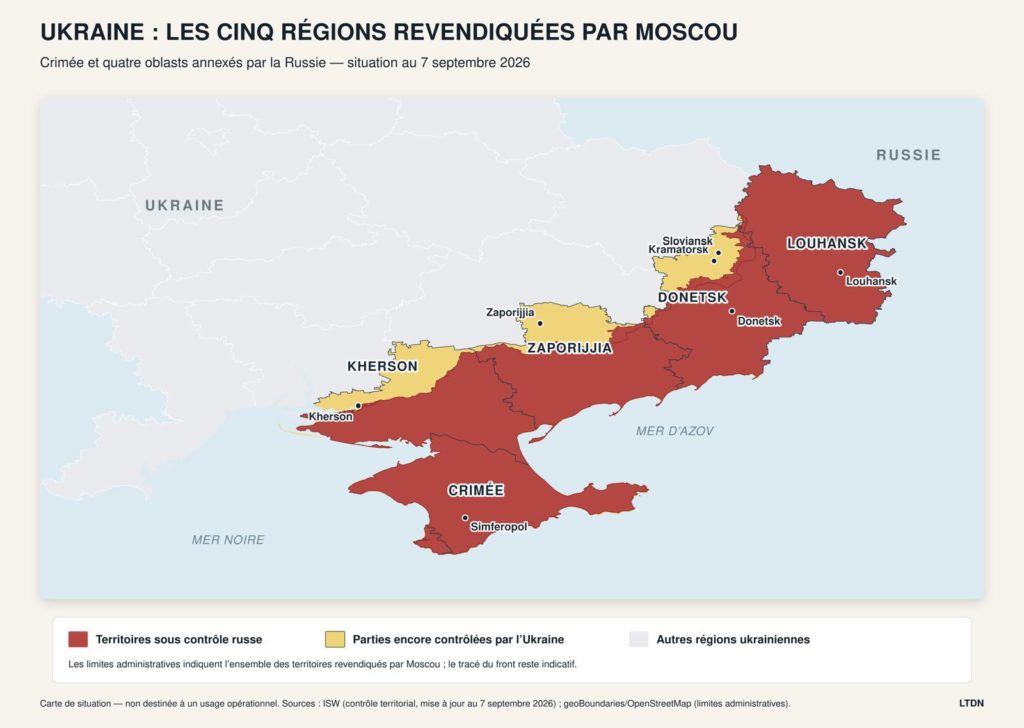
In addition to Crimea, annexed in 2014, Russia wants to seize the Ukrainian oblasts of Donetsk and Luhansk, as well as those of Zaporizhzhia and Kherson, whose annexation it proclaimed in 2022. This claim covers the full administrative borders of these four regions, even though the Russian army does not control all of them. Moscow is consequently demanding that Ukraine withdraw its soldiers from territory that the Russian army has not conquered. This gap between the front line and the map claimed by the Kremlin lies at the heart of the deadlock.
| Territory | Russian position | Sticking point in the negotiations |
| Crimea | Russian sovereignty and international recognition | Kyiv rejects any legal recognition |
| Luhansk | Full integration into Russia | Region almost entirely under Russian control |
| Donetsk | Ukrainian withdrawal from all the territory still held by Kyiv | Main immediate territorial obstacle |
| Zaporizhzhia | Recognition of the annexation of the entire oblast | The regional capital remains Ukrainian |
| Kherson | Recognition of the annexation of the entire oblast | La ville de Kherson et la rive droite restent ukrainiennes |
The immediate priority appears to be the western part of Donetsk oblast. The Kremlin still believes it can improve its position by force of arms. Vladimir Putin reminded the US envoys that Russia was advancing on the ground and that any settlement must address the “root causes” of the conflict. This language refers to a broader set of political and strategic demands, but it also serves to keep the maximalist territorial claim alive. According to Reuters, the US envoys put forward several options, though the Kremlin neither disclosed their content nor confirmed any compromise.
Can Russia still conquer the territory it claims?
The map of the five claimed regions reveals another dimension of the territorial deadlock: not all the areas still controlled by Ukraine pose the same military difficulty. Russia can still capture new sectors, particularly in Donetsk and in the remaining Ukrainian-held part of Luhansk. By contrast, fully occupying the four annexed oblasts would require operations on a far larger scale than the Russian army is currently capable of conducting.
Donetsk is the most attainable objective, but also the most costly. Russian forces are closing in on the fortified belt of Sloviansk, Kramatorsk, Druzhkivka and Kostiantynivka. They may yet make gains and threaten some of these cities. Taking them one after another, however, would require breaking through several urban defensive lines and then sustaining an advance under the constant surveillance of Ukrainian drones. The situation is far less favourable to Moscow in Zaporizhzhia. To control the whole oblast, the Russian army would not only have to push deep to the north but also seize Zaporizhzhia, a large Ukrainian city some distance from the current front line. In Kherson, the objective looks harder still: Russia would have to cross the Dnipro, establish and resupply several bridgeheads, and then retake the city of Kherson and the entire right bank.
Under current conditions, the complete conquest of the areas still held by Ukraine therefore looks highly unlikely in the short or medium term. On 7 September, the Institute for the Study of War reported no confirmed Russian advances in the Pokrovsk and western Zaporizhzhia directions. As early as August, the institute had assessed that the Russian pace was insufficient to take the rest of Donetsk quickly.
Vladimir Putin’s calculation therefore seems to rest less on a swift military victory than on time. The Kremlin can hope that Ukraine will eventually run short of men, that its Western backers will split, or that Washington will put enough pressure on Kyiv to obtain through negotiation the territory the Russian army is failing to conquer. The maximalist claim thus retains a military function, but a diplomatic one too: it turns land that is still Ukrainian into a bargaining chip.
Witkoff’s narrow room for manoeuvre: separating the Donbas from the southern oblasts
This hierarchy of military difficulties nonetheless leaves Steve Witkoff narrow room for negotiation. Washington could try to separate the Donbas from the two southern oblasts: focusing the bargaining on Luhansk, which is almost entirely occupied, and on the part of Donetsk that Ukraine still controls, without immediately demanding the evacuation of the Ukrainian-held areas of Zaporizhzhia and Kherson.
The plan would be to freeze the situation in Luhansk, then to seek a formula in Donetsk involving demilitarisation, a special economic zone or a limited withdrawal backed by guarantees. In Zaporizhzhia and Kherson, the line of contact would simply become the ceasefire line. Kyiv would retain, in particular, the city of Zaporizhzhia, the city of Kherson and the right bank of the Dnipro, without legally recognising the Russian annexations.
For the Kremlin, such a separation would be hard to accept: the four oblasts have been incorporated into Russian law, and Vladimir Putin continues to lay claim to their full administrative borders. It could, however, be presented not as a renunciation but as the postponement of a final settlement. Moscow would maintain its claims in principle while ceasing to demand, as a precondition for an end to the fighting, the handover of territory it appears unable to conquer. This distinction may well be the only territorial opening still available to American mediation.
What Kyiv can negotiate — and what it rejects
Ukraine’s legal position remains the restoration of its sovereignty within its internationally recognised 1991 borders, Crimea included. Ukraine could probably accept a freeze of the line of contact and defer a final settlement on the status of the occupied territories. Such a formula would amount to provisionally tolerating de facto Russian control without recognising de jure Russian sovereignty over the occupied territories. This distinction, seemingly a legal one, is politically fundamental: for Kyiv, it would mean suspending the war without legitimising the annexation.
Volodymyr Zelensky, however, refuses to withdraw from the areas Ukraine still controls in order to hand them over to Russia. He also takes the view that a permanent cession of territory could not be decided by the president alone: it would have to go through Ukraine’s institutions and, under the formula adopted, a referendum. After the meeting in Kyiv, Zelensky said that the leaders would have to discuss territorial questions, without claiming to be able to decide them on their own. The talks also covered security and economic guarantees, which are essential to prevent a ceasefire from becoming a mere pause before a fresh offensive.
The constitutional obstacle and Zelensky’s legitimacy
The distinction between de facto occupation and de jure sovereignty could offer Kyiv a provisional way out. At a pinch, Ukraine might accept that certain territories remain under Russian control for the time being, without recognising the annexations and without legally altering its borders. The ceasefire would then be separated from the final territorial settlement. Such a formula would temporarily sidestep a major constitutional difficulty. Article 73 of the Ukrainian Constitution stipulates that any change to the country’s territory must be decided exclusively by a nationwide referendum. . Neither the president, nor the government, nor even Parliament can therefore, on their own, recognise the permanent surrender of part of the country.
Volodymyr Zelensky’s position adds a political complication. His five-year elected term expired in May 2024; he nevertheless remains president in law. Article 108 provides that he continues to exercise his powers until a successor takes office, while Ukrainian legislation prohibits the holding of elections under martial law. His electoral legitimacy has therefore not been renewed since 2019. This does not legally prevent him from negotiating, but it makes it politically far harder to sign an irreversible agreement giving up territory. Moscow could also exploit the situation to challenge the validity of his signature. A formal cession would therefore in all likelihood require martial law to be ended or suspended, a popular vote and, probably, a fresh mandate for Ukraine’s leadership.
The US compromise of a “free economic zone”
In an attempt to bridge the gap, Washington had proposed turning the part of the Donbas still controlled by Kyiv into a demilitarised free economic zone. Ukrainian forces would withdraw from it, without the Russian army moving in; the territory’s sovereign status would deliberately be left unresolved. The arrangement seeks to make a ceasefire possible without forcing Kyiv to recognise the annexation and without compelling Moscow to publicly abandon its claim. But it is disputed by both sides. Ukraine fears that a withdrawal would weaken its defensive line. The Kremlin objects that, under Russian law, these territories are already an integral part of the Federation and therefore cannot be administered by a third party.
On 25 August, Reuters reported that Moscow was casting doubt on the feasibility of such a zone, while Zelensky tied any territorial formula to security guarantees and to democratic approval in Ukraine.
Can Trump buy a Russian compromise?
Washington has another lever: economic normalisation. At the meeting in Moscow on 5 September, economic cooperation and major bilateral projects were discussed alongside a settlement of the war. As early as February 2025, Steve Witkoff suggested that a peace agreement could allow American companies to resume their operations in Russia. Along the lines of the formulas considered with Iran, the United States could offer a gradual lifting of sanctions, financial licences, the return of investors and cooperation in energy, minerals or the Arctic. Each benefit would be tied to a verifiable step: a halt to strikes, observance of a ceasefire line or an agreed withdrawal.
The comparison has its limits, however. Much of the immobilised Russian assets and the trade sanctions depend on the Europeans; some American measures fall within the remit of Congress. Above all, Putin is pursuing territorial and strategic objectives that money is probably not enough to erase. An economic package could become the price of a ceasefire or accompany a compromise that has already been accepted. It seems less capable, on its own, of buying Moscow’s renunciation of the territories Russia claims.
The Europeans: indispensable backers or a brake on compromise?
Zelensky’s room for manoeuvre does not depend solely on Moscow and Washington. The national security advisers of the United Kingdom, France and Germany have inserted themselves into the final phase of the talks in Kyiv. Their presence reflects a determination not to leave Ukraine alone in the face of the American proposals and to be involved in any system of guarantees. The Europeans are not officially opposed to a ceasefire. London nevertheless appears particularly determined to prevent a deal that would turn Russia’s military gains into political ones, deprive Ukraine of essential defensive positions and give Moscow time to prepare a new offensive. Their line can be summed up as follows: yes to negotiations, no to a peace tantamount to capitulation without solid military guarantees.
This does not mean that Britain is seeking to wreck the talks. The British Prime Minister, Andy Burnham, and Donald Trump have said they want to pursue their efforts towards a ceasefire. But the Europeans refuse to accept a deal negotiated between Washington and Moscow and then imposed on Kyiv without a credible security mechanism.
This protection strengthens Ukraine’s position, but it also limits Zelensky’s freedom. If he accepts a territorial concession deemed excessive, he risks weakening European political support. If he rejects the compromise sought by Donald Trump, he risks weakening Washington’s military support. Two Western conceptions of peace thus emerge: one, American, prioritises the swift conclusion of a deal; the other, European, insists on the conditions for making it last.
Donetsk: peace in exchange for a fortress
The real bargaining therefore centres on the towns and fortified positions in western Donetsk still held by Ukraine. For Moscow, their handover would politically complete the annexation of the Donbas. For Kyiv, giving them up without a fight would amount to handing Russia what it has failed to conquer, while stripping away a vital part of Ukraine’s defensive depth. The dispute, then, cannot be reduced to a quarrel over borders. It concerns the military conditions of the post-war period. A poorly guaranteed ceasefire line could become the starting line for a future offensive. Conversely, Ukraine’s demand for an immediate return to the 1991 borders remains beyond the reach of any compromise Moscow would currently consider acceptable.
An impossible treaty, an armistice still conceivable
The Kremlin says it does not rule out new trilateral talks, while deeming it premature to announce a date or venue. Kyiv supports them in principle but accepts no territorial concessions. The United States says it has secured diplomatic movement, without publishing the new proposal it has sent to both capitals. At this stage, the “substantial progress” announced by Steve Witkoff must therefore be understood in a narrow sense: channels have reopened and preparations for a new meeting are advancing. Nothing yet allows the conclusion that Vladimir Putin is dropping his demand for territory he has not conquered, or that Volodymyr Zelensky is prepared to give it up.
A genuine peace treaty therefore appears impossible under present conditions. Russia is asking Ukraine to cede to it what its army has not conquered; Kyiv cannot legally give up its territory without consulting its population; and the Europeans reject any deal that would leave Ukraine without sufficient guarantees. The most likely outcome, should the negotiations succeed, would thus be a fragile armistice: the guns would fall silent without the war being politically over.
The negotiations are stalling not only over the question of who will keep the occupied territories. They are stalling over a more radical demand: Moscow wants Ukraine to hand over to it, in the name of peace, part of what the war has not given it.
Read more in La Tribune des Nations
- Ukraine: four and a half years after the invasion, who is gaining the upper hand?
- Four years of Russia’s war against Ukraine: from blitzkrieg to a fight for survival
External sources
- Steve Witkoff — official statement on the mission to Moscow and Kyiv, 6 September 2026
- Reuters — Moscow meeting, Kremlin positions and economic cooperation, 5 September 2026
- Ukrainian Presidency — statement by Volodymyr Zelensky after the Kyiv talks, 6 September 2026
- Council of Europe — Constitution of Ukraine, Articles 73 and 108
- Reuters — Trump-Burnham interview on the search for a ceasefire, 7 September 2026
- Reuters — Russian offensive against the Donetsk fortress belt, 8 September 2026
- ISW — pace of Russian advance and envelopment of Donetsk, 7 August 2026
- ISW — situation on the front line, 7 September 2026
Translated from French. The French original prevails.