Travellers make their way through a railway station during a power cut, illustrating how disruptions to the electricity supply can rapidly affect transport, communications and daily life. © UNICEF/Oleksii Filippov
What if the internet suddenly went dark? Payments frozen, hospitals cut off from their data, emergency alerts silenced, power grids collapsing: a UN report describes a “digital pandemic” scenario that is more plausible than one might think, and for which the world is unprepared.
Failures in digital infrastructure could trigger cascading disruptions across sectors and borders, warns a new expert report published by the United Nations Office for Disaster Risk Reduction, the Geneva-based International Telecommunication Union (ITU) and Sciences Po Paris.
The report sets out scenarios in which such failures cascade through systems. A solar storm on the scale of the one that narrowly missed the Earth in 2012 could disrupt satellites and power grids, halting financial transactions and communications, while a heatwave could overload data centres, affecting hospitals and emergency services.
Damage to submarine cables, which carry more than 99% of global internet traffic, could cut off entire regions for weeks, causing economic and logistical disruption.

© ILO/Bobot Go In the Philippines, a worker installs a new power cable at the top of a pylon.
Cascading digital failures
These doomsday scenarios come as the report highlights how deeply dependent modern societies have become on interconnected digital systems. These remain vulnerable to shocks ranging from natural hazards to infrastructure failures, as well as solar storms, space debris and extreme weather events.
It finds that up to 89% of digital disruptions stem not from the initial shock but from cascading effects across systems, while the number of people affected can be up to “10 times higher than the number initially exposed”.
“What if our digital systems collapsed… right now?” the head of the International Telecommunication Union asked journalists in Geneva, as if to send a shiver through the press room.
“We would not be able to follow this press conference live. The lights in this room would probably go out. Payment systems would eventually freeze, emergency calls would struggle to get through and it would become increasingly difficult to access reliable information on what to do. Such an outage is more likely than you think,” said Doreen Bogdan-Martin.
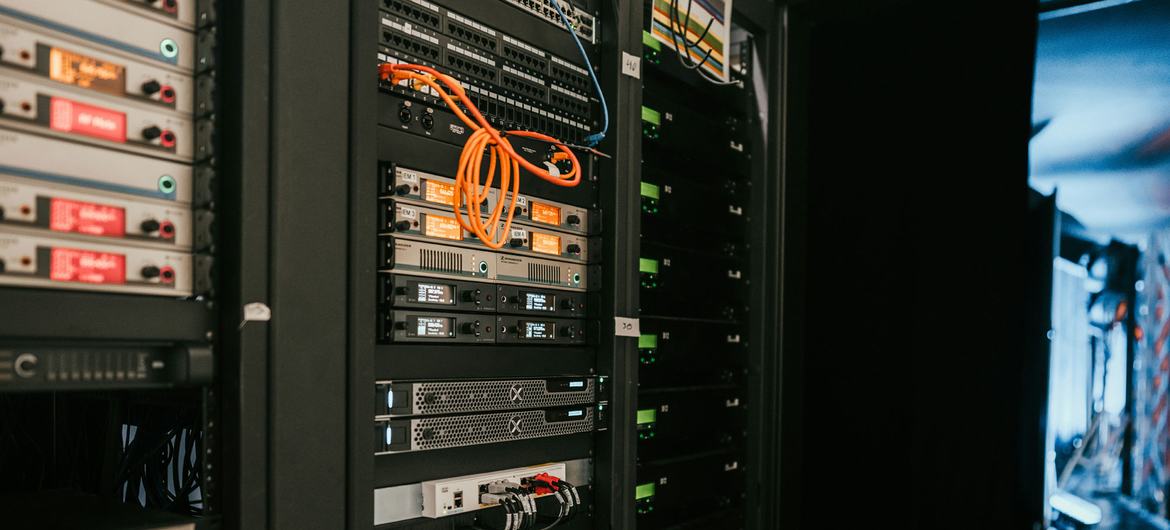
© Unsplash/Kevin Ache Servers in a data centre.
Power grids, satellites… the fragile foundations of the digital world
At the heart of these risks lies a dense web of interdependencies between systems, as well as geographical interdependence.
The report identifies four critical infrastructure domains – power grids, submarine cables, satellites and data centres – whose interconnections form the foundation of global digital systems.
Today, some 5.5 billion people – nearly 70% of the world’s population – use the internet. This use is vital to their lives, with health systems, financial markets, public services and even elections all relying on a complex web of digital infrastructure that now reaches every corner of the globe.
This intense global interconnectedness clearly brings great benefits, but it also carries great risks.
A successful hack on a small Ukrainian software company may seem trivial to the rest of us, but less than a year after the breach of M.E.Doc’s servers in 2017, the NotPetya incident had cost businesses around the world more than $10 billion.

Photo courtesy of ASN Red buoys mark the route of a submarine cable being laid in the ocean.
No longer a question of “if”, but “when”
Yet for all these catastrophic and unpredictable scenarios, countries are unprepared to cope with large-scale satellite failures, power outages or submarine cable breaks. The report also highlights a lack of preparedness for unintentional disruptions caused by natural disasters or infrastructure failures.
According to the UN, the severity of these impacts underlines the need for a concerted, collective response. The document therefore recommends strengthening international standards, maintaining analogue back-up capabilities and improving coordination on space systems, submarine cables and data centres.
Beyond raising awareness, the report also calls for stronger coordination, updated risk management frameworks and efforts to better identify risks, map cross-sector interdependencies and improve preparedness.
“As the report highlights, the risk of a digital disaster is not a question of if, but when. We would therefore do well to start preparing for it now,” stressed Kamal Kishore, Head of the United Nations Office for Disaster Risk Reduction (UNDRR).
Translated from French. The French original prevails.