From identifying targets to shortening nuclear decision-making timeframes, artificial intelligence is already transforming the conduct of military operations. In Geneva as in New York, the United Nations is seeking to establish safeguards, while rivalries between powers and the speed of innovation are complicating efforts to draw up international rules.
Will machines one day decide on their own who should live or die on the battlefield? For Robin Geiss, Director of the United Nations Institute for Disarmament Research (UNIDIR), this prospect is no longer mere science-fiction speculation. “Machine-led warfare is drawing ever closer,” he warned on 20 October at a press conference in New York, raising a central question: how far will states be willing to go in delegating to machines the capacity to target and kill human beings?
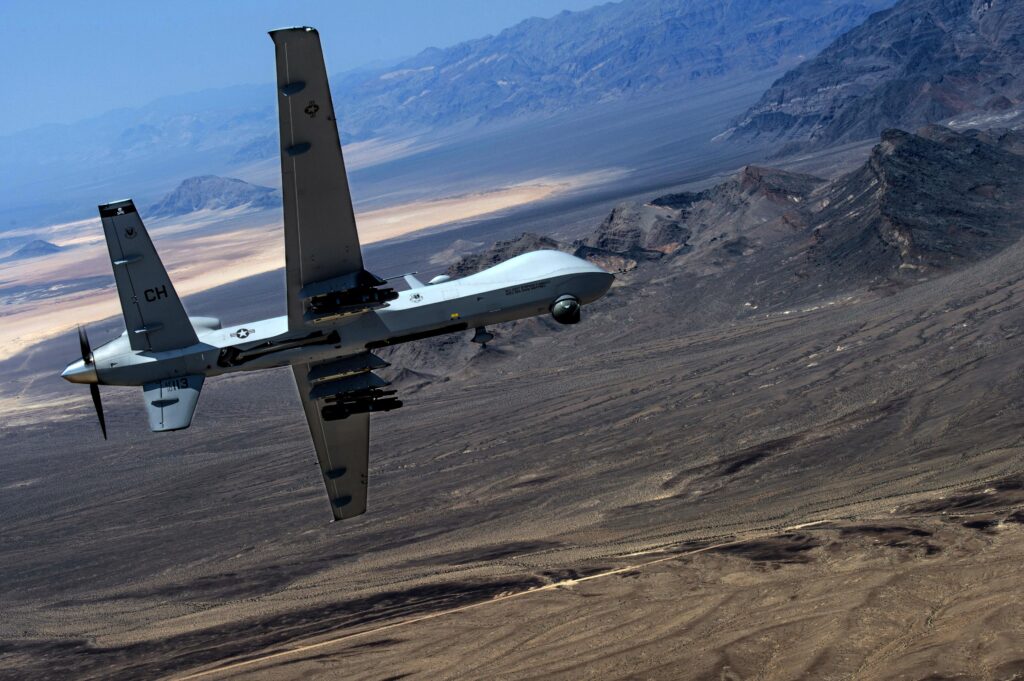
The danger is not limited to the emergence of robots capable of fighting without human intervention. Artificial intelligence is gradually being integrated into the entire military chain: intelligence processing, target recognition, drone piloting, the conduct of operations and cyberattacks. This development is changing the pace of combat, but also the place of human beings in decision-making.
The risk of faster but less controllable warfare
One of the main dangers lies in the shrinking time available to analyse a situation and decide on a response. Automated systems can process vast volumes of data and produce recommendations at a speed that a human operator would struggle to match. But speed guarantees neither the accuracy of the analysis nor the soundness of the decision.
“Decision cycles are getting shorter, they are approaching machine speed, and the room left for human judgement is narrowing, including in the nuclear domain,” Robin Geiss stressed.
In a military environment marked by uncertainty, an erroneous piece of data, a misidentified target or a misleading interpretation of an adversary’s behaviour can set off a chain of reactions that is hard to halt. The risk is particularly worrying between nuclear powers: a misinterpreted alert, handled at an accelerated pace, could reduce the opportunities for verification and de-escalation before an irreversible decision is taken.
The question therefore concerns not only the technical reliability of the systems. It is also a matter of accountability: who answers for a strike when the decision results from a combination of algorithms, data, parameters set by engineers and military orders? And how can it be ensured that a commander still has the time and information needed to exercise independent judgement?
Autonomy in weapons, moreover, covers different realities. A system that assists an operator in analysing a situation is not equivalent to a weapon capable of selecting and engaging a target without further human intervention. To draw up effective rules, states must be able to distinguish between these uses and specify the responsibilities attached to each.
Tech companies emerge as new players in international security
This transformation is also shifting a share of military power towards the private sector. The artificial intelligence capabilities deployed by armed forces often depend on technologies designed or supplied by companies: major defence groups, specialist software firms, tech start-ups and subcontractors. Investors also help to finance this ecosystem.
Decisions taken upstream — model design, the selection of training data, robustness testing, control mechanisms and deployment arrangements — can have direct consequences for how systems behave in conflict situations.
Yet traditional arms control instruments were designed primarily around relatively identifiable weapons, equipment and capabilities. They are less suited to evolving digital technologies, which are sometimes built into civilian products and can be modified or disseminated rapidly.
To fill part of this gap, UNIDIR is working with the Office of the United Nations High Commissioner for Human Rights (OHCHR) on a responsible conduct framework for companies in the sector. The aim is to put forward practical recommendations grounded in international law and the United Nations Guiding Principles on Business and Human Rights.
The scope of this initiative nevertheless remains limited: the planned recommendations are voluntary. They may help to change industry practices, but do not, on their own, constitute legally binding obligations. The framework’s effectiveness will therefore depend on the commitment of companies, the vigilance of states and the existence of mechanisms to verify practices.
Proliferation that reaches beyond the armed forces
The other concern relates to the spread of artificial intelligence capabilities to non-state actors. Tools once reserved for organisations with substantial technical resources are becoming more accessible. According to Robin Geiss, research shows that malicious actors are already using AI to help plan, carry out or support the logistics of their operations.
Terrorist organisations and criminal networks could thus exploit these technologies to enhance their capabilities, particularly in the digital sphere. Automating certain tasks can reduce the skills needed to prepare complex operations, even if it removes neither material constraints nor technical limitations.
The challenge is all the more delicate given that artificial intelligence has many legitimate civilian uses. Export controls and non-proliferation mechanisms, historically focused on sensitive equipment or technologies, must now take into account software tools distributed worldwide.
UNIDIR intends to work on this issue with the United Nations Institute for Training and Research (UNITAR) and Austria. The aim is to prevent misuse for malicious purposes without needlessly hampering research, innovation and peaceful applications of AI.
Geneva, testing ground for a still fragile dialogue
In the face of these developments, international diplomacy is running up against a fundamental problem: states do not necessarily share the same definition of autonomy, human control or the safety of weapons systems. These differences in vocabulary also reflect political disagreements over the limits to be placed on military technologies.
To facilitate the discussions, UNIDIR plans to launch a common glossary aimed at clarifying the terms used in the negotiations. The step may seem modest, but a shared vocabulary is a prerequisite for drafting rules that are understandable and enforceable.
The institute is also due to inaugurate a forum organised with Switzerland and Pakistan, bringing together representatives of states, industry, research and civil society. The initiative builds on UNIDIR’s centre of excellence on artificial intelligence, peace and security, established in Geneva in June 2026.
International Geneva thus intends to contribute to a dialogue that cannot be confined to discussions between governments alone. Researchers, the companies developing the systems, humanitarian organisations and civil society actors are all affected by the consequences of their use. Their participation does not guarantee consensus, but it can help to weigh military imperatives against the demands of the law and the protection of civilian populations.
Between great-power dialogue and a binding treaty
Robin Geiss has nonetheless noted a few signs of diplomatic openness. In September, the United States proposed to China a communication line dedicated to artificial intelligence-related incidents liable to threaten national security. Such a channel could help prevent misinterpretations, provided that the two powers agree to use it and to share the necessary information.
UN Secretary-General António Guterres, for his part, is calling for the adoption of a legally binding instrument on autonomous weapons systems. Such a step would aim to establish common obligations where current initiatives still rely largely on dialogue, political commitments and voluntary recommendations.
The path ahead nonetheless remains uncertain. States must reconcile their security concerns, industrial interests and military doctrines, while determining the level of human control that must be retained in decisions on the use of force.
The initiatives announced by the UN seek to bring positions closer together, make companies more accountable and better prevent misuse. They do not yet amount to an international regime capable of governing all military uses of AI.
The problem has now been clearly set out: technology is accelerating military decision-making, while the negotiation of rules remains slow. The challenge is not only to prevent the emergence of machines capable of killing without human control. It is also to preserve, in increasingly automated conflicts, the time needed for judgement, verification and de-escalation. Only on this condition can artificial intelligence be regulated without allowing the speed of systems alone to dictate the course of war.
Translated from French. The French original prevails.