From artificial intelligence to satellite surveillance, emerging technologies promise better protection for trade routes and undersea infrastructure. But the debate held at the UN Security Council on 29 October exposes a major contradiction: the tools designed to make the seas safer are being developed in a world where international law is itself being contested, from the Mediterranean to the Strait of Hormuz.
Maritime security is entering a new era. Autonomous drones, artificial intelligence (AI), connected sensors, satellite imagery and digital detection systems are gradually transforming the means of monitoring the oceans. These innovations give states the ability to spot suspicious activity more quickly, protect merchant vessels and detect threats to undersea cables, which have become essential to the functioning of the global economy.
It was this transformation that the United Nations Security Council examined on 29 October 2026, during an open debate chaired by the Greek Prime Minister, Kyriakos Mitsotakis. Behind the technological promises, the discussions brought a deeper issue to light: control of maritime spaces now depends as much on informational and digital superiority as on traditional naval power.
This shift does not, however, do away with old rivalries. It gives them new instruments, while creating vulnerabilities that could weaken international trade and heighten tensions between states.
Artificial intelligence, the oceans’ new sentinel
Maritime surveillance has traditionally relied on ships, aircraft, coastal radar and military patrols. The rise of digital technologies now makes it possible to cross-reference a vast volume of data: satellite imagery, radar signals, vessel positions and information from various intelligence sources.
Artificial intelligence can help identify unusual behaviour, detect suspicious movements or flag vessels whose activities warrant checking. At the same time, aerial, surface and underwater drones are expanding observation capabilities, sometimes at a lower cost than conventional assets.
The strategic stakes are considerable. Maritime security is not solely a matter for national navies: it also underpins energy supplies, the transport of goods and the functioning of communications networks. A prolonged disruption to a trade route or an attack on undersea infrastructure can have consequences far beyond the region concerned.
Emerging technologies can thus improve the early detection of threats and facilitate information-sharing between countries. But their effectiveness depends on the quality of the data, the interoperability of systems and the ability of states to cooperate.
India’s representative, Harish Parvathaneni, highlighted in particular the analysis of satellite imagery and radar data by artificial intelligence. He cited the Information Fusion Centre – Indian Ocean Region (IFC-IOR), based near New Delhi, as an example of cooperation aimed at improving maritime domain awareness.
This approach reflects an underlying trend: maritime security is becoming as much a matter of collecting, processing and sharing information as one of military presence.
For powers with the necessary digital infrastructure, satellites and processing capabilities, the advantage can be decisive. Conversely, states that rely on foreign systems risk becoming dependent on data, software and technical resources controlled by others.
A new vulnerability: warfare in the networks
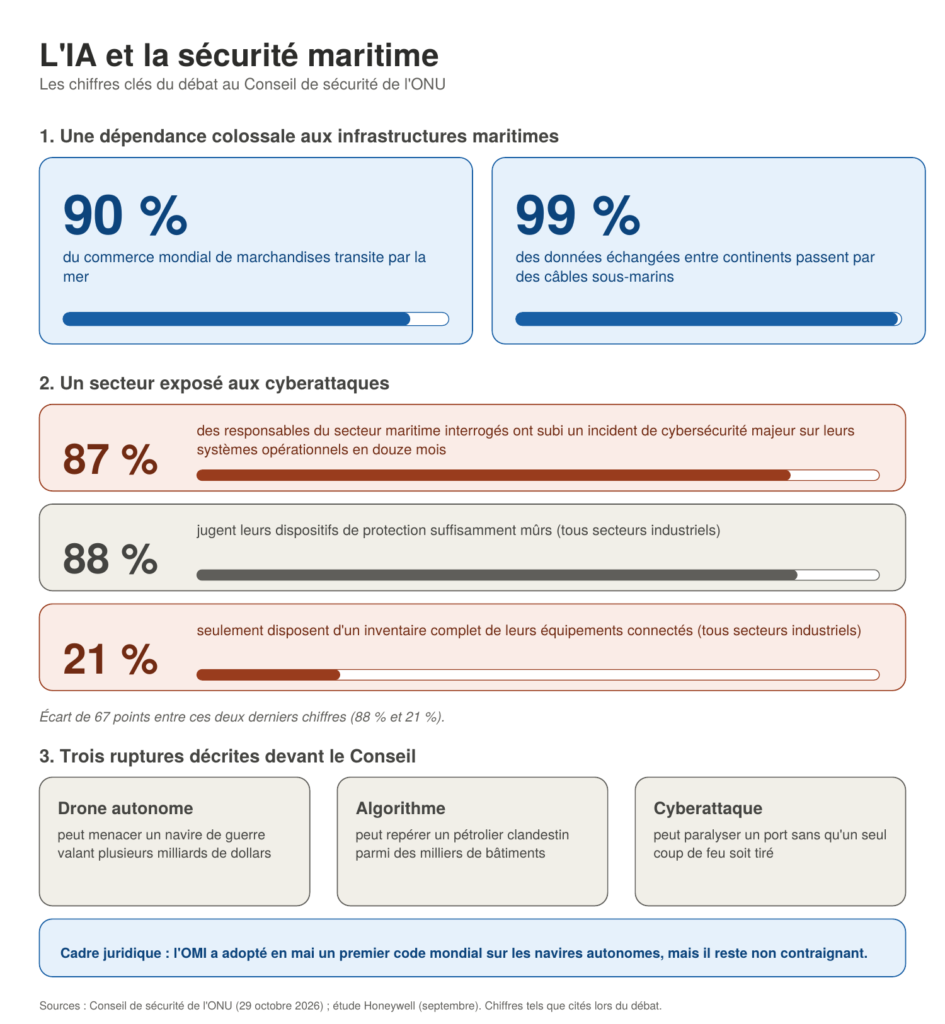
The same tools that improve surveillance can also become instruments of attack. The automation of ships and ports, the proliferation of connected sensors and growing reliance on IT systems are widening the attack surface for cyberattacks. An intrusion into a port system, the falsification of navigation data or the disruption of communications can compromise a ship’s safety without an adversary needing to deploy a fleet.
Autonomous drones pose another challenge. Their growing accessibility allows state and non-state actors to acquire surveillance, harassment or strike capabilities once reserved for better-equipped organisations.
The problem is therefore not limited to the sophistication of weapons. It also concerns the spread of relatively affordable technologies capable of producing disproportionate effects on critical infrastructure.
The Indian representative stressed the need for safeguards, the maintenance of human control and the establishment of accountability in the deployment of these tools. This concern points to a central question: who answers for the consequences of a decision taken or carried out by an automated system?
When an algorithm flags a vessel as suspicious, a drone tracks a target or a defence system triggers an action, responsibility cannot be handed over to the machine. Misidentification, biased data and cyber manipulation can lead to dangerous decisions, particularly when several military forces are operating in a confined space.
Cybersecurity is therefore becoming an essential component of maritime security. It requires resilient systems, verification mechanisms and procedures that allow effective human intervention to be maintained when circumstances demand it.
Strait of Hormuz exposes the limits of technology
Yet the tensions surrounding the Strait of Hormuz show that surveillance and detection are not enough to guarantee freedom of navigation. This strategic passage, through which a significant share of the world’s oil and gas trade transits, is a major point of vulnerability for energy supplies. A crisis in the area can swiftly ripple through to markets, shipping costs and relations between the major powers.
At the Security Council, Iran’s representative, Gholamhossein Darzi, rejected the accusations levelled at his country. In his view, the disruption to shipping is the result of the war waged by the United States and Israel against Iran, which he described as an act of aggression in breach of the Charter of the United Nations. He maintained that Iran’s measures were defensive and called on the Council to demand that Washington put an end to its actions.
These statements should be understood as Tehran’s official position, not as an independent finding that in itself establishes responsibility for the crisis.
The significance of this diplomatic confrontation lies elsewhere: it shows that maritime security cannot be reduced to the ability to detect a threat. It also depends on how that threat is defined, how responsibility is attributed and how legitimate the measures taken in response are.
The same military deployment or the same restriction on navigation may be presented by one state as a defensive measure and denounced by another as an unlawful obstruction. Technology can document movements, reconstruct events and help to establish the facts. On its own, it cannot resolve the political dispute over how those facts are interpreted.
This distinction is fundamental. Artificial intelligence can improve maritime situational awareness, but it is no substitute for independent investigation or for the diplomatic mechanisms needed to prevent escalation.
In the Mediterranean, the battle of the maps remains political
Maritime tensions are not confined to the Middle East. The Mediterranean remains an area where sovereignty claims, potential resources and the delimitation of maritime zones fuel rivalries.
The representative of Cyprus, Maria Michail, challenged the memorandum of understanding on maritime delimitation concluded in 2019 between Türkiye and Libya. Following its ratification by the Libyan House of Representatives, she asserted that the agreement could not be invoked against third states, nor could it infringe the sovereign maritime rights of other countries.
In particular, it relied on Article 121 of the United Nations Convention on the Law of the Sea, which sets out the legal regime of islands and specifies, subject to certain conditions, their entitlement to maritime zones. Notably, the text distinguishes islands from rocks which cannot sustain human habitation or economic life of their own, and which have no exclusive economic zone or continental shelf. Source: United Nations Convention on the Law of the Sea.
The Cypriot statement highlights an often less visible dimension of maritime crises: control of the seas also depends on the ability to impose an interpretation of the law, to secure recognition of boundaries and to consolidate diplomatic alliances.
Surveillance tools can certainly help to document activities at sea, track vessels or monitor the enforcement of certain measures. But they do not, in themselves, settle disputes over sovereignty and maritime boundaries.
The Mediterranean thus illustrates the coexistence of two forms of power. The first rests on material and technological means; the second on law, diplomacy and international recognition. Neither is sufficient for long without the other.
International law put to the test by the technology race
The Security Council debate ultimately raises a question that goes beyond the maritime sphere alone: how can technologies whose capabilities are advancing rapidly be regulated when states remain divided over the rules they should abide by?
The United Nations Convention on the Law of the Sea is a central framework for navigation, maritime zones and the rights of coastal states. But its application must now take account of new realities: autonomous drones, cyberattacks, constant surveillance and the vulnerability of undersea infrastructure.
The challenge is not necessarily to replace existing rules with a new legal regime, but to clarify how they apply to new forms of threat and to strengthen cooperation mechanisms. This means, in particular, improving information sharing, protecting critical infrastructure and developing verification procedures capable of distinguishing between technical incidents, criminal acts and hostile operations.
The risk would be to allow the technological race to outpace the capacity for political and legal oversight. In an environment where ships, drones and surveillance systems are increasingly interconnected, an error of analysis or a premature attribution of responsibility could trigger a disproportionate military response.
Conversely, communication and transparency mechanisms could help reduce the risk of misunderstanding, provided that states agree to share certain information and to subject their practices to common rules.
Cooperation remains difficult, however, when the major powers regard digital technologies as a strategic advantage to be safeguarded. Surveillance systems can serve to protect international trade, but also to increase intelligence capabilities, control disputed areas and reinforce a military presence.
Towards a multi-speed maritime security?
The debate on 29 October highlights three possible paths.
The first would be one of closer cooperation: data sharing, early-warning systems, cybersecurity standards and continued human control over the most sensitive decisions. It would make it possible to harness the benefits of artificial intelligence while reducing the risk of incidents.
The second would be one of technological fragmentation. Each power would develop its own surveillance networks, autonomous systems and cyber-defence capabilities, with cooperation confined to partners deemed reliable. Maritime security would then become more effective for some states, but more unequal on a global scale.
The third, finally, would be one of greater militarisation. Innovations designed to detect threats would fuel a naval and digital arms race, while regional crises would continue to be settled mainly through power politics.
These scenarios are not mutually exclusive. Cooperation agreements could advance in some regions while rivalries intensify elsewhere. It is precisely this coexistence that makes maritime governance so complex.
Technology will not replace diplomacy
Ocean security has become a global strategic issue. It bears on freedom of navigation, energy stability, trade, digital communications and the protection of critical infrastructure.
Artificial intelligence and autonomous systems offer new means of anticipating threats. But their effectiveness will depend as much on the reliability of the systems as on the ability of states to control their use and to cooperate.
The statements by India, Iran and Cyprus, for all their differences, shed light on three complementary dimensions of the problem: operational cooperation, disputes over responsibility in conflicts and the defence of sovereign rights.
The real challenge, then, is not simply to build more closely monitored seas. It is to ensure that this surveillance does not become yet another instrument of confrontation.
For while technology makes it possible to see more clearly what is happening at sea, it does not determine what states are prepared to do with what they see. That decision remains a political one. And in a world shaped by strategic competition, diplomacy and respect for international law remain indispensable to prevent the pursuit of security from producing new forms of insecurity.
Translated from French. The French original prevails.