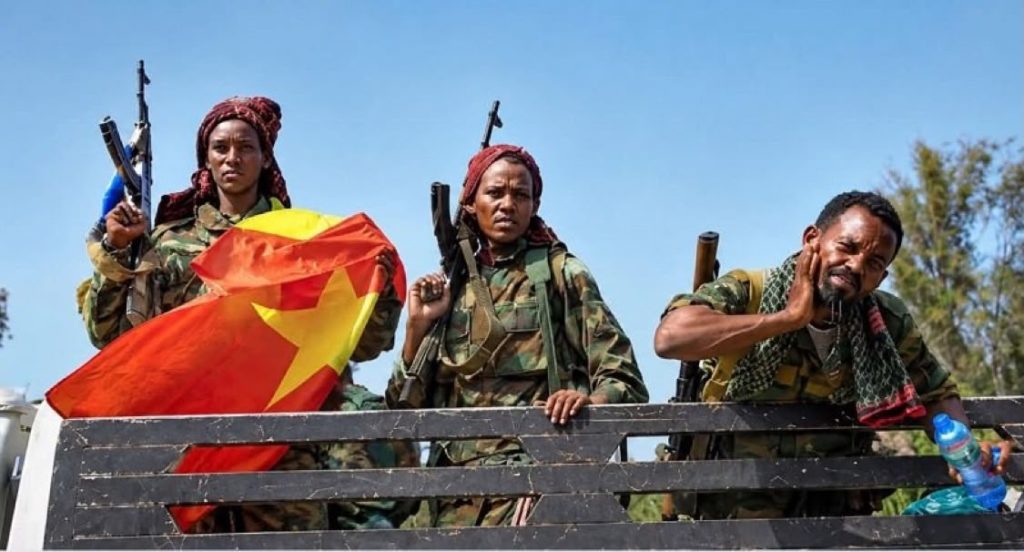
The capture of airports in Tigray and reported fighting in the neighbouring Afar region have raised fears that the peace concluded in 2022 is collapsing. Seven armed movements have announced their intention to overthrow the Prime Minister, Abiy Ahmed. Among them are two former enemies: the Tigray People’s Liberation Front (TPLF) and the Fano militias of Amhara. For the population, the threat is that of a new war in regions still bearing the scars of the last one.
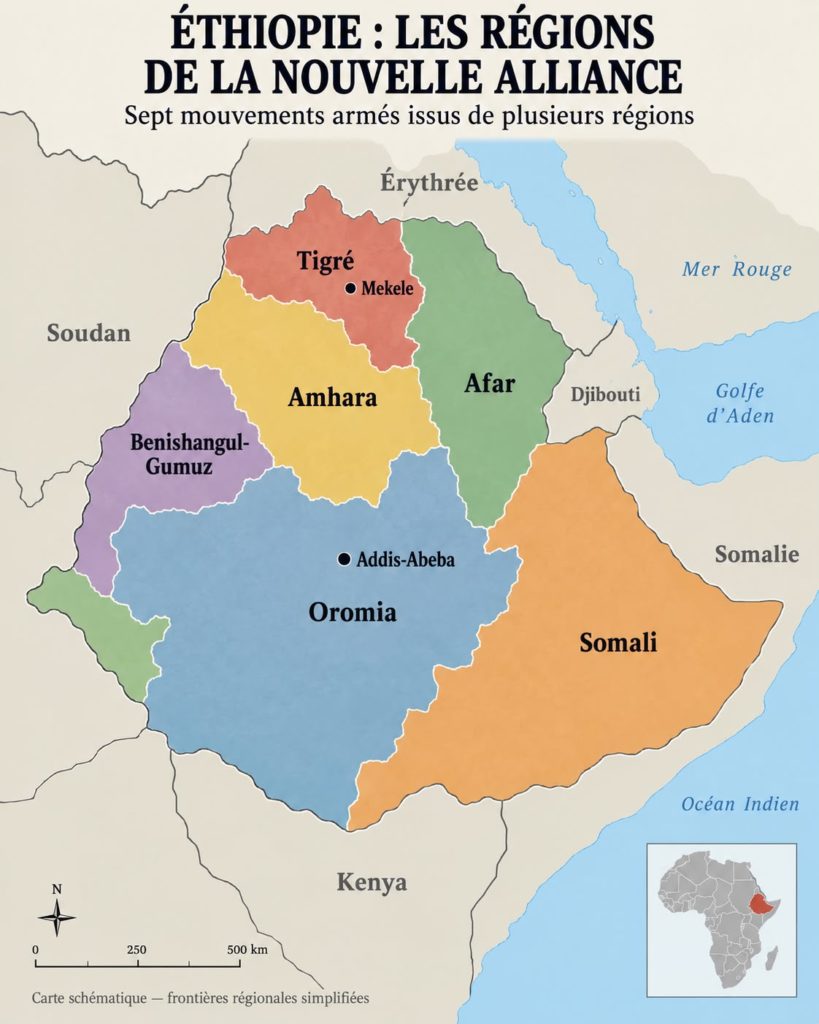
Ethiopia is home to more than eighty ethnolinguistic groups. The Amhara and the Tigrayans, found mainly in the northern highlands, speak Amharic and Tigrinya respectively, both Semitic languages; most of them are Orthodox Christians. The Oromo, who are more numerous and live mainly in the centre and south, speak Afaan Oromo, a Cushitic language, and include both Christians and Muslims. The Afar, in the north-east, and the Somalis, in the east, also speak Cushitic languages and are predominantly Muslim. The regions are often named after a people, but no administrative map on its own captures the diversity of their inhabitants.
These peoples were not brought together within a single state at the same time. The Ethiopian state has an ancient political core in the northern highlands. Its present territory took shape mainly at the end of the 19th century: Menelik II, first King of Shewa and then Emperor from 1889 to 1913, extended his authority to the south, west and east. His conquests absorbed kingdoms, towns and societies that had until then been governed by their own rulers, at a time when the European powers were advancing into the Horn of Africa.
This expansion met with resistance. Some rulers negotiated their submission and retained a degree of autonomy; others fought the imperial armies. The Arsi Oromo, in particular, put up prolonged resistance. Alliances varied from place to place, however: Oromo chiefs also took part in the expansion of the Empire. This history has left opposing memories: for some, the building of a state capable of preserving its independence; for others, the conquest and domination of the peripheries.
After the fall of the military dictatorship in 1991, a coalition dominated by the TPLF established a federal system based largely on languages and regional identities. The 1995 Constitution granted “nations, nationalities and peoples” the right to self-government and even, under a defined procedure, to secession. It was intended to address the legacy of centralised rule. Yet the demarcation of the regions, the sharing of resources and the division of powers between Addis Ababa and the regional authorities have remained contested. These issues give the current conflict its political depth.
Airports seized as fighting spreads beyond Tigray
On 23 September, Tigrayan forces took control of the airports at Mekelle and Shire, according to AFP. Control of the airport at Axum was also reported, though this was not established with the same degree of certainty. Ethiopian Airlines suspended its flights to the three cities. Fighting between Tigrayan and federal forces was also reported in Abala and Erebti, in the neighbouring Afar region. The hostilities are therefore already spilling beyond Tigray alone, even if their extent remains difficult to gauge.
The seizure of the airports also carries political weight. The 2022 peace agreement provided for the federal authorities to regain control of airspace, aviation security and federal facilities in Tigray. Their passing into the hands of Tigrayan forces calls into question one of the practical arrangements on which the peace rested.
Why war broke out in 2020
The 2020 war had its roots in the struggle for control of the federal state and for Tigray’s autonomy. The TPLF had been the mainstay of the ruling coalition from 1991 to 2018. The arrival of Abiy Ahmed brought that dominance to an end; his plan to merge the coalition parties into a new Prosperity Party deepened the rift. The TPLF refused to be absorbed into it and denounced a concentration of power in Addis Ababa. The government, for its part, disputed the legitimacy of the Tigrayan leaders after they refused to recognise federal authority.
The postponement of national elections during the 2020 pandemic turned this rivalry into an open crisis. Tigray held its own regional election in September, which Addis Ababa rejected. In early November, an attack on the federal army’s Northern Command, blamed by the government on the TPLF, triggered the federal offensive. The crisis of legitimacy and of control over the armed forces became a two-year war. The Ethiopian army, Eritrean forces and Amhara units fought the Tigrayan forces. The conflict then spread to Amhara and Afar.
Eritrea’s intervention and the destruction of Tigray
Eritrea was no bit-part player. Its army crossed the border to fight the TPLF alongside federal forces. The intervention was part of a long-standing hostility between the Eritrean government and the Tigrayan leadership. Investigations have documented massacres of civilians, sexual violence, abductions and looting by Eritrean soldiers. Serious abuses have also been attributed to the other parties to the conflict. The exact human toll remains impossible to establish. For the 2020–2022 war, an estimate of around 600,000 deaths is frequently cited. It covers deaths linked to violence, hunger and the collapse of access to healthcare; the figure is not a definitive count.
On top of this toll come the physical destruction and the disruption of daily life. Health facilities were damaged or looted, services interrupted and residents displaced. A study of Tigray’s health system found damage at the vast majority of the facilities assessed. Even after the fighting ended, repairing buildings, restoring healthcare and enabling displaced people to return will take years.
The Pretoria Agreement: a peace that left questions unresolved
On 2 November 2022, following negotiations held under the auspices of the African Union in Pretoria, the federal government and the TPLF signed an agreement for a permanent cessation of hostilities. Among other things, it provided for the protection of civilians, humanitarian access, the disarmament of Tigrayan fighters, the restoration of federal authority and an interim regional administration. The fate of the disputed territories was to be settled in accordance with the Ethiopian Constitution.
The agreement ended open warfare but did not dispel mistrust. Eritrea, despite its military involvement, took no part in the negotiations. Its forces continued to commit abuses in areas they occupied after the signing. The territories disputed between Tigray and Amhara, the return of displaced people and justice for victims remained particularly sensitive issues.
Why the crisis is flaring up again
In May 2026, the TPLF restored its pre-war political institutions and reappointed Debretsion Gebremichael as head of the region. The move called into question the interim administration provided for under the Pretoria agreement. The TPLF, for its part, accused Addis Ababa of failing to honour the agreement, notably over the funding of the regional administration. Sporadic clashes and drone strikes reported in recent months have deepened the crisis. Mutual accusations must be distinguished from verified facts.
This regional rupture is compounded by a national challenge. Seven movements have announced an alliance aimed at overthrowing Abiy Ahmed and establishing a transitional government. It brings together the TPLF, the Fano movement from Amhara, the Oromo Liberation Army and four other groups from the Somali, Afar and Benishangul-Gumuz regions.
The rapprochement between Fano and the TPLF is the most striking reversal. During the Tigray war, Fano militias fought the TPLF alongside the federal army. They later rose up against Addis Ababa. Their shared opposition to Abiy Ahmed neither resolves their territorial disputes nor settles the question of their ability to conduct coordinated operations. The announcement of an alliance does not prove the existence of a unified military front.
The risk of a regional conflagration
Civilians in Tigray, Afar and Amhara are the most exposed: fresh displacement, disrupted access to healthcare, roads and air links cut, and difficulties in delivering aid. The previous war showed how a breakdown in essential services could kill far from the front lines.
The risk of spillover beyond Ethiopia’s borders is real. As early as 2020, tens of thousands of Tigrayans fled to Sudan. At the same time, Sudanese and Ethiopian forces clashed over the disputed border area of al-Fashaga. The two phenomena must be distinguished: the exodus was a direct consequence of the Tigray war, whereas the territorial dispute had its own causes, even if the war heightened tensions along the border.
To the east, the fighting reported in Afar recalls the war’s spread to that region in 2021. Tensions between the Afar and Issa communities, particularly in Djibouti and in the border areas, are a separate matter. The available evidence does not allow the Issa to be presented as an organised actor in the Tigray war or in the current fighting.
The other major unknown is Eritrea. An ally of Addis Ababa against the TPLF in 2020, it has since fallen out with the Ethiopian government. Addis Ababa now accuses Asmara of aiding the new alliance; Eritrea has rejected such accusations in the past. At this stage, nothing allows a fresh Eritrean intervention or a war between the two states to be taken for granted. Such a development would, however, change the scale of the conflict.
Beyond the question of whether the seven movements can topple Abiy Ahmed, another question arises: can Ethiopia’s leaders still prevent this crisis, which has already spread to several regions, from plunging millions of people back into a war whose devastation the country has never repaired?
External sources
AFP, fighting and airports, 23 September 2026
Reuters, alliance of the seven movements, 21 September 2026
AP, composition of the alliance, 21 September 2026
Pretoria Agreement, 2 November 2022
Human Rights Watch, violence after the agreement
Study on the damage to Tigray’s health system
The formation of the Ethiopian state, Cambridge University Press
Conquest and Oromo resistance, Cambridge University Press
Ethiopia and federalism, ConstitutionNet
Translated from French. The French original prevails.