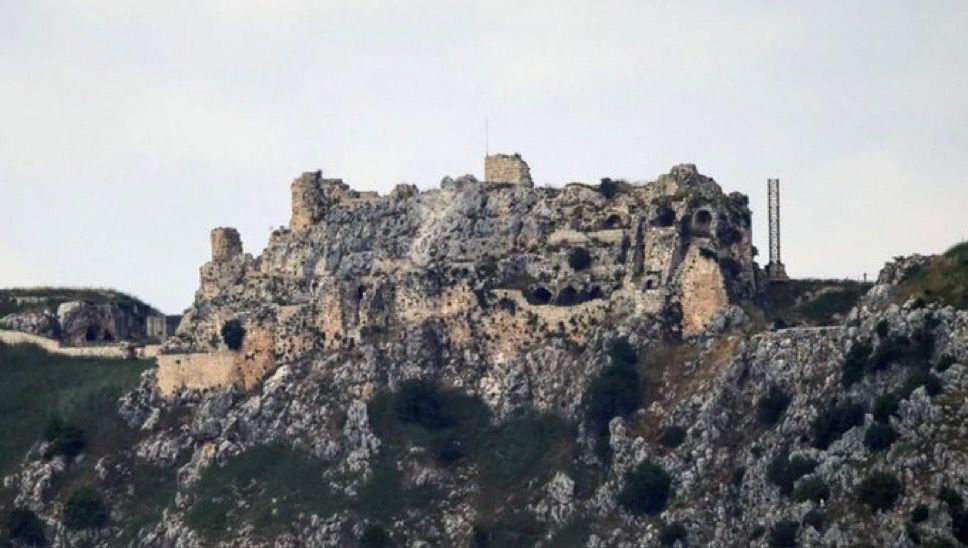
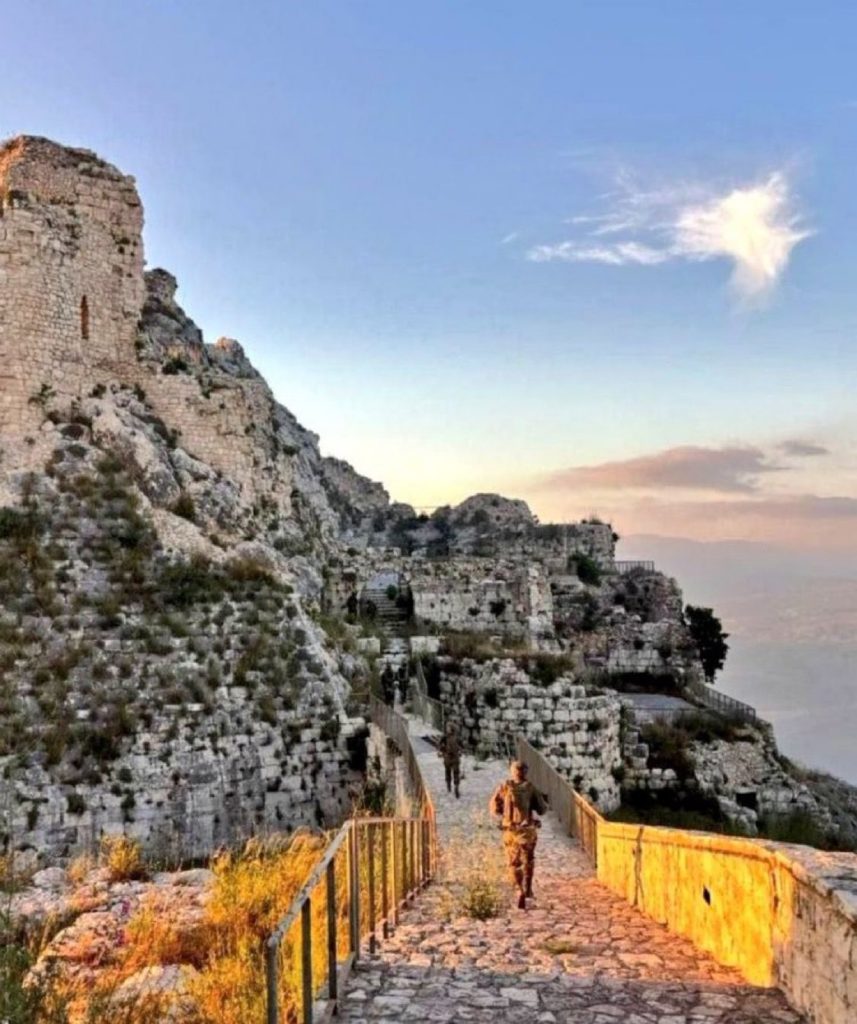
Israeli forces have seized the strategic position of Beaufort Castle, built by the Crusaders, in southern Lebanon. The position overlooks the entire region, including northern Israel.
In practical terms, the occupation of Beaufort Castle means that Nabatieh and the Zahrani area are now more exposed to the Israeli army’s sights.
The occupation of the castle is the result of the Israeli military operation in the area of the “Beaufort hills” and the “Saluki valley” in southern Lebanon. The aim of the operation is to dismantle Hezbollah’s infrastructure and eliminate its members, who posed a direct threat to Israeli civilians in the Galilee Panhandle region and the town of Metula, and it forms part of ongoing efforts to strengthen operational control in southern Lebanon.
Hezbollah had been directing its military and combat activities from the Beaufort Castle position.
Since occupying Beaufort Castle, the Israeli army has been able to observe the projectile-launching infrastructure in the area and destroy it.
ALREADY IN 1976
In 1976, after the security situation in southern Lebanon collapsed as a result of the civil war, Palestinian organisations expanded and turned the fortress of Shaqif, known as Beaufort Castle, into a forward position overlooking much of “the security zone”, the area of southern Lebanon under Israeli control, and a significant part of northern Israel.
It became possible for them to target several sites with a variety of weapons. From that point on, the fortress began to be targeted by the Israeli army and the (Christian) South Lebanon Army led by Said Haddad, causing damage to parts of it, particularly when it was bombarded in air raids.
On 6 June 1982, at the start of a fresh Israeli invasion, Beaufort Castle was attacked at around four in the afternoon following an artillery and aerial bombardment. The battle continued until six o’clock the following morning, 7 June. The Israeli Golani Brigade suffered six dead and several wounded, while the entire Palestinian garrison, some thirty fighters strong, was wiped out.
It was thus that the Israeli flag was raised there in the presence of the then Prime Minister, Menahem Begin, and the Minister of Defence, Ariel Sharon.
Likewise, “Major Saäd Haddad”, commander of the South Lebanon Army, raised the Lebanese flag above the fortress. For 18 years, Beaufort Castle was turned into an Israeli military site, with the addition of buildings and fortifications, which were blown up during the withdrawal in May 2000.
ISRAELI ARMY ORDERS EVACUATION OF AREA SOUTH OF THE ZAHRANI
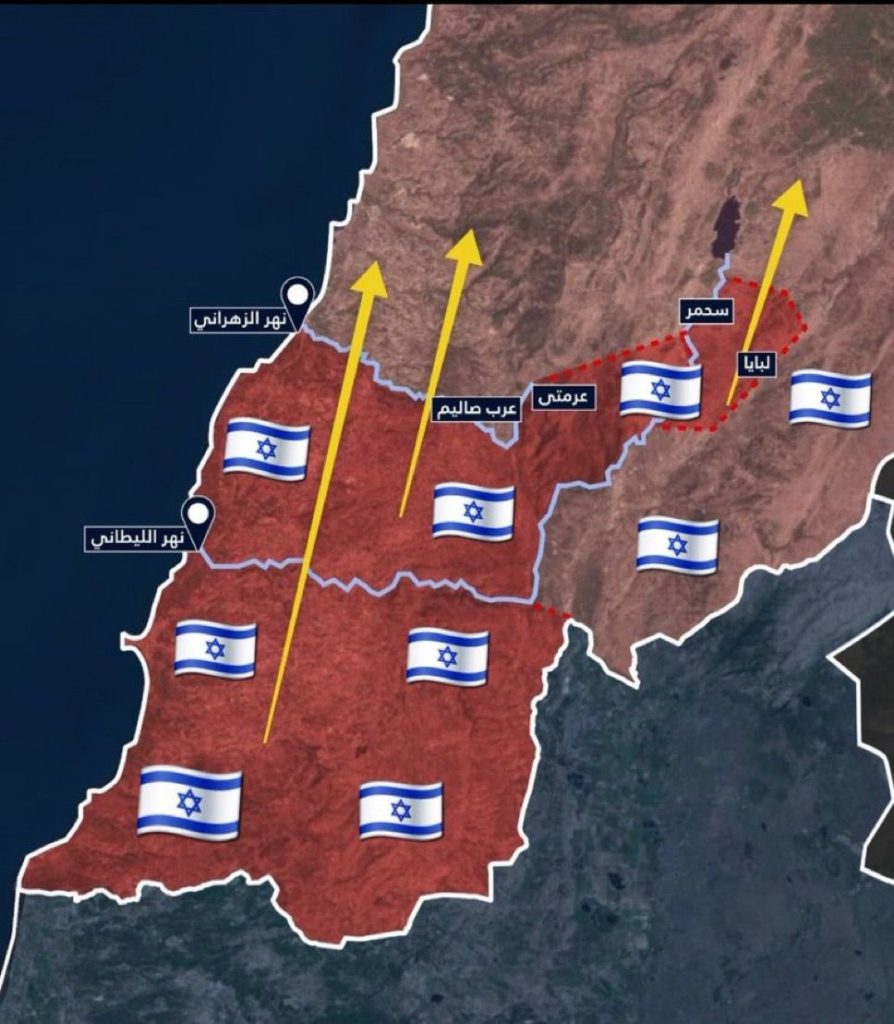
“Urgent warning to residents of southern Lebanon, and in particular to all residents south of the Zahrani River. In light of the terrorist party Hezbollah’s violation of the ceasefire agreement and its targeting of the Israeli home front, the Defence Forces are compelled to act forcefully against it, particularly in your areas. The Defence Forces have no intention of harming you. Out of concern for your safety, we are addressing all residents south of the Zahrani River – as shown on the map – you must evacuate your homes immediately,” the Israeli army announced.
“Anyone in the vicinity of Hezbollah members, its facilities or its combat assets is putting their life at risk. Any building used by Hezbollah for military purposes could become a target!”
Before Israeli soldiers advanced northwards, the Israeli air force carried out large-scale strikes, along with artillery and tank fire, against Hezbollah’s infrastructure. Israeli soldiers then conducted a series of operations to search for and neutralise the Shia militia’s infrastructure in the area, and carried out essential engineering work to lay the groundwork for the assault operation.
The Defence Forces are currently operating near the town of “Nabatiyeh”, a key Hezbollah stronghold in southern Lebanon, and stand ready to widen the scope of the assault as required.
HEZBOLLAH KEEPS UP BOMBARDMENT OF ISRAEL
Hezbollah, for its part, has fired some 24 rockets and several drones from Lebanon towards northern Israel since midnight, triggering 19 “red alert” sirens across the North, in one of the most extensive attacks carried out by Hezbollah in recent weeks.
Most of the projectiles were intercepted or fell in open areas, causing no injuries.
One rocket struck a shopping centre in the town of Kiryat Shmoneh overnight, causing material damage, while further damage was inflicted on civilian property by shrapnel.
Rockets attributed to Hezbollah also came down today in the eastern Mediterranean, near the town of Nahariya, close to bathers on the beach.
In the wake of these rocket barrages, Israel’s “Home Front Command” tightened security restrictions throughout northern Israel; school closure orders were issued in communities along the Lebanese border, while educational activities in parts of the Upper Galilee region » and the northern Golan were confined to protected shelters only. Public gatherings were restricted, beaches closed, and workplaces were instructed to suspend operations except at sites with appropriate shelters. The deteriorating security situation prompted some 2,500 residents to leave the town of Kiryat Shmoneh, while the town’s mayor announced the suspension of classes following consultations with the national authorities.
NO PROGRESS IN NEGOTIATIONS
Meanwhile, there has been no progress in the Israeli-Lebanese negotiations in Washington.
The negotiations, imposed by the United States in order to wrest the Lebanon card from the hands of Iran’s Islamic Revolutionary Guard Corps, have failed quite simply because the Lebanese government has nothing to negotiate with. It no longer controls its own territory, whether in the south or in the Bekaa. Nor does it have control over the weapons needed to accept a ceasefire.
Now that Israel has set foot in the Lebanese quagmire, it will be forced to go further.
The next objective could be Jezzine. By taking control of Jezzine, the Israeli army would cut Hezbollah’s supply lines from the Bekaa, strangle its forces in Beirut, and link the Israeli army to less hostile areas via the mountains of western Lebanon as far as Akkar in the north.
Israel would then find itself in a position of strength should negotiations in Washington resume.
Translated from French. The French original prevails.