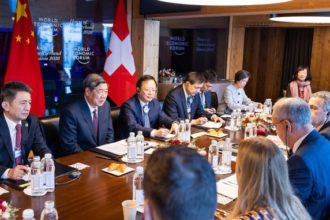
In Geneva, at the 114th International Labour Conference, the Republic of the Congo set out a vision founded on social dialogue, social protection and youth employment, while reaffirming its commitment to international labour standards.
In the corridors of the Palais des Nations and the headquarters of the International Labour Organization (ILO), where governments, employers and trade unions from around the world gather every year, the debates at this 114th International Labour Conference are taking place against a backdrop of geopolitical uncertainty, economic slowdown and accelerating technological change.
It was against this backdrop that the delegation of the Republic of the Congo, led by Minister of State Pierre Mabiala, Minister of the Civil Service, Labour and Social Dialogue, presented Brazzaville’s social and economic priorities to the assembly gathered in Geneva. The delegation also included Rodrigue Malanda-Samba, Minister of Employment, Ingrid Eboucka-Babakas, Minister of Social Security, and Aimé Clovis Guillond, Ambassador and Permanent Representative of the Congo to the United Nations in Geneva.

In his address, Pierre Mabiala stressed the need to put social dialogue back at the heart of public policy. In the face of the upheavals caused by climate change, migration, demographic shifts and the proliferation of conflicts, the minister argued that consultation between governments, employers and workers was now “an imperative” rather than a mere institutional mechanism.
This stance is in keeping with the political agenda championed by President Denis Sassou-N’Guesso, re-elected last March, one of whose central aims is to make social dialogue a lever for stability and development.
A strategy of social modernisation
Beyond the statement of principle, the Congolese delegation presented a series of reforms undertaken with the support of the ILO. Brazzaville is notably pressing ahead with the implementation of its Decent Work Country Programme 2023-2026, is taking part in Alliance 8.7, which aims to combat forced labour, human trafficking and child labour, and is gradually strengthening its occupational safety and health framework.
The Congolese government is also highlighting the creation of the Universal Health Insurance Fund (CAMU), presented as a major step towards extending social protection. On a continent where the informal economy remains dominant and social coverage is often limited, such schemes have become important indicators of states’ capacity to manage economic and demographic transitions.
One of the most significant points of the address, however, concerned youth employment. The Congo announced its intention to ratify several major ILO conventions on employment policy, human resources development and labour statistics. The move is intended to modernise the tools for steering the labour market and to strengthen the state’s ability to anticipate changes in the world of work.
The challenges facing Africa’s young people in search of opportunities
This emphasis on young people is no accident. Like many African countries, Congo faces mounting demographic pressure. According to projections by international institutions, Africa will account for the largest increase in the working-age population anywhere in the world over the coming decades.
Against this backdrop, the issue is no longer simply one of creating jobs, but also of their quality, their formalisation and how well they match the needs of economies that will have to diversify.
Brazzaville’s reference to international conventions on vocational training reflects a desire to frame this policy in terms of upskilling, at a time when automation, artificial intelligence and digital transformation are gradually redefining occupations in every region of the world.
Women’s rights and protection
The Congolese government also announced its intention to ratify ILO Convention No. 190 concerning violence and harassment in the world of work. The decision builds on the Mouebara Law, adopted to step up the fight against violence against women and to promote their legal protection.
In an international environment where social criteria and equality issues are playing a growing role in public policy as well as in economic relations, the announcement was seen as a sign of convergence with the international standards championed by the Geneva-based organisation.
Geneva, a laboratory for global social balance
Beyond the case of Congo, this address illustrates the debates currently running through the International Labour Conference. Since its founding in 1919, the ILO has rested on a simple conviction: lasting peace cannot be separated from social justice.
Yet this balance is now coming under fresh strain. The effects of climate change on employment, economic migration, technological divides and the social consequences of conflict are reshaping governments’ priorities.
Concluding his address, Pierre Mabiala stressed the need for a collective response to the “countless social injustices” that continue to weaken contemporary societies. The phrase sums up the spirit of this Geneva conference: in an increasingly fragmented world, labour governance remains one of the few arenas where social dialogue, international cooperation and economic development still come together.
Geneva – Palais des Nations / International Labour Organization.
Translated from French. The French original prevails.