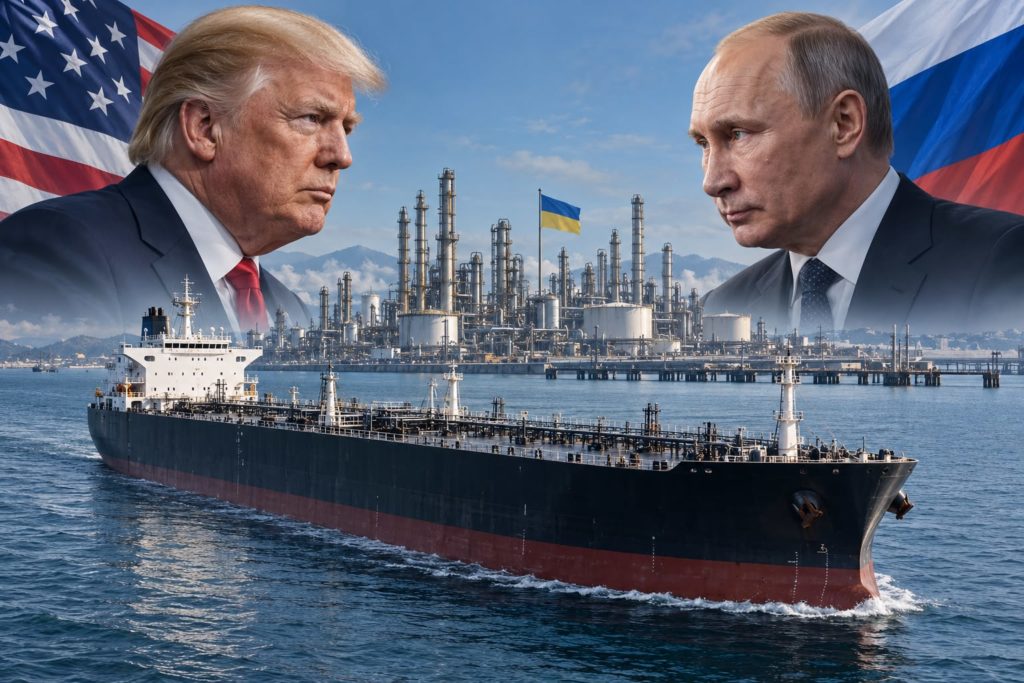
AI-generated illustration.
A deal announced by Donald Trump on 9 October opens a six-month US exemption for Russian fuels. Republican lawmakers oppose it. Kyiv sees it as a way for Russia to finance its war. London is maintaining its sanctions, and Europeans must reconcile support for Ukraine with protecting their consumers. For Moscow, the shortage is becoming a diplomatic lever.
On 9 October 2026, Donald Trump announced that Russia would immediately supply more than 300,000 tonnes of diesel to the US and global markets, followed by 500,000 tonnes in November. These commitments have yet to materialise in actual deliveries. With the 3 November midterm elections approaching, the US president wants to secure a visible fall in fuel costs. [2]
The decision has nevertheless drawn opposition even within the Republican camp. On 10 October, Representative Brian Fitzpatrick announced his intention to introduce a bill to ban purchases of Russian oil, with the backing of his colleague Don Bacon. He intends to use a procedure that can force a vote in the House without the approval of its leadership, provided 218 signatures are gathered. These lawmakers warn of the risk of financing Moscow’s war against Ukraine. Whether a vote will be held, and the outcome of the initiative, remain uncertain. [18]
The Office of Foreign Assets Control, the US agency responsible for financial sanctions, issued General Licence No. 135 on the same day. It authorises, until 7 April 2027, certain transactions relating to the sale, delivery and import of Russian diesel, including into the United States. It does not lift all sanctions, nor does it authorise debits from the US accounts of the Central Bank of Russia, the National Wealth Fund or the Russian Ministry of Finance. [1]
Diesel powers lorries and agricultural machinery, and is also used for some heating. Its price therefore weighs on the cost of transporting goods and of many products. But buying crude is not enough to produce more fuel: refineries capable of processing it are also needed. And Russia has precisely these facilities. The experts interviewed by Associated Press believe that Russian supplies could have a limited effect on prices. [3]
Russia’s political gain is more immediate: Washington is now seeking a fuel that is subject to sanctions. As early as 1 October, Vladimir Putin had linked the return of Russian diesel to the global market to an easing of restrictions. The deal allows him to present Moscow as a useful supplier, at a time when Western countries are seeking to curtail its means of waging war. [17]
Kyiv rejects reward without anything in return
Volodymyr Zelensky has condemned the new revenue being handed to Moscow: allowing Russia to sell its petroleum products amounts, in his view, to financing the continuation of the conflict. His criticism is aimed above all at the lack of any clear and lasting de-escalation in return. [4]
On 10 October, Donald Trump turned on his Ukrainian counterpart, saying it was time for Ukraine to “have a new president”. He also criticised the strikes on Russian refineries, which he blames for part of the rise in diesel prices. The accusation adds to American pressure on Kyiv to halt these attacks. [19]
Ukraine’s anger does not, however, mean that Kyiv rejects any energy truce. Its interest lies in protecting power stations, electrical substations and heating networks before winter. A reciprocal suspension of attacks could protect civilians, while temporarily limiting Ukrainian strikes on Russian facilities.
According to the Kyiv Independent, citing American and Ukrainian officials briefed on the talks, Moscow is demanding sanctions relief and seeking to link the energy truce to a ceasefire in the Black Sea. Which restrictions are targeted has yet to be specified. Kyiv is pressing for a reciprocal halt to strikes and objects to granting Russia additional economic benefits in exchange for this pause. [5]
For Ukraine, the risk is twofold: seeing its adversary receive fresh resources, and coming under greater pressure to give up the strikes that are disrupting Russia’s oil industry. A truce could be useful if it is genuinely reciprocal and monitored. Granting an economic concession before securing that reciprocity, however, would weaken Ukraine’s negotiating leverage.
London keeps up pressure on Moscow
The British government responded directly to the announcement, saying it intends to keep up the pressure on Russia through its sanctions and to continue its military and financial support for Ukraine. It pointed out that Moscow has rejected ceasefire proposals while pressing on with its attacks. [6]
This response builds on a decision taken the previous day. On 8 October, London had announced 38 new designations targeting, among others, oil companies, shadow fleet tankers and supply networks for Russia’s military industry. The contrast is stark: the United Kingdom is seeking to close off outlets just as the United States is reopening one. [7]
This divergence does not automatically mean a transatlantic rift. It does, however, undermine the coherence of a policy whose effectiveness depends on coordinated action by the main financial centres, insurers and shipping operators.
Berlin and Paris caught between military support and the energy bill
On 4 October in Kyiv, Friedrich Merz had reaffirmed Germany’s support and argued for a negotiated peace imposed neither on Ukraine nor on Europe. That position, which predates the diesel agreement, shows the scale of the problem facing Berlin: cutting its energy bill without strengthening the adversary Germany is seeking to contain. [8]
France is already responding to the surge in fuel prices by drawing on its reserves. On 7 October, the government announced that it would release 10 million barrels of diesel onto the market. It is aiming for a reduction of 12 to 18 cents per litre for three months, with retailers monitored. This is a government target, not a result already secured at the pump. [9]
According to Reuters, Washington had previously pressed France and Germany to release more of their stocks, raising the prospect of a US ban on diesel exports. The Commission and several European governments had opened consultations on the matter. [11]
Paris and Berlin therefore face a dilemma. They support Ukraine, but their consumers and businesses are also suffering from the shortages. Russian fuel can ease pressure on the global market while also improving Russia’s economic position. Washington decides on its waiver; the Europeans must manage some of the consequences.
European Commission confronts divergence within the G7
On 2 October, G7 leaders announced a coordinated release of 100 million barrels over four months, with an initial emphasis on diesel. Their statement explicitly linked market stabilisation to keeping sanctions against Russia in place. A week later, the US waiver introduces an exception that puts this common position to the test. [10]
The European Commission is expected to help coordinate the energy response and to ensure that European sanctions are enforced. It cannot, however, decide on its own to lift them: sanctions acts are adopted by the Council, which represents the member states. A US licence therefore does not automatically alter the obligations of European companies. [12]
On 8 October, the Council extended until 9 October 2027 the measures targeting Russia’s destabilising activities abroad. This regime is separate from the oil restrictions, but it confirms that Europe’s policy of pressure remains in place. [13]
The challenge for Europe is now to maintain a credible position. Stepping up aid to Kyiv while allowing sanctions coordination to weaken could lead Europe to offset, through its own budgets, some of the economic advantages conceded to Moscow elsewhere.
And where Iran fits into the equation
The war in the Gulf, shipping restrictions in the Strait of Hormuz and insecurity along the Bab el-Mandeb route have given alternative supplies new value. Moscow can capitalise on this demand without relying on either passage to export from the Baltic or the Black Sea. Exports via the Black Sea nevertheless remain exposed to Ukrainian operations.
The paradox for Tehran is that the disruption it helps to cause may strengthen Russia’s bargaining power with Washington. Its Iranian partner bears the brunt of war and isolation; Moscow can use the shortage to advance its own interests.
The official IRNA news agency disputes the American explanation blaming the surge in fuel prices on Ukrainian strikes. [15]
This media narrative does not constitute an official Iranian response to the agreement of 9 October. For Tehran, the strategic issue is above all the gap between partnership and protection: the Russian-Iranian agreement contains no mutual defence clause. Close cooperation therefore does not mean that Moscow has committed itself to intervening militarily in the event of an attack. [14]
It would be premature to infer from this an “Iran for Ukraine” trade-off, as some have claimed. The energy rapprochement is established; a Russian commitment to abandon Tehran in exchange for American concessions is not. The hypothesis deserves examination, but it cannot be presented as the proven content of an agreement.
A Russian advantage that does not guarantee victory
Higher prices do not make Russia’s difficulties disappear. According to Reuters, oil and gas tax revenues fell by 17% over the first nine months of 2026, despite Urals crude trading above $92 at the end of September. Falling production and exports, together with movements in the rouble’s exchange rate, are limiting the gains. [16]
Three outcomes must therefore be distinguished: more favourable prices, a US trade opening and greater diplomatic leverage. None of them, on its own, guarantees Russian prosperity or victory in Ukraine.
The essential change lies elsewhere. Washington, which sought to put pressure on Moscow by restricting its energy outlets, is now asking for Russian fuel to deal with its own political emergency. Kyiv fears it will pay the price, the Europeans must preserve their cohesion, and Tehran can see that its partner’s interests are not the same as its own. The shortage is not merely redrawing oil routes: it is also changing the value of alliances.
Translated from French. The French original prevails.