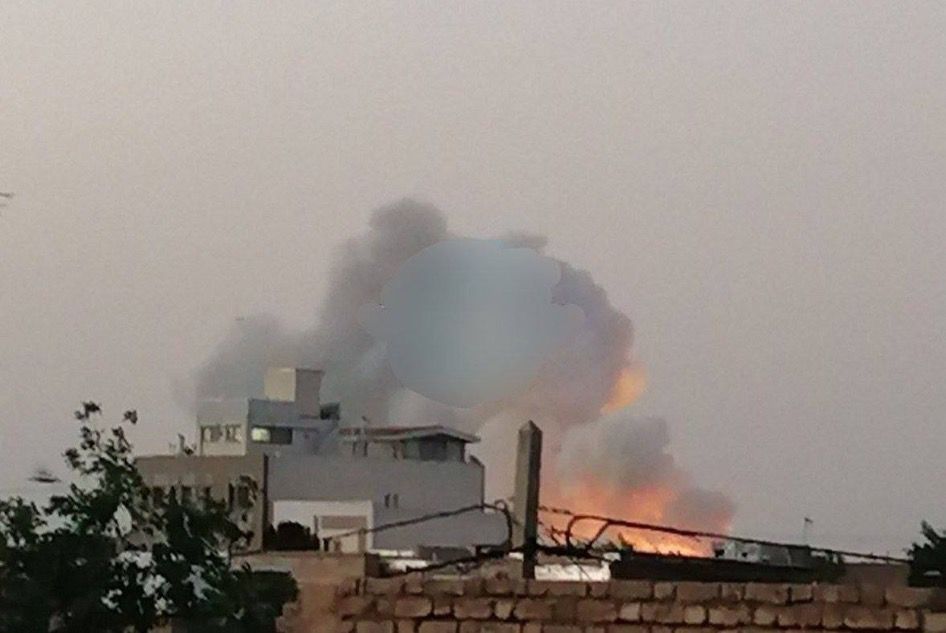
Bombardment of Isfahan.
The Middle East has entered a new phase of tension after a series of military exchanges between Israel, Hezbollah and Iran, reviving fears of a regional conflagration and testing the diplomatic efforts undertaken in recent months. The latest escalation began on Sunday 7 June when the Israeli army struck Hezbollah positions in Dahieh, the southern suburbs of Beirut and a stronghold of the Lebanese Shia movement. The operation came a few hours after rocket fire targeting northern Israel, which the Israeli authorities attribute to Hezbollah.
These strikes mark a turning point at a time when several international mediators were still trying to prevent the conflict from spreading. They also raise questions about relations between the Israeli government and its main ally, the United States. A few days earlier, the Israeli Prime Minister, Benjamin Netanyahu, had suspended similar operations following an intervention by the US President, Donald Trump, according to several media outlets. Washington feared at the time that an attack on Beirut would provoke a direct response from Iran and jeopardise the negotiations under way in the region.
According to several US media outlets, Donald Trump expressed his irritation after Sunday’s Israeli strikes, considering that they had not been coordinated with Washington. The US President is also reported to have warned that a further escalation risked jeopardising a diplomatic agreement with Tehran which, in his view, was close to being concluded.
Iran enters the confrontation directly
The crisis escalated further when Iran claimed responsibility for several ballistic missile launches targeting Israel’s Ramat David air base in northern Israel. The Israeli army said it had intercepted all of the projectiles using its air defence systems. No deaths or major damage were reported.
In a statement, the Revolutionary Guards presented the attack as a response to recent Israeli strikes in Lebanon, notably in the Tyre and Nabatieh areas and in the southern suburbs of Beirut. The Iranian authorities accuse Israel of being responsible for civilian casualties and population displacement.
Tehran nevertheless warned that the operation was merely a “warning”, threatening to expand its military action in the event of further Israeli strikes in Lebanon.
Israel strikes back on Iranian soil
In response to the Iranian missile fire, Israel announced on Monday that it had struck several military targets in western and central Iran. According to a statement from the Israeli army, the attacks targeted missile-launch infrastructure as well as other strategic military facilities.
Iranian state media reported explosions in several cities, including Tehran, Tabriz and Isfahan. The Iranian authorities confirmed the strikes, condemning a fresh violation of their sovereignty and accusing Israel of fuelling regional instability.
A few hours later, Iran launched a new wave of missiles at Israel. Israeli defence systems were activated in several parts of the country and air-raid sirens sounded in numerous towns and villages.
According to initial reports, the latest attacks caused no immediate casualties, but they point to a continuing cycle of reprisals that is causing concern in Western capitals and among neighbouring Arab states.
Tehran showcases new-generation missiles
The Iranian news agency Fars, which is close to the Revolutionary Guards, said that Iran had used latest-generation Kheibar missiles in its strikes on Israel. According to the Iranian authorities, the ballistic missile has a range of around 2,000 kilometres and is better able to evade certain missile defence systems.
No independent source has, however, confirmed that this model was used. The Israeli military merely confirmed that several ballistic missiles had been fired from Iran, without specifying the weapons involved.
The announcement nonetheless carries considerable symbolic weight. For several years, Tehran has sought to demonstrate the progress of its ballistic missile programme, which is regarded as one of the country’s main deterrents against Israel and the United States.
Diplomatic efforts undermined
As tensions mount, the international community is issuing repeated calls for restraint. Washington has stressed that it did not take part in the Israeli strikes on Iran and continues to favour a diplomatic solution.
But the chain of reprisals between Israel, Hezbollah and Iran is now fuelling fears of a wider conflict involving several regional actors.
As the exchanges of strikes continue, observers believe the situation could prove one of the most dangerous episodes since the ceasefire agreed in the spring. The risk of open regional confrontation now appears higher than ever.
Breaking news
Iran’s Fars news agency, citing the Islamic Revolutionary Guard Corps, has announced the end of the armed forces’ operations.
It added, however, that if the aggression and atrocities continue, particularly in southern Lebanon, far tougher and more crushing measures than before would be taken.
No immediate official reaction from the Israeli authorities has been reported
Translated from French. The French original prevails.