In partnership with Chine Magazine
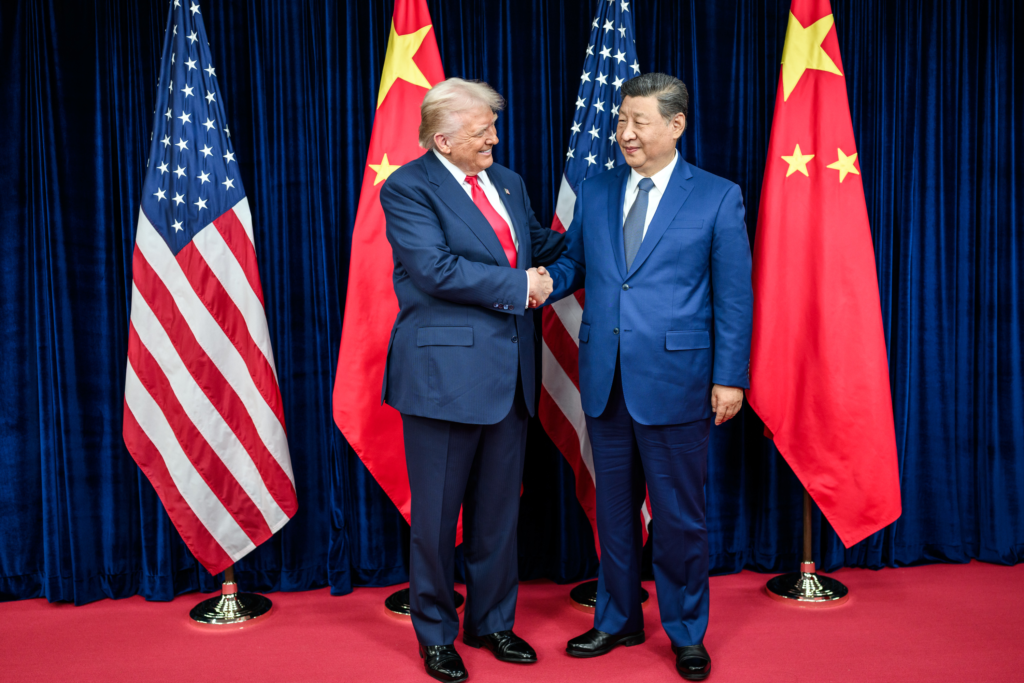
At the invitation of Chinese President Xi Jinping, US President Donald Trump will pay a state visit to China from 13 to 15 May. It will also be the first visit to China by a US president since 2017, and the first since the two leaders met in Busan in October 2025.
Speaking at a press conference on 11 May, Chinese Foreign Ministry spokesperson Guo Jiakun said that “President Xi will have an in-depth exchange of views with President Trump on major issues concerning China-US relations, as well as world peace and development”.
He added that “head-of-state diplomacy plays an irreplaceable role in setting the strategic direction of China-US relations. China is willing to work with the United States, in a spirit of equality, respect and mutual benefit, to expand cooperation, manage differences and bring greater stability and certainty to a world marked by turbulence and transformation”.
The statement is intended to signal China’s willingness to ease tensions with its main rival. Indeed, Edgard D. Kagan, Senior Adviser and holder of the Freeman Chair in China Studies, told the Center for Strategic & International Studies (CSIS) that “China’s top priority is greater stability in its relationship with the United States, including greater predictability on tariffs”.
On tariffs, the trade war between the two countries has now been running since 2018, and it intensified with Donald Trump’s return in 2025.
Boeings and soya beans
Despite the US President’s punitive tariffs, China remains confident: in 2025 it managed to counter Donald Trump’s unprecedented trade escalation, which had pushed tariffs above 140%. Xi Jinping subsequently threatened to restrict these flows in April and October 2025, prompting the US President to back down rather than brandish the threat of new levies.
China is one of the few countries to have stood up to the American billionaire. Beijing has kept up the pressure by continuing to gradually restrict its deliveries of rare earths and magnets to the United States.
The current context is therefore far more favourable to China, even though it faces economic challenges at home. It is seeking to buy time to consolidate its technological and industrial position and revive its economy. The United States, for its part, wants symbolic victories above all, rather than deeper structural reforms of China’s economic model. Beijing is thus probably willing to buy Boeing aircraft and American soya beans to ensure stability, and to announce the creation of a “Board of Trade” and a “Board of Investment” with a view to sealing an agreement aimed at reducing barriers to investment in the United States.
A massive investment commitment from China is possible, but whether it materialises remains to be seen, so wary are Chinese companies of being blacklisted or hit with additional tariffs.
This is why Donald Trump’s visit is an important test for the fragile trade truce between Washington and Beijing, established after the two men met in November 2025. The truce could be extended, but opinions differ: some observers maintain that Donald Trump and Xi Jinping will find a way to reach agreement on trade, while others believe the disagreement will not be resolved during the three-day visit.
Easing tensions
Threats on both sides persist. In mid-April, Donald Trump threatened China with 50% tariffs on its goods if China provided military assistance to Iran in the war in the Middle East. Despite this tense situation, Chinese Vice-Premier He Lifeng will lead a delegation to South Korea to hold economic and trade consultations with the US Treasury Secretary, Scott Bessent, on 12 and 13 May, according to the Ministry of Commerce. A sign of a desire to ease tensions.
Seeking to ease tensions, Edgard D. Kagan maintains that China “welcomes Trump’s visit to Beijing, the first by a US president in nearly nine years, which it will present as recognition of its increased global influence and of its ability to stand firm against the Trump administration’s initial attempts at pressure”.
On Iran, China wants to avoid applying any pressure that might appear to favour the United States and cast Washington in the right in this war. Beijing has no wish to become involved in the conflict, which could jeopardise its security interests and its influence in a region where the United States no longer holds sway. Evan A. Feigenbaum, an American political scientist and vice-president for studies at the Carnegie Endowment for International Peace, explained that “China has focused on internal security and law and order, not on external defence commitments, an area in which it has no fundamental interest”.
Even so, China is pressing Donald Trump to reach a deal to reopen the Strait of Hormuz, as its closure is hampering the shipping of nearly 30% of Chinese goods. For now, Beijing’s oil reserves, its use of coal and its leadership in renewable energy are allowing it to limit the initial impact of the strait’s closure. In the long term, however, rising energy costs will hit China directly and reduce demand in many of the export markets that propped up the Chinese economy in 2025.
On Taiwan, Xi Jinping will reaffirm China’s sovereignty over the island, which Beijing regards as its 23rd province, and will seek an explicit commitment from the United States to limit arms sales, in return for a more.
Uncertain whether such an agreement will be signed, China is counting on a regular rhythm of meetings at the highest level, which could encourage the United States to refrain from any action on Taiwan likely to irritate Beijing. “I’m going to have that discussion with President Xi. President Xi would like us not to go ahead with that arms sale,” the US President told reporters on 11 May.
Taiwan’s fears
Mr Trump had already raised the issue of arms sales with the Chinese president in January 2026, telling the New York Times he was convinced that Xi Jinping would not attempt to attack Taiwan as long as he was in the White House. The Chinese president “may do it when we have a different president, but not with me as president”, Donald Trump insisted. His second term ends in January 2029.
Taipei, for its part, fears that Beijing may succeed in persuading Donald Trump to voice his “support” for peaceful reunification, or to declare that the United States “opposes” rather than “does not support” Taiwanese independence, according to Edgard D. Kagan, Senior Adviser and Freeman Chair in China Studies. Moreover, the Taiwanese government fears that Donald Trump’s confidence in his relationship with President Xi Jinping could lead to weaker American support for Taiwan in areas such as security, trade and Taiwan’s efforts to maintain its network of official and unofficial international relations.
On high technology, the two men are expected to focus on artificial intelligence and on a possible easing of US restrictions on chip exports. The summits between Joe Biden and Xi Jinping in 2023 and 2024 established a technical dialogue on artificial intelligence and produced an agreement not to link it to the command and control of nuclear forces. The meeting between Donald Trump and Xi Jinping could build on these achievements, with modest results.
However, the United States wants to prevent China from gaining access to the most advanced American technologies (Nvidia, lithography equipment, design software), believing that the chips could strengthen the Chinese military and accelerate Beijing’s strategy of “military-civil fusion”. For its part, China will try to secure an easing of US restrictions in the high-tech sector and access to cutting-edge American components, but also to buy time to develop its technological self-sufficiency.
In conclusion, the meeting between Presidents Xi Jinping and Donald Trump is important because it concerns the rivalry between the world’s two largest powers in key areas that have become pillars of their economies. However, the main issue at stake in the meeting is defusing trade tensions and avoiding an escalation of the economic war. But the two men will also try to establish a relationship characterised by coordination, cooperation and stability.
Translated from French. The French original prevails.