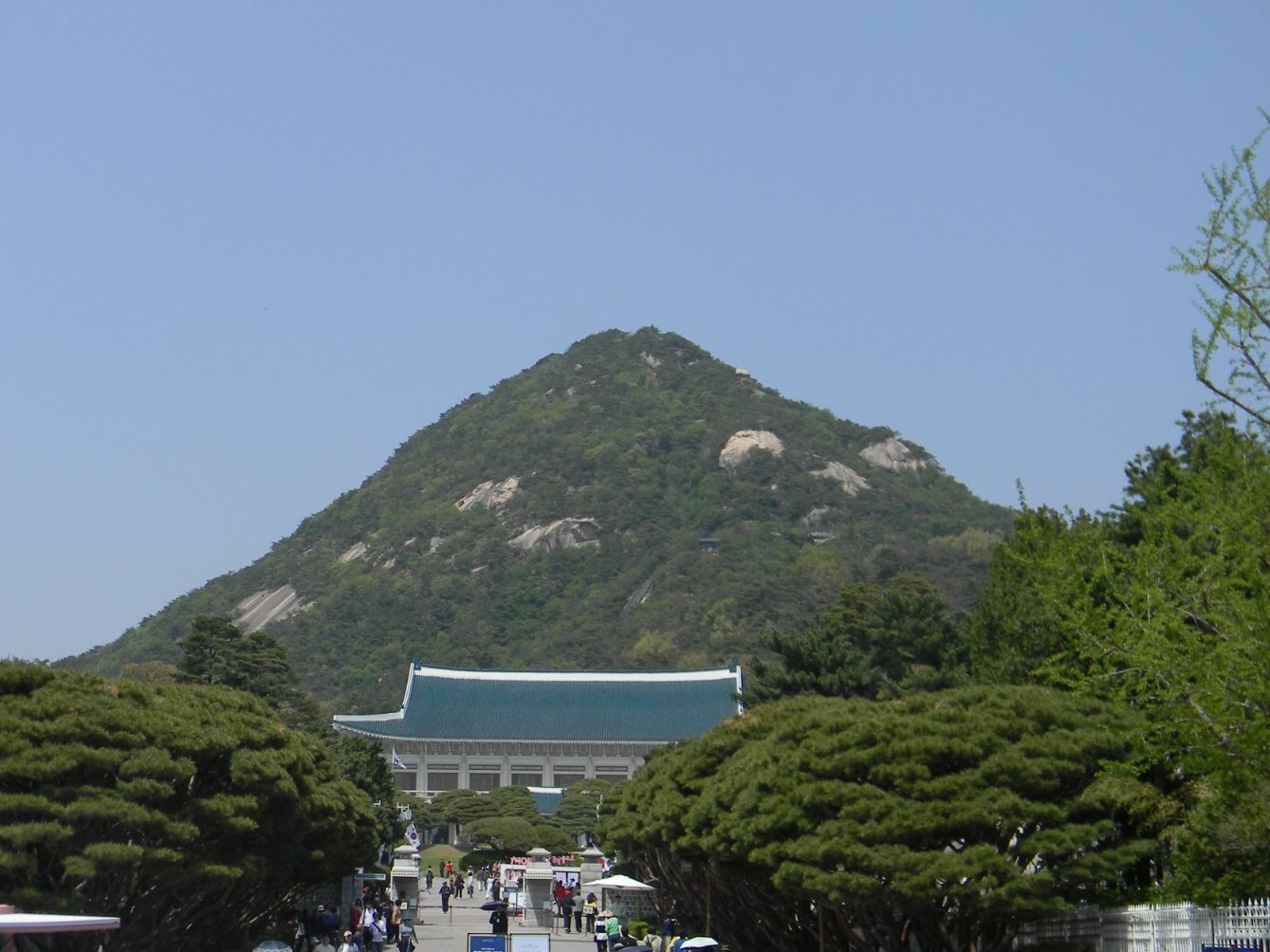
The Blue House, or “Cheongwadae“, the presidential palace in Seoul, at the foot of Bukhansan mountain. (Alice Jourdan, Seoul, April 2025)
On Monday 5 May 2026, a vessel operated by the South Korean company HMM Co. was targeted by Iran in the Strait of Hormuz, causing an explosion and a fire. Donald Trump immediately responded by pointing to the “responsibility” of the vessel, which had allegedly chosen to “go it alone” rather than be escorted by US forces.
The US president seized the opportunity to suggest that South Korea join the US mission to assist transit through the strait, an initiative named “Project Freedom“. The project has since been suspended, following a decision by Donald Trump on Wednesday 6 May. Seoul therefore no longer needs to consider taking part. These events come as South Korea appears to be engaged in reshaping its ties with Washington.
On 28 April 2026, President Lee Jae Myung addressed his cabinet at the presidential palace in Seoul, broaching the sensitive subject of relations between South Korea and the United States and, with it, the question of Seoul’s military dependence on Washington.
In recent months, diplomatic relations between the two allies have been strained, notably because of Donald Trump’s threats of tariffs against South Korea. Faced with the escalating conflict in the Middle East, Lee Jae Myung is taking a stance and choosing to distance himself from the United States. This new policy takes the form of a statement addressing, on the one hand, South Korea’s military independence and, on the other, Seoul’s desire to move closer to the Global South.
A deliberate push for strategic autonomy
On defence, Lee Jae Myung insists that South Korea must take charge of its own defence in response to mounting security concerns, in a direct reference to American involvement in the war in the Middle East. “Should we not be prepared to defend ourselves, to conduct operations ourselves and to build an operational strategy ourselves?“
This stance rests on substantial national military capabilities. South Korea has ranked fifth in the world for military strength since 2024, according to the Global Firepower study. Lee Jae Myung asks: “But why do we still have this feeling of anxiety, as though without a foreign military presence we would not be able to defend ourselves?” It is a rhetorical question referring directly to the heavy American military presence in South Korea since the second half of the 20th century.
This repositioning is far from trivial. The American military presence on South Korean soil is both large – 28,000 troops of United States Forces Korea (USFK) were stationed in the country in 2025 – and long-standing, dating back to 1953. South Korea also benefits from the American nuclear umbrella, a protection considered essential in the face of the North Korean threat, as Seoul does not possess nuclear weapons.
On Wednesday 13 May, US and South Korean defence officials met in Seoul to discuss strengthening their strategic cooperation, against a backdrop of recent disagreements. During the talks, South Korea notably negotiated the return of wartime operational control (OPCON), which has until now been held by Washington. Seoul is also seeking to take charge of the buffer zone on the North Korean border, currently under UN jurisdiction, and wants to acquire nuclear-powered submarines.
What emerges above all from this meeting, presented as an effort to deepen bilateral cooperation, is Seoul’s determination to regain levers that are essential to its national security, even though both sides officially profess their intention to put into practice military cooperation initiatives that have been raised time and again. The meeting came a few days after the South Korean Minister of Defence, Ahn Gyu-back, had himself acknowledged the existence of disagreements in their relationship.
A drive to strengthen cooperation with the Global South.
On the diplomatic front, Lee Jae Myung stressed the importance of a diplomacy he describes as “pragmatic, strategic and flexible“, with the aim of increasing the country’s room for manoeuvre and reducing its dependence on any specific region, in order to secure a stable engine of growth. Against a backdrop of tensions and war in the Middle East, as well as upheaval in the global balance, including in economic terms, the South Korean President announced that “in future, we will extend our diplomatic horizon towards the Global South“.
Lee Jae Myung is thus paving the way for a rapprochement with the countries of the Global South, at the expense of the United States, his country’s long-standing ally. Lee Jae Myung’s remarks mark the beginning of a paradigm shift in Seoul’s relations with the United States.
The Minister of Foreign Affairs announced on Wednesday 6 May that a seminar entitled “A Korea-Africa partnership for joint responses to global crises” will be held on Wednesday 13 May to discuss the strategic importance of developing bilateral relations with African countries. The seminar comes ahead of a major summit of foreign ministers from various African countries, scheduled for next month. Seoul’s desire to strengthen its cooperation with African countries is part of the rapprochement with the Global South outlined by Lee Jae Myung.
Seoul, a player in the Middle East war
South Korea depends heavily on oil exports from the Gulf states, shipped via the Strait of Hormuz. The war and regional instability therefore pose a tangible threat to its economy. Seoul has not officially entered the conflict alongside its American ally and has provided no direct strategic assistance. While South Korea is distancing itself from Washington, and therefore from any involvement in the war, the United Arab Emirates’ use of the Korean M-SAM 2 missile interceptor (or Cheongung-II system) against Iranian attacks nevertheless makes Seoul a more or less indirect player in the conflict.
Since 2011, South Korea has also maintained a special forces unit in the Emirates, tasked with training Emirati troops. This unit is the only one authorised to conduct autonomous military operations and to take part in combat outside peacekeeping missions.
South Korea finds itself in a paradoxical position: hit by the war’s repercussions on oil supplies, it is nonetheless profiting from the conflict as an arms exporter to the Gulf states, while also being drawn into it through its military cooperation with the UAE, and all this even as it refuses to join the United States in securing the Strait of Hormuz.
An opportunity for Pyongyang?
For North Korea, this backdrop of war, combined with the growing distance between Seoul and Washington, may look like an opportunity. For Pyongyang, regional tensions lend legitimacy to its determination to keep expanding its arsenal and nuclear capabilities. On Thursday 14 May, with the United States tied up on the Middle Eastern front and South Korea absorbed in strengthening its strategic autonomy, Pyongyang was consolidating its ties with Hanoi. Vietnam’s foreign minister was received by his North Korean counterpart with the aim of stepping up exchanges in various sectors, notably communication between their diplomatic institutions, and of discussing current regional and international issues.
Translated from French. The French original prevails.