While the WTO Ministerial Conference (MC14) exposed the persistent deadlock in the international trading system, initiatives such as the Geneva AI Governance Institute are emerging as pragmatic responses to the crisis of multilateralism. At the crossroads of technological and political challenges, they are sketching out, from Yaoundé to Geneva, the contours of a more inclusive, cooperative and action-oriented artificial intelligence.
https://www.linkedin.com/company/gaigi/posts/?feedView=all
In Yaoundé, the 14th Ministerial Conference of the World Trade Organization (MC14) was not merely the stage for arduous trade negotiations; it also highlighted, once again, the structural limits of a multilateral system in search of renewal. Behind the measured communiqués and diplomatic wording, the conclusion is inescapable: the major powers are struggling to agree on a thorough reform of the WTO, whether of its dispute settlement mechanisms or of its capacity to take on contemporary challenges, foremost among them the governance of digital technology and artificial intelligence.
This stalemate, which few official actors were willing to call a failure, nonetheless reflects a genuine impasse. Above all, it exposes a widening gap between the speed of technological change and the slowness of multilateral decision-making. Against this backdrop, Yaoundé looks less like a culmination than a symptom of a system running out of steam, still held together by states’ shared determination to preserve a common framework, but unable, for now, to deliver responses that match what is at stake.
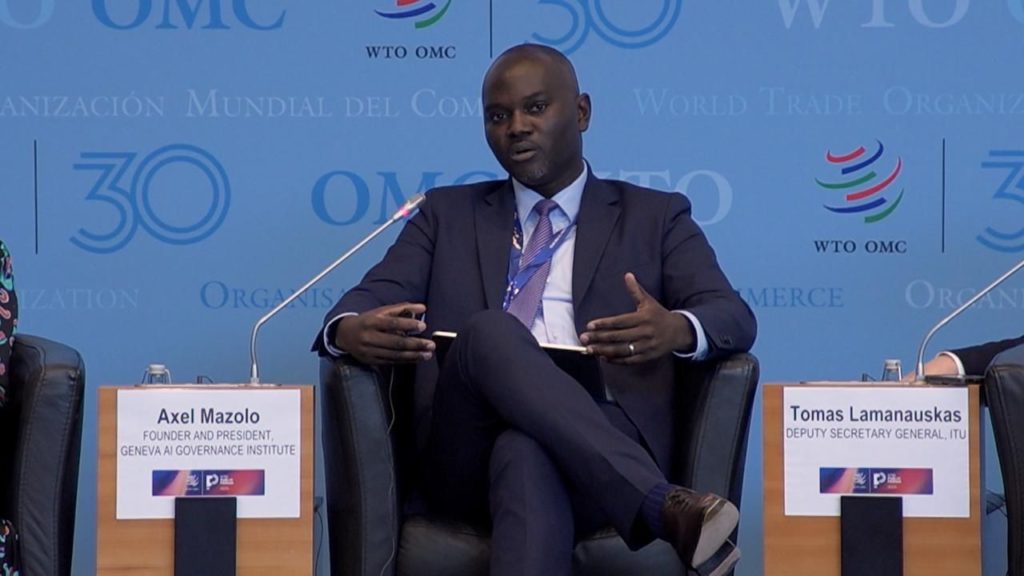
It is precisely in this gap that initiatives such as the Geneva AI Governance Institute (GAIGI), founded by Axel Mazolo, find their place. Far from replacing existing institutions, the institute offers complementary, more agile spaces capable of experimenting with approaches suited to the complexity of today’s digital world. At a time when traditional multilateralism is faltering, such platforms are emerging as laboratories for practical solutions.
GAIGI’s presence in Yaoundé therefore takes on particular significance. It reflects a determination not to wait for a hypothetical revival of the system before making progress on issues that have become central. This approach, which favours action over declarations, resonates especially in the countries of the Global South. GAIGI champions a vision in which artificial intelligence is not reduced to a dialogue between major powers but is fully open to African states. “AI governance cannot be left to the dominant powers alone […] it must include African voices,” Axel Mazolo insists. At a time when the rules of the game are still being written, such inclusion appears to be a condition of legitimacy as much as of effectiveness.
In Yaoundé, Christophe Ravel, Secretary-General of GAIGI, took this reading further, calling for “moving to action and asserting the sovereignty of each party’s choices”. Behind this phrase lies a clear strategic line: supporting states as they build their own frameworks, while embedding them in a compatible and open international architecture.
Implicitly, what is emerging is a transformation of multilateralism itself. In the absence of global consensus, it is tending to reshape itself around hybrid initiatives, halfway between traditional institutions, think tanks and cooperation platforms. GAIGI fits squarely into this shift, seeking to structure what its founder calls “infrastructures of trust”. The aim is not to bypass states, but to offer them operational tools in an environment where formal negotiations are moving too slowly.
This momentum finds a natural extension in the forthcoming milestones. The AI for Good conference, in Geneva next July, will be a first opportunity to consolidate these approaches, ahead of the global summit on artificial intelligence scheduled to take place in Switzerland in 2027. From this perspective, Geneva appears as a strategic anchor point, true to its tradition of multilateral diplomacy, but now open to more flexible and innovative formats.
Geneva has a unique asset: an ecosystem in which science, diplomacy and the economy can engage with one another. It is in this space that a new grammar of international action could emerge, one capable of overcoming the deadlock seen at the WTO without abandoning the multilateral ideal. For, despite the difficulties, few states wish to bury this framework. The Yaoundé conference showed as much: while disagreements persist, the will to preserve a common platform remains strong. It is precisely in this in-between space — between attachment to multilateralism and an inability to reform it quickly — that initiatives such as GAIGI find their relevance.
They do not replace the existing system, but they foreshadow the ways in which it might evolve. By offering concrete responses to the current crisis, they help keep alive the idea of international cooperation suited to the realities of the 21st century.
Translated from French. The French original prevails.