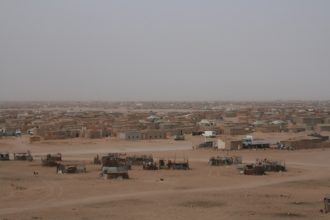
The cloud giants (Amazon, Microsoft, Google) control more than 60% of the market, while Africa, home to 17% of the world’s population, has only 2% of global storage capacity.
By El Hassane Hzaine — 13 May 2026, published in English in Marocco World News.
The new architecture of global power illustrates the unequal exchange theorised by Arghiri Emmanuel and developed further by the late Moroccan economist Aziz Belal: yesterday, the South exported raw materials and imported manufactured goods; today, it supplies raw data while the digital added value is captured by the dominant centres.
The cloud giants (Amazon, Microsoft, Google) control more than 60% of the market, and Africa, home to 17% of the world’s population, has only 2% of global storage capacity. African data flows, is processed and is governed elsewhere, reproducing a structural dependency in an intangible form. In this context, digital nationalism becomes a historic imperative for the South: it means breaking the unequal digital exchange, regaining control of data, building local ecosystems and turning vulnerability into collective power.
Northern Virginia, in the United States, is the brain of the global network. Dublin and Frankfurt filter European and African data. Singapore dominates South-East Asia. Johannesburg, Nairobi and Accra are trying to emerge as African hubs, but remain satellites on a global scale.
The Fourth Industrial Revolution, which Nir Kshetri describes as an opportunity for a qualitative leap for marginalised populations, can be inclusive only if it goes hand in hand with a digital sovereignty capable of turning dependence into autonomy and of making the digital revolution an instrument of social justice rather than a new tool of domination.
In The Fourth Revolution and the Bottom Four Billion, Nir Kshetri showed that the Fourth Industrial Revolution (artificial intelligence, blockchain, the Internet of Things, big data) could offer marginalised populations a qualitative leap comparable to that brought about by mobile banking, crowdfunding and even, I might add, Starlink, which has democratised high-tech tools and solutions.
Hubs and satellites: how the new world works
The digital world is not flat; it is organised around central “hubs” and satellite peripheries. To understand this new geoeconomics, one must examine the map of this digital galaxy, as well as the ties of unequal exchange and dependence on the hubs, the servers, the satellite manufacturers and those who control the undersea cables, who could one day choke us in the event of a breach of contract or for other reasons, as happened in West Africa when Moroccan telecommunications companies were the only ones able to keep internet service running.
Northern Virginia, in the United States, is the brain of the global network. Dublin and Frankfurt filter European and African data. Singapore dominates South-East Asia. Johannesburg, Nairobi and Accra are trying to emerge as African hubs, but remain satellites on a global scale.
These hubs are not mere technical centres: they are strategic transit points liable to become chokepoints for the countries that depend on them. The data passing through them are subject to the laws of the host country, its alliances and its diplomatic priorities. Countries that do not host a hub become, by default, passive consumers. They export their raw data and import finished services, reproducing the old centre-periphery pattern.
One crucial point: connectivity is not sovereignty. A country can have an excellent high-speed internet connection and 4G or 5G coverage while remaining digitally vulnerable if its critical data reside outside its legal borders. Having access to the internet does not mean controlling the internet.
How can digital vulnerability be measured?
To answer this question, we have designed a prototype tool for measuring digital vulnerability, a kind of digital dependency barometer called the CCRI (Cloud Coercion Resilience Index). A score close to 100 indicates critical vulnerability; below 30, genuine resilience. Most countries of the Global South fall within an unsettling intermediate zone.
This analysis is based on the Cloud Coercion Resilience Index (CCRI), initially calibrated on 30 countries using ordinary least squares (OLS) regression for the period 2025-2026. The model explains 87% of the variance in cloud coercion risk and 74% of vulnerability to cyberattacks (adjusted R²). Data sources include the ITU Global Cybersecurity Index (2025 edition), national cybersecurity reports available online, data from the World Bank and the OECD, and incident reports from various countries.
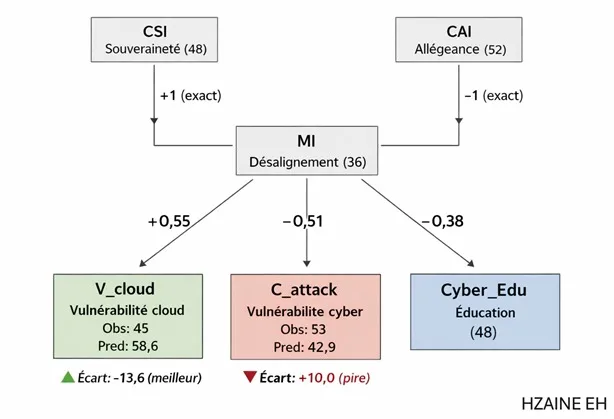
The model is built on four factors explaining cloud vulnerability and vulnerability to cyberattacks (two dependent variables).
First factor: the Cloud Sovereignty Index (CSI)
Does a country genuinely control its cloud infrastructure, or does it rent out its sovereignty to a foreign company like a digital sharecropper? The higher the score, the harder it is for an external provider to cut off access or impose its terms.
Second factor: the Cloud Allegiance Index (CAI)
Diversification is not merely good business practice — it is a matter of survival. Relying on a single tech giant, whether American or Chinese, is a structural weakness. Spreading contracts across several providers reduces the risk of being strangled when the geopolitical winds shift. The CAI measures: diversity of providers (Herfindahl-Hirschman Index, 40%), mutual legal assistance treaties (30%), adequacy decisions on data transfers (20%) and preferences for sovereign clouds (10%).
Third factor: the Misalignment Index (MI)
A combination of factors F1 and F2, it represents the political blind spot: the gap between what a country believes it controls and what it actually controls. A high MI means living under the illusion of sovereignty while critical infrastructure sits in someone else’s data centre. It is the digital equivalent of believing you own your house when you have signed away the title deeds.
Fourth factor: cyber education (Cyber_Edu)
The best laws and infrastructure are useless if officials click on phishing links and small businesses leave their servers exposed. Human preparedness is the last line of defence — or the first point of failure. Cyber_Edu is a composite index: cybersecurity curricula in primary schools (25%) and secondary schools (25%), professional certification rates (25%) and the reach of public awareness campaigns (25%).
A simple but revealing logic
The logic is simple but extremely revealing: the more sovereign a country is, the less vulnerable it is. The more captive it is to undiversified suppliers, the more exposed it is. Cyber education protects, but only if a minimum level of infrastructure already exists. No lever works on its own; they all operate in symbiosis.
What does the empirical analysis reveal?
The coefficients reveal the marginal effects of each predictor:
- Digital sovereignty (DSS) is the best shield: each point gained halves cloud vulnerability.
- Misalignment (MI) acts as a risk multiplier: beyond a certain threshold, it automatically adds 8 to 18 points of vulnerability.
- Geopolitical context matters: in high-risk areas, sovereignty offers twice as much protection — an argument for investment even in times of instability.
- Cyber education is no silver bullet: it only works fully if the country already has a solid foundation of technical control (CSI > 55). Otherwise, it is like training soldiers without giving them weapons.
In other words, digital sovereignty is the best shield. Every 10-point gain in the CSI reduces the risk of cloud coercion by 6.5 points and vulnerability to cyberattacks by 5.1 points. But misalignment is a silent killer. Every 10-point rise in the MI increases the risk of coercion by 5.5 points and vulnerability to attacks by 3.8 points. Beyond a certain threshold, misalignment automatically adds between 8 and 18 points of vulnerability.
Cyber education works only if the foundations are solid. Training citizens and civil servants reduces attacks, but only if the sovereignty index already exceeds 55. Otherwise, it is like arming soldiers with sticks against drones.
Context amplifies everything. In conflict zones and unstable regions, internal sovereignty offers twice as much protection. Investing in digital infrastructure in times of geopolitical instability is an insurance policy against future drift.
The finding that digital education carries the same protective weight as CSI digital sovereignty (0.38 in absolute value) is particularly significant for public policy: improving cyber education is as effective as building sovereign infrastructure in reducing cyber vulnerability, while being quicker and cheaper to implement.
Empirical country profiling
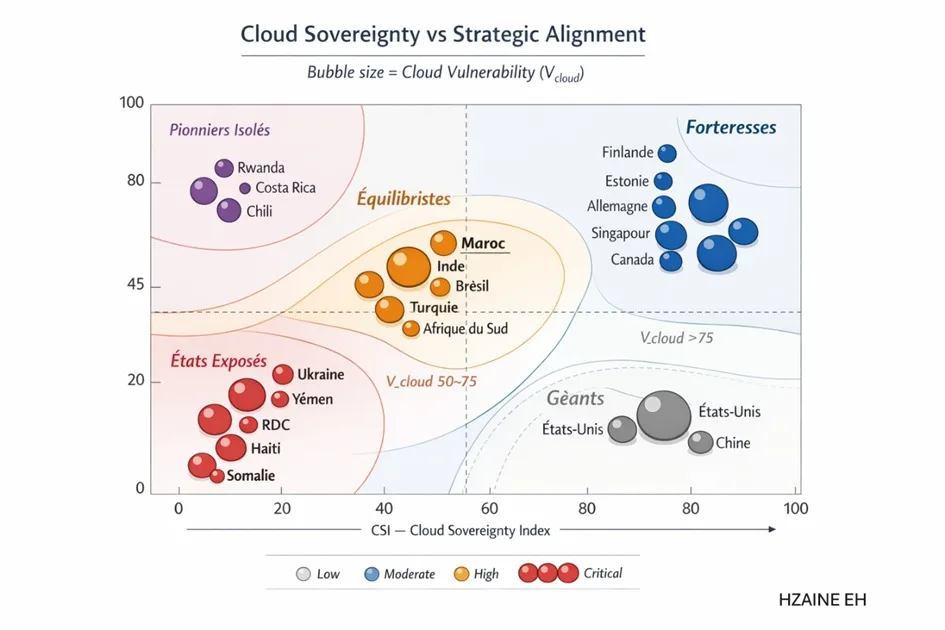
Applying the model worldwide reveals five profiles that map out digital dependency.
Digital fortresses (digital sovereigns)
They sit at the top. Their vulnerability scores are remarkably low. Their secret is not size — Estonia, Finland and Singapore punch well above their weight — but foresight, pooling of resources and proactive regulation.
The platform giants
The United States and China, thanks to their considerable geoeconomic power, are not subject to cloud coercion; they wield it as a weapon. Their risk is not being cut off but technological decoupling — a digital cold war forcing others to pick a side.
The hybrid strategists
These are most of the pragmatic emerging economies. They have abandoned the utopia of total self-sufficiency and are now playing the card of strategic diversification and diplomatic multi-alignment.
The isolated pioneers
They outperform their regional neighbours but pay a high price for their autonomy. Their technical isolation drives up maintenance costs and weakens collective resilience.
The vulnerable states
More than a hundred countries, often in conflict, under sanctions or undergoing reconstruction, regard digital sovereignty as an unattainable luxury.
Morocco: a model at the heart of the balancers
Morocco perfectly embodies the category of the balancers. With a cloud vulnerability score of 45 (28th in the world), it is the most resilient country in North Africa to the risk of a cloud cut-off. However, its cyberattack index of 53 (32nd place) is more worrying: the country is more vulnerable to intrusions than to coercion, revealing a structural weakness.
The figures are a reminder of how far there is still to go: 879 cyberattacks in 2025, 2.1 million Moroccan credentials circulating on the dark web, and a cloud market entirely dominated by foreign providers. A digital sovereignty index score of 48 points to a relatively solid foundation, but one still far from full resilience. An MI of 36 reveals a moderate but real misalignment: the country still relies too heavily on foreign giants without a sufficient local safety net. Cyber education, at 48, illustrates a common paradox: advanced legislation, but a civil service and a population still inadequately trained to deal with everyday threats.
Morocco’s relative strength lies in its CAI (15th place), a sign of effective diversification of cloud providers. However, this advantage is undermined by weak Cyber_Edu (21st), an insufficient CSI (20th) and a moderate MI (18th). The composite ranking puts Morocco 19th in the world, in the category of “developing hybrid strategists”.
Morocco currently performs on a par with Brazil and India, but lags behind the United Arab Emirates in cyber education. The 2030 target would, however, enable the Kingdom to overtake all its other developing hybrid peers.
Morocco’s flagship digital sovereignty projects
Beyond the Mohammed VI geostationary satellites, three major projects could be complete game-changers for the Kingdom and for Africa.
Sovereignty through computing: Toubkal
A supercomputer offering 3.15 petaflops of computing power. This is no prestige project: among other things, it enables climate modelling for precision agriculture and genomic analysis for sovereign medicine, keeping sensitive data on national soil.
Green sovereignty
The concept of “data processing close to energy sources” involves deploying data centres in Dakhla and Tétouan powered by Moroccan solar and wind energy. It attracts cloud giants with clean energy while keeping their servers under Moroccan jurisdiction.
The AlJazari project
Launched in 2026 and named in honour of the medieval Muslim polymath Al-Jazari, the project develops artificial intelligence models in Arabic and Amazigh. The aim is not only to preserve these languages but also to protect cultural identity against the biases built into Western or Chinese AI systems.
Towards collective digital autonomy
An African proverb says: “If you want to go fast, go alone; if you want to go far, go together.” Indeed, no country in the Global South can win the battle for digital sovereignty on its own. The figures are unequivocal: a shared data centre can cut operating costs by 40%, as a 2008 Fujitsu study shows. In cyber defence, NATO’s Locked Shields exercise has grown from 4 countries in 2010 to 41 today, proof that cooperation accelerates learning.
A CERT team sharing intelligence with its neighbours identifies threats far earlier than an isolated team. Regional cloud infrastructure reduces dependence on the American giants. Finally, harmonised legislation such as the EU’s GDPR provides collective leverage that no country could muster on its own.
India grasped this with India Stack, a set of open APIs and digital public infrastructure that makes it possible to build sovereign digital services without starting from scratch.
Brazil demonstrated it with Pix, its instant payment system, which broke the grip of the private Visa and Mastercard networks by pooling public trust.
The African Union is also making progress on a continental data governance framework, to prevent each member state from adopting isolated regulations that carry no weight against foreign giants. ASEAN is likewise harmonising its digital regulations, aware that regional alignment multiplies the influence of each of its members.
These initiatives are not anti-globalisation; they are pro-fairness, since they seek not a break but a better position within globalisation and the Fourth Industrial Revolution.
Ultimately, the salvation of the countries of the Global South would depend on three essential steps:
- A national audit of digital dependency, particularly on the cloud;
- Investment in “IDE”: Infrastructure, Diversification and Education;
- Pragmatic South-South cooperation through an international public-private coalition inspired by the 1955 Bandung Conference, aimed at building a multipolar New International Digital Order, fair in its distribution of costs and benefits, and free from the monopoly over data.
Translated from French. The French original prevails.